
Amazon affiliate links - we earn a commission.Affiliate disclosure

Buying guide · 12 min read · Updated 2026-11-27

Best Budget Belt Sanders (2026)

Budget belt sanders compared on motor power, belt size, variable speed, dust handling and handheld or benchtop design, with tips on avoiding gouges.

Brianna Cole, Lead Product EditorBy Brianna ColeLead Product Editor6 picks comparedSpec-sheet verified
Best Budget Belt Sanders

At a glance

Our top picks

Side by side

Spec comparison

PieceMotorBeltSpeedPrice tier
WEN 7.5-Amp 3-by-21-Inch Variable Speed Handheld Portable Belt Sander (HB321V)Best Overall BudgetWEN 7.5-Amp 3-by-21-Inch Variable Speed Handheld Portable Belt Sander (HB321V)7.5 amp, variable speed3 by 21 inches620 to 1200 feet per minuteLow in this lineup
SKIL 6 Amp 3 by 18 Inch Belt Sander with Pressure Control (7510-01)Best Gentle StarterSKIL 6 Amp 3 by 18 Inch Belt Sander with Pressure Control (7510-01)6 amp3 by 18 inchesn/aLow to middle in this lineup
WEN 10-Amp 4-by-24-Inch Variable Speed Combination Handheld and Benchtop Belt Sander (HB424V)Best Dual-Use PickWEN 10-Amp 4-by-24-Inch Variable Speed Combination Handheld and Benchtop Belt Sander (HB424V)10 amp, variable speed4 by 24 inches660 to 1310 feet per minuteMiddle of this lineup
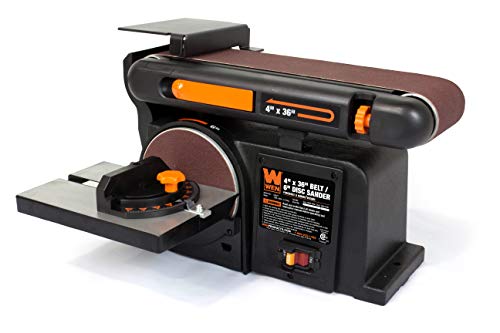
WEN Benchtop Belt and Disc Sander with 4 by 36 Inch Belt, 6 Inch Disc and Cast Iron Base (6502T)Best Benchtop ChoiceWEN Benchtop Belt and Disc Sander with 4 by 36 Inch Belt, 6 Inch Disc and Cast Iron Base (6502T)n/a4 by 36 inches, tilts 0 to 90 degreesn/aLow to middle in this lineup
Metabo HPT Belt Sander, 3 by 21 Inch, Variable Speed, 9.0 Amp Motor, Soft Grip, 5-Year WarrantyBest Power CordedMetabo HPT Belt Sander, 3 by 21 Inch, Variable Speed, 9.0 Amp Motor, Soft Grip, 5-Year Warranty9 amp, 1020 watt3 by 21 inchesVariable speed dialUpper middle in this lineup
DEWALT 20V MAX Belt Sander, Cordless, Brushless, Tool Only (DCW220B)Best Step-Up PickDEWALT 20V MAX Belt Sander, Cordless, Brushless, Tool Only (DCW220B)n/an/aVariable speedTop of this lineup

A belt sander removes wood fast, which makes it the tool for leveling boards, stripping old finishes and shaping edges. That speed also makes it easy to gouge a surface, so features such as variable speed, pressure feedback and good dust handling matter more than raw power. Wear eye and hearing protection and a dust mask, because a belt sander throws fine dust and runs loud.

This guide compares six budget belt sanders, including a benchtop machine and one cordless step-up. We evaluated each on published specifications, motor power, belt size, speed control and owner feedback patterns, and we avoid price figures because prices change. Relative price tiers show where each model sits, and the reasons for each rank are explained.

Before you buy

6 Criteria to Look For Before Buying a Budget Belt Sander

  1. 01

    Motor power and belt size

    Motor amps and belt size set how fast a sander removes wood. A 6 to 7.5 amp motor with a 3 by 18 or 3 by 21 inch belt suits light work. A 9 to 10 amp motor with a 4 by 24 inch belt removes more and suits floors and large panels. More power adds weight. Check how much stock you actually need to remove, because a larger sander can be overkill for small projects and tiring to use.

  2. 02

    Variable speed

    Variable speed lets you slow the belt for softer woods, plastics and finishing, and speed it up for stock removal. It is the most useful feature for a budget sander. The WEN, Metabo and DeWalt have it, and the Skil does not. Fast belts burn wood. Slower speeds also reduce heat and burning on hardwood and make it easier to avoid sanding through veneer.

  3. 03

    Handheld or benchtop

    A handheld sander travels over the work, and a benchtop sander brings the work to the machine. Handheld suits large surfaces and benchtop suits small parts and shaping. Some models, such as the WEN HB424V, do both. Choose by the work you do. If you are unsure, buy a handheld first, since it covers more jobs, and add a benchtop sander later if you need one.

  4. 04

    Dust collection

    Belt sanders produce a lot of dust. A dust bag is basic, and a vacuum port is better. The Skil lists micro-filtration, the Metabo includes a bag and the DeWalt lists high collection efficiency. Wear a respirator regardless. A vacuum port connected to a shop vacuum collects far more dust than a bag, so check that the port fits your hose.

  5. 05

    Weight and control

    A heavy sander is stable but tiring. A soft grip and a front handle help. Let the weight do the work, and do not press down. Beginners should start with a lighter model. Choose the lightest sander that has enough power for your jobs, since fatigue leads to mistakes.

  6. 06

    Belt changes and tracking

    A quick-release lever makes belt changes easy. Tracking adjustment keeps the belt centered. Belts are consumables, so check that common sizes are available. A 3 by 21 inch belt is easy to find. Keep a few spare belts in the sizes you use, since a dull belt is the main reason a sander feels weak.

Detailed reviews

The 6 best budget belt sanders, explained

01
WEN 7.5-Amp 3-by-21-Inch Variable Speed Handheld Portable Belt Sander (HB321V)
7.5 A motor3 by 21 in beltVariable speedLock-on switch
Check price on Amazon
Best for: DIY users who want a variable-speed handheld belt sander at a low price.

The WEN HB321V is a corded handheld belt sander with a 7.5 amp motor, a 3 by 21 inch belt and variable speed from 620 to 1200 feet per minute. It adds a lock-on switch for continuous sanding and a quick-release belt tension lever for fast belt changes. It is the best budget balance in this guide and sits near the bottom of the price range.

Variable speed is the feature that matters most on a budget belt sander, because it lets you slow down for softer woods and finish work. Compared with the Skil 7510, it has more power and speed control. Compared with the Metabo HPT, it has less power and a shorter warranty but costs less. Many owners keep this model as their only belt sander for years, using it for tabletops, door edges and the occasional rough board.

A 3 by 21 inch belt is the common size and is easy to find. Clamp the work, keep the sander moving and let the weight do the job. It suits DIY users who want a capable first belt sander.

What works

  • Variable speed from 620 to 1200 feet per minute
  • Lock-on switch for long runs
  • Quick-release belt tension lever
  • Common belt size, easy to find

Watch out for

  • Less power than 9 amp models
  • Dust collection is basic
  • Heavier than a random orbit sander

Specs

Motor
7.5 amp, variable speed
Belt
3 by 21 inches
Speed
620 to 1200 feet per minute
Features
Lock-on switch, quick-release tension lever
Price tier
Low in this lineup
02
SKIL 6 Amp 3 by 18 Inch Belt Sander with Pressure Control (7510-01)
6 A motor3 by 18 in beltPressure controlMicro-filtration
Check price on Amazon
Best for: Beginners who want a compact, forgiving belt sander with pressure feedback.

The Skil 7510 is a 6 amp belt sander with a 3 by 18 inch belt, a pressure control feature that warns you when you press too hard and a micro-filtration dust system. The pressure control is useful for beginners, since too much force is a common way to gouge wood. It is a gentle starter at the lower end of the power scale.

A 6 amp motor is enough for light stock removal on small projects, and the 18 inch belt keeps the tool compact. Compared with the WEN HB321V, it has less power and no variable speed but comes from a known tool brand with pressure feedback. Compared with the Metabo HPT, it is smaller and lighter duty. Because it is small, it is easy to handle one-handed on a bench while the other hand steadies the work.

It suits new woodworkers who want a forgiving tool for furniture, shelves and small refinishing jobs. Keep it moving, and finish with an orbital sander. It is not the tool for stripping a deck.

What works

  • Pressure control warns of excess force
  • Micro-filtration dust capture
  • Compact 3 by 18 inch belt
  • Known tool brand

Watch out for

  • Lower power
  • No variable speed
  • Smaller belt limits speed on large work

Specs

Motor
6 amp
Belt
3 by 18 inches
Feature
Pressure control warns of excess force
Dust
Micro-filtration dust capture
Price tier
Low to middle in this lineup
03
WEN 10-Amp 4-by-24-Inch Variable Speed Combination Handheld and Benchtop Belt Sander (HB424V)
10 A motor4 by 24 in beltBenchtop mountVariable speed
Check price on Amazon
Best for: Hobbyists who want a handheld sander that doubles as a benchtop sander.

The WEN HB424V is a 10 amp, 4 by 24 inch belt sander with variable speed from 660 to 1310 feet per minute that attaches to a benchtop to become an upward-facing stationary sander. A lock-on switch allows constant sanding without a continuous trigger grip. It is the most versatile corded choice here and sits in the middle of the price range.

A larger belt removes more material and covers more area per pass, which suits floors, tabletops and rough stock. Compared with the HB321V, it has more power and a wider belt but is heavier. Compared with a dedicated benchtop sander, it is less stable but cheaper and does two jobs. Owners who use it on a bench often fit a simple fence or stop, which turns a handheld sander into a surprisingly capable shaping tool.

The benchtop mode is useful for shaping small pieces, sharpening and finishing, but it is not a precision machine. Secure it to a bench with clamps. It suits hobbyists who want both a handheld and a stationary sander.

What works

  • 10 amp motor and 4 by 24 inch belt
  • Handheld or benchtop use
  • Variable speed from 660 to 1310 feet per minute
  • Lock-on switch

Watch out for

  • Heavier to handle
  • Benchtop mode is basic
  • Larger footprint

Specs

Motor
10 amp, variable speed
Belt
4 by 24 inches
Speed
660 to 1310 feet per minute
Mode
Handheld or upward-facing benchtop
Price tier
Middle of this lineup
04
WEN Benchtop Belt and Disc Sander with 4 by 36 Inch Belt, 6 Inch Disc and Cast Iron Base (6502T)
4 by 36 in belt6 in discCast iron baseBelt tilts 0 to 90
Check price on Amazon
Best for: Small-part woodworkers who want a stationary belt and disc sander.

The WEN 6502T is a stationary benchtop machine with a 4 by 36 inch belt that tilts from 0 to 90 degrees and a 6 inch disc, mounted on a cast iron base. It is not a handheld tool, which makes it a different choice from the others here. The cast iron base helps keep vibration down.

A benchtop sander is the better tool for shaping small parts, squaring edges and sharpening tools, where you bring the work to the sander instead. Compared with the handheld models, it needs bench space but gives more control. Compared with the HB424V, it is more stable and more precise. Because the tool is stable, it is also a good way to sharpen chisels and plane irons with the right belt and a light touch.

It suits woodworkers who do small pieces such as boxes, knife handles and turned parts. Use the table or a fence for accurate work. It is not the right choice for large flat surfaces such as floors.

What works

  • Belt tilts 0 to 90 degrees
  • Belt and disc in one machine
  • Cast iron base reduces vibration
  • Good for small parts

Watch out for

  • Stationary only
  • Needs bench space
  • Not for large panels

Specs

Belt
4 by 36 inches, tilts 0 to 90 degrees
Disc
6 inch disc
Base
Cast iron base
Format
Stationary benchtop belt and disc sander
Price tier
Low to middle in this lineup
05
Metabo HPT Belt Sander, 3 by 21 Inch, Variable Speed, 9.0 Amp Motor, Soft Grip, 5-Year Warranty
9 A motor3 by 21 in beltVariable speed5-year warranty
Check price on Amazon
Best for: Users who want a more powerful corded belt sander with a warranty.

The Metabo HPT belt sander has a 9 amp, 1020 watt motor, a 3 by 21 inch belt, a variable speed dial at the base of the handle, a soft grip and a five-year warranty. It includes a sanding belt and a dust bag. It is the most powerful 3 by 21 inch corded sander in this lineup.

The extra power helps with stripping and leveling, and the speed dial lets you manage the cut. Compared with the WEN HB321V, it has more power and a longer warranty at a higher tier. Compared with the DeWalt, it is corded and cheaper. The five-year warranty is the standout, since belt sanders take a lot of abuse and a longer cover is real peace of mind.

A soft grip and a well-placed speed dial make long sessions easier. Use the dust bag to keep the area clean. It suits users who want power and a warranty without moving to a premium cordless tool.

What works

  • 9 amp motor with variable speed
  • Soft grip and a good warranty
  • Dust bag included
  • Common belt size

Watch out for

  • Higher tier than basic models
  • Corded only
  • Heavy for overhead work

Specs

Motor
9 amp, 1020 watt
Belt
3 by 21 inches
Speed
Variable speed dial
Includes
Sanding belt and dust bag
Price tier
Upper middle in this lineup
06
DEWALT 20V MAX Belt Sander, Cordless, Brushless, Tool Only (DCW220B)
20V cordlessBrushlessVariable speedDust collection
Check price on Amazon
Best for: Owners of the 20V platform who want a cordless belt sander.

The DeWalt DCW220B is a 20V cordless belt sander with a brushless motor, variable speed and dust collection. The listing claims up to 95 percent dust collection efficiency with the right setup. It is sold as a tool only, so a battery and charger are extra. It sits at the top of this lineup on price and is the step-up pick.

A cordless sander frees you from a power cord, which helps on ladders, in vehicles and on job sites. Compared with the corded models, it is more convenient but costs more once a battery is added. Compared with the Metabo HPT, it is lighter on cord management but similar in power. Cordless sanders also make it easier to work in a van or on a roof where a cord would be a hazard.

The tool-only price assumes you already own DeWalt batteries. It suits tradespeople and owners of the 20V platform. If you do not, a corded model is better value.

What works

  • Cordless and brushless
  • Variable speed
  • Dust collection listed
  • Works with 20V batteries

Watch out for

  • Top price tier here
  • Battery and charger sold separately
  • Corded models cost less

Specs

Power
20V MAX cordless, brushless motor
Speed
Variable speed
Dust
Dust collection listed up to 95 percent efficiency
Supply
Tool only, battery and charger sold separately
Price tier
Top of this lineup

Spec decoder

What the listing measurements really mean

The numbers brands lead with, translated into what they tell you about fit, comfort and wear at home.

Amps

A measure of motor current. Higher amps suggest more power. Amps are a rough guide, and design and gearing also affect performance.

Watch forThe HB424V lists 10 amps.

Belt size

The width and length of the sanding belt. A belt that is too wide for the work makes control harder.

Watch for3 by 21 inch belts are the most common.

Feet per minute

The belt speed. Higher speeds remove wood faster. Slower speeds suit finishing and soft woods.

Watch forThe HB321V lists 620 to 1200.

Tracking

The adjustment that keeps the belt centered. If the belt drifts to one side, a small turn of the tracking knob fixes it.

Watch forCheck it when you change belts.

Brushless

A motor type that is efficient and lasts longer. It also tends to run cooler and last longer than a brushed motor.

Watch forThe DeWalt lists a brushless motor.

Methodology

How We Evaluated These Budget Belt Sanders

Power and speed

We compared motor amps, belt sizes and speed ranges from published specifications and owner feedback patterns. Our scores are editorial assessments, not measurements. We also compared how listings describe pressure control and weight, since beginners most often damage work by pressing too hard.

Control and comfort

We looked at weight, grips and pressure features. We treated power claims as relative, since motors of the same amp rating can perform differently.

Dust handling

We noted bags, filters and vacuum ports. We noted which models include a dust bag or vacuum port in the box.

Reliability

We weighed owner comments about belt tracking, switches and motor failures, and discounted unsupported claims. We looked for repeated mentions of belt tracking trouble and early switch failure across owner comments.

Value

We judged each model by relative price tier and avoided price figures. The DeWalt is labeled a step-up. Marketing claims such as dust collection efficiency were treated with caution.

Decision guide

How to Choose the Right Budget Belt Sanders

By Need

SituationPickWhy
Low costWEN HB321VVariable speed.
BeginnerSkil 7510Pressure control.
Dual useWEN HB424VHandheld or benchtop.
Small partsWEN 6502TBenchtop.

By Job

SituationPickWhy
FurnitureSkil 7510Gentle.
Decks and floorsWEN HB424VLarge belt.
StrippingMetabo HPTPower.
Job siteDeWalt DCW220BCordless.

Handheld vs Benchtop

Handheld

Better for large flat surfaces and stripping.

Benchtop

Better for small parts, edges and tool sharpening.

Pick by the size of your work.

By Budget Tier

SituationPickWhy
LowWEN HB321VBasic.
Low to middleSkil 7510Starter.
MiddleWEN HB424VDual.
Top of lineupDeWalt DCW220BStep-up.

What to Look For

Speed

Variable speed controls the cut.

Dust

A bag or vacuum port keeps the shop cleaner.

When to Spend More

Spend more if

You work on a job site or already own the battery platform.

Save if

You sand occasionally at home.

Ownership

Maintenance schedule

The upkeep that decides whether a piece still looks good in year five.

TaskIntervalWhy it matters
Replace worn beltsAs neededDull belts burn wood and slow work. Replace when the grit is gone. Keep a few spare belts in the same size.
Check belt trackingWith each beltA belt that wanders can run off the roller. Adjust the knob. Lightly oil the tracking pivot if it gets stiff.
Empty the dust bagEvery sessionA full bag cuts airflow and raises motor heat. Tap the bag out outdoors to avoid breathing the dust.
Clean the ventsMonthlyDust blocks cooling and shortens motor life. Use compressed air. A soft brush also helps around the motor.
Inspect the cord and switchSeasonallyFrayed cords and sticky switches are safety risks. Replace the cord if the insulation is damaged.

FAQ

Frequently Asked Questions

Which belt size is best?

A 3 by 21 inch belt suits most users. A 4 by 24 inch belt covers more area per pass. Fine dust is easy to breathe in, so wear a mask.

Is variable speed necessary?

It is very useful for softer woods and finishing. A single speed is fine for rough work. Choose a lower speed for softer woods and a higher speed for stripping.

Can a belt sander finish a surface?

It removes material fast and leaves scratches, so follow with an orbital sander. Use a finer grit and then a random orbit sander for a smooth finish.

How do I avoid gouges?

Keep the sander moving, start on the work and lift off as you finish. Do not press down. Let the belt reach full speed before it touches the work.

Are cordless belt sanders worth it?

They are convenient, but the battery adds cost. Corded models are cheaper. If you own the batteries already, the cost gap is much smaller.

Should I buy the DeWalt step-up?

Buy it if you own the 20V platform. A corded model costs less. Check that the battery platform you already own matches the model you buy.

Bottom line

The short version

Browse more budget belt sanderson Amazon →
Brianna Cole, Lead Product Editor

About the author

Brianna Cole

Lead Product Editor, SenseiReview

Brianna Cole leads SenseiReview's buying guides, turning published specifications, documentation and owner feedback patterns into clear verdicts across home, tech, fitness, outdoor and DIY products.

More from Brianna →

Keep reading

Related guides