
Amazon affiliate links - we earn a commission.Affiliate disclosure

Buying guide · 12 min read · Updated 2026-11-26

Best Budget Yoga Mats (2026)

The best budget yoga mats for 2026, with honest notes on NBR foam thickness, length, sweaty grip and floor work versus balance poses.

Brianna Cole, Lead Product EditorBy Brianna ColeLead Product Editor4 picks comparedSpec-sheet verified
Best Budget Yoga Mats

At a glance

Our top picks

Side by side

Spec comparison

PieceSizeThicknessMaterialCarry
Amazon Basics 1/2 Inch Yoga Mat 74 x 24 inch with StrapBest Overall BudgetAmazon Basics 1/2 Inch Yoga Mat 74 x 24 inch with Strap74 x 24 inches0.5 inchNBR foamIncluded strap
Gaiam Essentials Thick Yoga Mat 72 x 24 inch 10 mmBest Value Textured SurfaceGaiam Essentials Thick Yoga Mat 72 x 24 inch 10 mm72 x 24 inches10 mm, about 2/5 inchHigh-density NBR foamEasy-Cinch strap
CAP 1/2 Inch Thick Yoga Mat 68 x 24 inch with StrapBest Latex-Free CushionCAP 1/2 Inch Thick Yoga Mat 68 x 24 inch with Strap68 x 24 inches1/2 inchLatex-free NBR foamStrap included
CAP Barbell High Density Exercise Mat 68 x 24 inch 12 mm GrayBest Gray AlternativeCAP Barbell High Density Exercise Mat 68 x 24 inch 12 mm Gray68 x 24 inches12 mm, about 1/2 inchHigh-density latex-free NBR foamStrap included

Budget yoga mats are almost all NBR foam: soft, light and cheap. They suit stretching, Pilates, core work and gentle floor sequences, and they cushion knees and spines on hard floors.

Where they struggle is standing balance and sweat. A thick, squishy mat wobbles under a single foot, and NBR loses its grip when wet. Choose by length and thickness first, then accept that you are buying comfort rather than studio-grade stability.

Before you buy

6 Criteria to Look For Before Buying a Budget Yoga Mat

  1. 01

    Thickness and stability

    Yoga mats of 3 to 6 mm give stable standing poses, while 10 to 12 mm adds comfort but wobbles under one foot. A half inch of NBR foam suits floor work, not balance poses. The common mistake is choosing the thickest mat and then struggling with tree pose. In this lineup the Gaiam's 10 mm is the firmest and the CAP and Amazon Basics mats are about 12 mm. A useful rule is to ask what you do most: if it is planks, bridges and abdominal work, pick the thicker mat, and if it is lunges, warrior poses and single-leg balances, pick the thinner one. If you do both, a firm 10 mm mat is the better compromise.

  2. 02

    Length and width

    Standard length is 68 to 72 inches, and tall users want 74 inches or more. Width is typically 24 inches. If your feet or head hang off the end in a plank or savasana, the mat is too short. The Amazon Basics mat at 74 inches is the only one here that clears six feet comfortably. Width matters too: a 24 inch mat is standard, but broad-shouldered users may find that their hands slide off the edge in wide-armed poses. Measure yourself lying down with arms overhead, and add a few inches.

  3. 03

    Material and grip

    NBR foam is cheap, soft and light, but it grips less when wet than PVC or natural rubber. Latex-free options like the CAP suit people with allergies. Texture helps a little on a clean floor. For hot or sweaty classes, a heavier rubber or PVC mat is the better tool. A common workaround is to lay a thin yoga towel over a foam mat, which absorbs sweat and restores some traction. It adds a layer to wash, but it costs far less than replacing the mat with a premium one.

  4. 04

    Portability

    Most budget mats include a strap, and some use a cinch carrier. NBR foam is light enough to carry to a class. Roll it loosely so the foam keeps its shape. A mat that stays curled needs to be flattened before use. Unroll it the evening before and lay it flat, or roll it the opposite way for a few minutes. Corners that curl up are a trip hazard in a lunge, so give new foam time to settle.

  5. 05

    Care and odour

    New foam can smell until it airs out. Wipe with a damp cloth and avoid harsh cleaners that dry out the foam. Keep it out of direct sun and hot cars, since heat can warp NBR. A low-odour foam such as the Gaiam's is a small ownership benefit. If a new mat smells strongly, air it out in a ventilated room for a few days before use, and never roll it up in a closed bag while it is still off-gassing.

  6. 06

    Durability and wear

    Foam compresses where your hands and feet land and the edges can crumble over time. Heavier use shortens the life, and a budget mat is usually replaced every year or two. Do not expect a lifetime mat at this tier. Rotating between two mats, or keeping one for floor work and one for stretching, spreads the wear and can double the life of each. If you practise daily, consider a denser, heavier option. The foam on a budget mat is full of tiny air cells, and those compress and do not recover once the mat has been used for hundreds of sessions. A mat that feels thin in the middle, where your hands and knees land, has reached the end of its life.

Detailed reviews

The 4 best budget yoga mats, explained

01
Amazon Basics 1/2 Inch Yoga Mat 74 x 24 inch with Strap
74 x 24 inches1/2 inch NBR foamCarrying strap
Check price on Amazon
Best for: Tall users and anyone who wants a long, cushioned floor mat.

The Amazon Basics mat is the longest in this lineup at 74 inches, which makes it the sensible pick for anyone over about six feet tall. It is made of NBR foam half an inch thick, which cushions knees, hips and the spine for floor exercises, and it comes with a carrying strap.

Against the CAP mats it has an extra six inches of length, which matters in a full-body stretch or a long plank. Against the Gaiam Essentials it is thicker and softer, which is better for sit-ups and Pilates but worse for balance. It ranks first because the length and padding suit the widest range of bodies and routines.

NBR foam stretches and springs back, but it also compresses permanently where your hands and feet land. Wipe the mat with a damp cloth and let it air dry, away from direct sun. Do not use it for hot yoga, since the surface loses grip when wet. Over a couple of years, expect surface wear and edge crumbling.

What works

  • 74 inch length suits tall users
  • Half inch foam cushions joints well
  • Strap makes carrying easy
  • NBR foam springs back after use

Watch out for

  • Too soft for stable standing poses
  • Surface loses grip when sweaty
  • Foam can compress and wear over time

Specs

Size
74 x 24 inches
Thickness
0.5 inch
Material
NBR foam
Carry
Included strap
Best for
Floor work and stretching
02
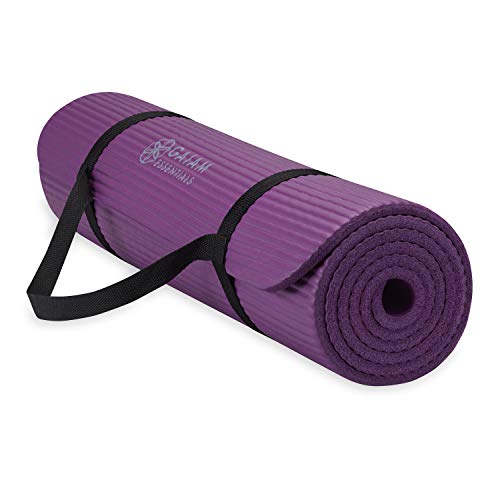
Gaiam Essentials Thick Yoga Mat 72 x 24 inch 10 mm
72 x 24 inches10 mm NBR foamTextured surface
Check price on Amazon
Best for: Yoga beginners who want comfort with a bit more firmness.

The Gaiam Essentials is a 72 inch mat in 10 mm high-density NBR foam, with a textured surface meant to reduce slipping on hard floors and an Easy-Cinch strap for carrying. The slightly thinner foam gives a firmer base than the half inch Amazon Basics mat.

Against the Amazon Basics it is shorter by two inches and a little thinner, so it is better for standing poses and worse for deep cushioning. Against the CAP mats it is longer and has a texture that helps grip on a floor, though not under a sweaty palm. It ranks second because it balances comfort and stability and carries a known brand name.

Wipe it clean with a damp cloth and let it dry fully before you roll it. Roll it with the top surface outward so it lies flat. A new mat may have a mild odour that fades after airing. Do not leave it in a hot car, since foam can warp. A texture helps on a clean floor but cannot rescue a wet hand.

What works

  • 10 mm foam is cushioned but not mushy
  • Texture helps grip on hard floors
  • Easy-Cinch strap keeps the roll tidy
  • Low-odour foam wipes clean

Watch out for

  • 72 inches is short for very tall users
  • Texture does not fix sweaty-hand slip
  • Foam compresses with repeated use

Specs

Size
72 x 24 inches
Thickness
10 mm, about 2/5 inch
Material
High-density NBR foam
Surface
Textured
Carry
Easy-Cinch strap
03
CAP 1/2 Inch Thick Yoga Mat 68 x 24 inch with Strap
68 x 24 inches1/2 inch NBR foamLatex-free
Check price on Amazon
Best for: Shorter users and latex-sensitive buyers doing floor exercise.

The CAP mat is a half inch of latex-free NBR foam at 68 by 24 inches, with a strap. The latex-free material is useful if you have a latex allergy, and the cushioning is generous for knees and elbows in planks, sit-ups and stretching.

Against the Amazon Basics mat it is six inches shorter, which is a real limit for taller people. Against the Gaiam Essentials it is thicker and softer, so it is a cushioned exercise mat first and a yoga mat second. It ranks third because the 68 inch length suits shorter and average users only.

The mat suits floor work such as Pilates, core routines and gentle stretching. Standing poses on a half inch of soft foam feel unstable, so keep your feet planted and your stance wide. Clean with a damp cloth and store it rolled loosely. Foam of this type is not meant for outdoor use on rough surfaces.

What works

  • Latex-free foam suits allergic users
  • Half inch of cushioning protects joints
  • Strap included for easy carry
  • Works for Pilates, planks and sit-ups

Watch out for

  • 68 inches is short for taller users
  • Soft foam wobbles in standing poses
  • Edges can crumble with heavy use

Specs

Size
68 x 24 inches
Thickness
1/2 inch
Material
Latex-free NBR foam
Carry
Strap included
Use
Yoga, Pilates, stretching, sit-ups
04
CAP Barbell High Density Exercise Mat 68 x 24 inch 12 mm Gray
68 x 24 inches12 mm NBR foamGray with strap
Check price on Amazon
Best for: Buyers who prefer a gray mat for casual floor work.

This CAP mat uses the same foam specification as the black CAP mat, listed at 12 mm thickness in gray, with a strap. It is a plain, soft, cushioned mat for floor work, and it is included here as an honest sibling rather than a separate design.

Against the black CAP mat the difference is mostly colour and the way the thickness is quoted, so choose the one that is easier to find. Against the Gaiam Essentials it is thicker and softer but shorter. It ranks last because it offers no advantage over the other CAP mat and shares the same 68 inch limit.

If you want a neutral colour that hides dirt on a living room floor, the gray version fits. Clean it with a damp cloth and let it dry fully. Use it for core and stretching, not for balance-heavy flows. Replace it when the surface cracks or compresses permanently, which can happen after a year or two of daily use.

What works

  • Gray finish hides dirt well
  • 12 mm of foam cushions joints
  • Latex-free material for allergy concerns
  • Strap included for rolling and carrying

Watch out for

  • No advantage over the black CAP mat
  • 68 inch length limits taller users
  • Soft foam is unstable for standing poses

Specs

Size
68 x 24 inches
Thickness
12 mm, about 1/2 inch
Material
High-density latex-free NBR foam
Colour
Gray
Carry
Strap included

Spec decoder

What the listing measurements really mean

The numbers brands lead with, translated into what they tell you about fit, comfort and wear at home.

Thickness

The cushioning depth of the mat, in millimetres or inches. Thicker feels softer but less stable.

Watch forThe Gaiam is 10 mm while the CAP and Amazon Basics mats are about 12 mm.

NBR foam

Nitrile butadiene rubber foam is soft, light and low in cost. It tends to lose grip when wet.

Watch forAll four picks use NBR.

Length

The long dimension of the mat. Standard is 68 to 72 inches, and tall users need 74 inches or more.

Watch forOnly the Amazon Basics mat reaches 74 inches.

Latex-free

The mat contains no natural rubber latex, which matters for people with allergies.

Watch forThe CAP mats are listed as latex-free.

Texture

A patterned surface that adds some grip on a dry mat. It does not make a wet mat grippy.

Watch forThe Gaiam lists a textured foam surface.

Methodology

How We Evaluated These Budget Yoga Mats

Length and fit

We compared stated dimensions against height ranges. The Amazon Basics mat is 74 inches while the CAP mats are 68 inches. We rewarded length that suits more bodies.

Thickness and stability

We looked at stated thickness and how it suits floor work versus standing poses. The Gaiam's 10 mm is the firmest of the four. Owner feedback patterns show wobble is the main complaint with thick foam.

Grip and surface

We read texture and material claims, and discounted any promise of grip when wet. NBR foam is slippery under sweat. We marked down overstated grip claims, because no foam mat of this type is a sweat-proof surface. Listings that were clear about being for floor work and gentle practice scored higher than those implying studio use.

Portability and care

We considered straps, odour and cleaning instructions. All picks include a strap or carrier. Easy care scored well.

Value versus compromise

Each pick sits in the lower half of the price range. Only four distinct mats existed there, so we included an honest sibling rather than invent variety. The lower half of the range holds few mats with different foam, so thickness and length did most of the sorting.

Decision guide

How to Choose the Right Budget Yoga Mats

By Height

SituationPickWhy
Over six feet tallAmazon Basics 74 inchLongest in the lineup
Average heightGaiam Essentials 72 inchStandard length
Shorter usersCAP 1/2 inch68 inches is enough
Gray finish preferenceCAP 12 mm grayNeutral colour

By Budget

Budget tierPickWhy
Lowest spendCAP 1/2 inchCheapest of the four
Low spendCAP 12 mm graySame foam in a neutral shade
Low to mid spendAmazon Basics 74 inchExtra length
Upper end of guideGaiam EssentialsTextured surface

Thin vs Thick Foam

Gaiam 10 mm (thinner)

Firmer feel and better for standing poses. It cushions knees less on hard floors.

Amazon Basics 1/2 inch (thicker)

More cushion for planks, sit-ups and Pilates. It wobbles more under one foot.

Pick the thinner mat for flows and standing poses. Pick the thicker mat for floor exercise.

By Practice Style

SituationPickWhy
Pilates and coreAmazon Basics 74 inchSoft cushioning
Gentle yoga flowGaiam EssentialsFirmer and textured
Stretching at homeCAP 1/2 inchLatex-free comfort
Hot yogaNone of theseNBR is too slippery

For Beginners Specifically

Look for

A mat long enough for your height, moderate thickness and a strap. Do not overspend on a mat before you know your practice. Most beginners discover after a month whether they prefer a firm or a soft surface, and a low-cost foam mat lets you find out without regret. Add a block and a strap later if you need them.

In this comparison

The Gaiam Essentials balances comfort and stability. The Amazon Basics mat is best for tall users.

When to Spend More

Spend more if

You practise often, sweat heavily or want a stable surface for balance poses. Rubber and PVC mats grip better and last years longer.

Save if

You stretch, do Pilates or follow gentle videos a few times a week. NBR foam does that well.

Ownership

Maintenance schedule

The upkeep that decides whether a piece still looks good in year five.

TaskIntervalWhy it matters
Wipe the matAfter each useSweat and dirt build up in foam. A damp cloth with a drop of mild soap is enough. Do the same to the underside, because dust under the mat makes it slide on smooth floors.
Air dry fullyAfter each wipeA damp roll grows odours. Lay it flat or hang it until it is dry.
Roll looselyEvery timeTight rolls can crease the foam. Roll with the top surface outward. Store it flat or standing on end in a closet, away from radiators.
Keep away from heat and sunAlwaysHeat can warp NBR foam. Do not leave it in a hot car, and do not store it next to a heater or a sunny window where the surface can fade and harden.
Check edges and surfaceEvery few monthsCrumbling edges and cracks mean the foam is breaking down. Replace it before it sheds. Foam crumbs on a bare floor are a sign that the outer skin has broken down, and they stick to hands and feet during a pose.

FAQ

Frequently Asked Questions

Is a thicker yoga mat better?

For comfort, yes. For balance, no. A half inch of foam cushions joints but wobbles in standing poses. Choose by practice style. If you mostly follow videos in a small room, a mat that is a little too thick is rarely a problem, whereas one that is too thin hurts your knees in kneeling poses.

Can I use NBR foam for hot yoga?

It is a poor choice, since the surface loses grip when wet. A natural rubber or PVC mat suits sweaty classes better.

How long should my yoga mat be?

Standard is 68 to 72 inches. Taller users need 74 inches or more. A mat that is too short leaves your feet or head on the floor. The quick test is to lie down on the floor, stretch your arms overhead and measure from fingertips to heels, then add about four inches.

How often should I replace a budget mat?

Every year or two with regular use. Replace it when the surface cracks or the foam compresses permanently. A fresh mat restores the cushioning that your joints have been quietly losing, so do not hold on to a worn one out of habit. Many people replace theirs at the start of a new routine.

How do I clean a foam mat?

Wipe it with a damp cloth and mild soap, then air dry. For a deeper clean, a mix of water and a little white vinegar works, but rinse it afterwards. Avoid soaking or harsh cleaners. Keep it out of direct sun. Do not machine wash foam, and do not hang it over a radiator to dry.

Are the two CAP mats different?

Only in colour and how the thickness is quoted. They share the same foam type and size. Pick whichever is easier to find. If one is out of stock or listed at a different price, the other is a safe swap, and the same cleaning and care advice applies to both.

Bottom line

The short version

Browse more budget yoga matson Amazon →
Brianna Cole, Lead Product Editor

About the author

Brianna Cole

Lead Product Editor, SenseiReview

Brianna Cole leads SenseiReview's buying guides, turning published specifications, documentation and owner feedback patterns into clear verdicts across home, tech, fitness, outdoor and DIY products.

More from Brianna →

Keep reading

Related guides