
Amazon affiliate links - we earn a commission.Affiliate disclosure

Buying guide · 12 min read · Updated 2026-11-21

Best Chef Knives Under $50 (2026)

Five 8 inch chef knives compared on steel type, forged versus stamped construction, edge angle, handle comfort, sharpening and long-term care for home cooks.

Brianna Cole, Lead Product EditorBy Brianna ColeLead Product Editor5 picks comparedSpec-sheet verified
Best Chef Knives Under $50

At a glance

Our top picks

Side by side

Spec comparison

PieceBladeConstructionHandleBest use
Victorinox Fibrox Pro 8 inch chef knife with TPE handleBest OverallVictorinox Fibrox Pro 8 inch chef knife with TPE handle8 inch stamped high-carbon stainless steelStamped, lightweightErgonomic TPE non-slip gripAll-purpose home and professional prep
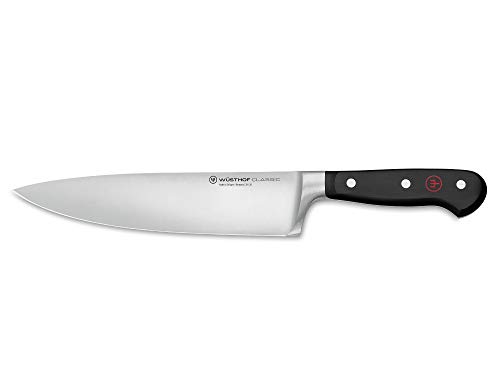
Wusthof Classic 8 inch chef knife, forged in SolingenBest ForgedWusthof Classic 8 inch chef knife, forged in Solingen8 inch forged high-carbon stainless steelFully forged with bolster and full tangBlack synthetic with three rivetsHeavy chopping and daily prep
Henckels Classic 8 inch forged chef knifeBest Mid-Tier ForgedHenckels Classic 8 inch forged chef knife8 inch forged stainless steelFully forged for balanceSynthetic with rivetsGeneral prep and chopping
Sunnecko 8 inch Damascus VG10 chef knife with 67 layersBest Japanese-Style EdgeSunnecko 8 inch Damascus VG10 chef knife with 67 layers8 inch Damascus clad with VG10 coren/aErgonomic handle, full tang stylePrecision slicing and vegetables
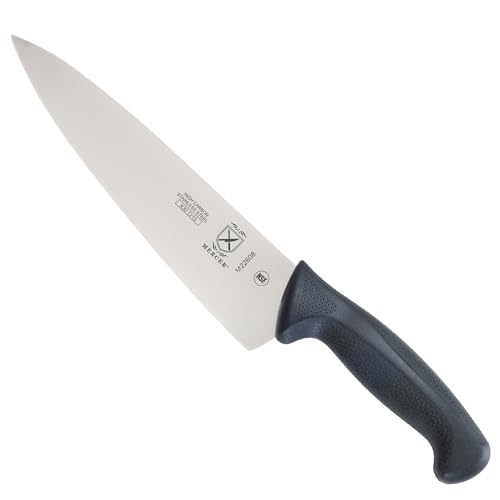
Mercer Culinary Millennia 8 inch chef knife with black handleBest ValueMercer Culinary Millennia 8 inch chef knife with black handle8 inch one-piece high-carbon Japanese steelStamped, one pieceTextured non-slip gripCulinary school and everyday prep

The chef knife does most of the work in a home kitchen: slicing onions, mincing herbs, breaking down a chicken, cutting squash. A good one feels balanced, holds an edge between sharpenings and can be brought back to sharp with a simple stone or rod.

Most listings stress pattern, layer counts and exotic steels, but cooking comfort depends on balance, grip, edge angle and how easily you can maintain the edge. We evaluated five 8 inch chef knives from the candidate pool using published specifications, listing details and patterns in owner feedback, then ranked them by fit for real kitchens.

Before you buy

6 Criteria to Look For Before Buying a Chef Knive Under $50

  1. 01

    Forged vs stamped blade

    A forged knife is shaped from a heated billet and usually has a bolster, a full tang and more weight, like the Wusthof Classic. A stamped knife is cut from sheet steel and is lighter and thinner, like the Victorinox Fibrox Pro. Neither is automatically better, since heat treatment and edge geometry matter more than the method. The mistake is assuming heavy means good. Try both styles if you can, because weight preference is personal. Pick up one of each style in a shop if you can, because a few seconds in the hand beats any spec line.

  2. 02

    Steel type and hardness

    German steels, such as those in Wusthof and Henckels, are relatively soft at about 56 to 58 on the Rockwell scale, which makes them tough and easy to sharpen. Japanese steels like VG10 are harder, often 60 or higher, holding a finer edge but chipping more easily. Hardness is a tradeoff between edge retention and toughness. Choose softer steel if you are hard on knives. Ask whether you will sharpen at home; if not, hardness is less important than toughness and service.

  3. 03

    Edge angle and sharpness

    German knives often have edges around 15 to 20 degrees per side, while Japanese knives are often 10 to 15. A finer angle slices with less force but dulls or chips more readily. The Wusthof Classic lists about 14 degrees and the Sunnecko 10 to 12. Match the angle to how you cut, because chopping bones needs a stronger edge. Learn what angle your stone or guide sets, since a mismatch quietly ruins a fine edge.

  4. 04

    Handle and balance

    A knife should balance near the heel of the blade so it feels natural in a pinch grip. Handles that are too small cramp the hand, and those that are too slick are dangerous when wet. The Victorinox has a textured handle, the Wusthof a riveted synthetic one. Try to hold a knife before buying, or favor grips with a reputation for comfort. Check the heel of the handle for a smooth transition so a long prep session does not leave a sore spot.

  5. 05

    Sharpening and maintenance

    Every knife dulls, so what matters is how easily you can restore it. Softer steels respond to a honing rod and a simple stone, while hard steels need careful whetstone work. A bolster, as on forged German knives, can complicate sharpening the heel. If you do not sharpen, buy a knife you can send for service. Buy a honing rod and a stone at the same time as the knife, so maintenance starts on day one.

  6. 06

    Length and use

    Eight inches is the standard for most home cooks, long enough for big vegetables and short enough for control. A 6 inch knife suits smaller hands, and a 10 inch knife suits large cutting boards. The common mistake is buying a very long knife and then using a short part of it. Hold the knife in a pinch grip and see whether your knuckles clear the board at the end of the cut.

Detailed reviews

The 5 best chef knives under $50, explained

01
Victorinox Fibrox Pro 8 inch chef knife with TPE handle
8 in bladeStamped steelTPE handleSwiss made
Check price on Amazon
Best for: Home cooks who want the best performance for the least money and care.

The Fibrox Pro is a stamped blade rather than a forged one, so it is lighter and thinner than a German forged knife. The 8 inch high-carbon stainless blade arrives sharp and holds an edge well for the category. The textured thermoplastic elastomer handle stays grippy when wet and greasy, which is why it is common in professional kitchens.

The tradeoff is feel. There is no bolster or full tang weight, so the knife feels lighter and less substantial than a Wusthof. It also lacks the finish of a forged knife. Compared with the Wusthof Classic, it costs a fraction of the price and sharpens easily, but has less heft for heavy chopping. Compared with the Mercer Millennia, it has a similar stamped design with a more refined handle and edge.

Ownership is easy. A basic whetstone or honing steel keeps the edge sharp, and hand washing preserves it even though the listing calls it dishwasher safe. Owner feedback patterns often describe these knives lasting for years, and the handle remains grippy even as the blade wears.

What works

  • Sharp out of the box and easy to resharpen
  • Grippy TPE handle stays secure when wet or greasy
  • Lightweight stamped blade reduces fatigue in long prep
  • Low cost compared with forged knives

Watch out for

  • Lighter feel without a bolster than forged knives
  • Plain finish is less attractive than premium knives
  • Handle plastic can scuff over years

Specs

Blade
8 inch stamped high-carbon stainless steel
Construction
Stamped, lightweight
Handle
Ergonomic TPE non-slip grip
Care
Listed dishwasher safe, hand wash advised
Best use
All-purpose home and professional prep
02
Wusthof Classic 8 inch chef knife, forged in Solingen
ForgedHigh-carbon stainlessFull tangBolster
Check price on Amazon
Best for: Cooks who want a heavy, durable forged knife that will last for decades.

The Wusthof Classic is the benchmark forged German chef knife. It is forged from a single piece of high-carbon stainless steel, with a full bolster and tang that give it weight and balance for heavy chopping. The edge is sharpened to a finer angle than older German knives, which gives better slicing than its traditional reputation suggests.

The tradeoff is cost and care. It is the most expensive knife in this lineup, and the weight tires some hands. Compared with the Victorinox Fibrox Pro, it feels more substantial and holds its geometry longer, but costs several times as much. Compared with the Henckels Classic, it has a finer edge and a longer track record for fit and finish.

Ownership requires normal care. Hand wash and dry, hone regularly and sharpen on a stone every year or so. Owner feedback patterns describe these knives lasting decades, and Wusthof offers lifetime warranty service. The bolster can make full length sharpening harder, so learn to sharpen it properly or use a service.

What works

  • Fully forged single piece gives balance and durability
  • Full bolster and tang provide weight for heavy chopping
  • Fine edge angle slices better than traditional German knives
  • Lifetime warranty and long track record

Watch out for

  • Costs several times what a stamped knife does
  • Heavier weight fatigues some hands
  • Bolster complicates sharpening the heel of the edge

Specs

Blade
8 inch forged high-carbon stainless steel
Construction
Fully forged with bolster and full tang
Edge
About 14 degrees per side per the maker
Handle
Black synthetic with three rivets
Best use
Heavy chopping and daily prep
03
Henckels Classic 8 inch forged chef knife
Fully forgedGerman engineeredBolsterTriple rivets
Check price on Amazon
Best for: Buyers who want a forged German knife at a mid-tier cost.

The Henckels Classic is a fully forged German chef knife with a bolster, triple riveted handle and a balanced feel. It cuts and chops well and is a common wedding gift because the brand is so widely recognized. The weight is solid but not as heavy as the Wusthof.

The tradeoff is that the edge is a little thicker and the finish less refined than the Wusthof. Compared with the Wusthof Classic, it costs less but is slightly less sharp and refined. Compared with the Victorinox, it has more weight and a bolster, but needs more sharpening skill.

Ownership is routine. Hand wash and dry, hone and sharpen as needed. Owner feedback patterns report that the blades hold up well with proper care, and the handles stay tight. It is a reliable middle choice for buyers who want a forged knife without the top tier cost.

What works

  • Fully forged construction gives balance and weight
  • Widely recognized brand with replaceable handles
  • Triple riveted handle feels solid
  • Lower cost than the Wusthof Classic

Watch out for

  • Edge is a little thicker than Wusthof's
  • Bolster complicates sharpening the heel
  • Heavier than stamped alternatives

Specs

Blade
8 inch forged stainless steel
Construction
Fully forged for balance
Handle
Synthetic with rivets
Origin
German engineered
Best use
General prep and chopping
04
Sunnecko 8 inch Damascus VG10 chef knife with 67 layers
VG10 core67 layers10 to 12 degree edge8 in blade
Check price on Amazon
Best for: Cooks who want a fine Japanese-style edge for slicing vegetables and boneless proteins.

The Sunnecko has a VG10 steel core clad in 67 layers of Damascus pattern steel. VG10 is a well-known Japanese stainless steel that takes a very sharp edge, and the listing states an edge of about 10 to 12 degrees per side, much finer than a German knife. The pattern is mostly cosmetic, but the VG10 core is the performance part.

The tradeoff is that thin, hard steel chips more easily if misused. Do not twist it through bones or frozen food. Compared with the Wusthof, it slices more finely but is less forgiving. Compared with the Victorinox, it offers a sharper edge and nicer appearance, but demands more care.

Ownership requires attention. Hand wash and dry immediately, use a wooden or soft board and sharpen on a whetstone. Owner feedback patterns on VG10 Damascus knives say the edge is excellent but the quality can vary by seller, so check the return policy. Treat it as a slicing knife, not a cleaver.

What works

  • VG10 core takes a very fine, sharp edge
  • Thin 10 to 12 degree edge slices with little force
  • Damascus pattern gives an attractive finish
  • Lightweight and nimble for precise work

Watch out for

  • Thin hard steel chips if twisted or used on bones
  • Needs careful hand washing and drying
  • Quality can vary more between sellers than major brands

Specs

Blade
8 inch Damascus clad with VG10 core
Layers
67 layer cladding
Edge
10 to 12 degrees per the listing
Handle
Ergonomic handle, full tang style
Best use
Precision slicing and vegetables
05
Mercer Culinary Millennia 8 inch chef knife with black handle
StampedJapanese steelSantoprene handle8 in blade
Check price on Amazon
Best for: Beginners and anyone who wants a reliable, inexpensive chef knife.

The Mercer Millennia is the budget workhorse. It is a stamped, one piece high-carbon Japanese steel blade with a textured non-slip handle, a design widely used in culinary school kits. The blade is wide enough for a good knuckle clearance, and the edge arrives sharp enough for daily use.

The tradeoff is refinement. The steel is not as hard as VG10, so it dulls faster, and the handle is plain. Compared with the Victorinox, it costs a bit less but the handle is less comfortable. Compared with the Henckels, it is lighter and lacks the bolster, but is easier to maintain and replace.

Ownership is simple. Hand wash, hone and sharpen as needed. Owner feedback patterns describe these knives as sturdy and easy to resharpen, and the low cost makes replacement painless. It is a good second knife or a beginner knife.

What works

  • Very low cost for a well-made stamped blade
  • Wide blade gives good knuckle clearance
  • Textured handle stays secure when wet
  • Easy to resharpen with basic tools

Watch out for

  • Edge dulls faster than harder steels
  • Plain handle is less comfortable than the Victorinox
  • Stamped blade has no bolster or heft

Specs

Blade
8 inch one-piece high-carbon Japanese steel
Construction
Stamped, one piece
Handle
Textured non-slip grip
Style
Wide blade with knuckle clearance
Best use
Culinary school and everyday prep

Spec decoder

What the listing measurements really mean

The numbers brands lead with, translated into what they tell you about fit, comfort and wear at home.

HRC (Rockwell hardness)

A measure of steel hardness. Higher numbers hold an edge longer but chip more easily.

Watch forGerman knives such as the Wusthof are often around 56 to 58, VG10 knives like the Sunnecko go higher.

Full tang

The steel extends through the full length of the handle. It adds balance and strength.

Watch forThe Wusthof Classic and Henckels Classic have full tangs, the stamped knives do not.

Bolster

The thick junction between blade and handle on many forged knives. It adds weight and protects the hand.

Watch forA bolster can make sharpening the heel of the edge harder.

Edge angle

The angle at which each side of the blade is ground. Smaller angles slice easier but are less durable.

Watch forThe Sunnecko lists 10 to 12 degrees, the Wusthof about 14.

Damascus layers

Layers of steel folded or clad around a core for appearance and sometimes toughness. The core steel decides sharpness.

Watch forThe 67 layers on the Sunnecko are cosmetic, the VG10 core does the work.

Methodology

How We Evaluated These Chef Knives Under $50

Spec sheet and listing review

We compared blade length, steel type, edge angle and handle design as published by each maker. We checked that specs were reported on the same basis. For example, edge angles are listed per side or total.

Construction and balance

We compared forged and stamped designs and the effect on weight and feel. These choices matter more than pattern. They explain the gap between the Wusthof and Victorinox.

Edge and steel

We looked at steel hardness, edge angle and sharpening needs. Harder steel holds an edge but is brittle. This explains the Sunnecko's position.

Ownership and care

We read owner feedback patterns about edge retention, handle wear and rust. We weighed ease of sharpening. This shaped the picks for beginners.

Value for the cook

We compared price tier against construction and edge for beginners and experienced cooks. A cheap stamped knife often beats a poorly cared for expensive one. This shaped the budget pick.

Decision guide

How to Choose the Right Chef Knives Under $50

By Cook Style

SituationPickWhy
Beginner, low maintenanceVictorinox Fibrox ProEasy to sharpen with a grippy handle
Heavy choppingWusthof ClassicForged weight and bolster
Precision slicingSunnecko VG10Fine 10 to 12 degree edge
Tight budgetMercer MillenniaLowest tier with a sound stamped blade

By Budget

SituationPickWhy
Lowest costMercer MillenniaLower tier, stamped
Low to mid tierVictorinox Fibrox ProBest performance for the cost
Mid tier, forgedHenckels ClassicForged German construction
Higher spend, long lifeWusthof ClassicFully forged with lifetime warranty

German vs Japanese Style

German style

The Wusthof, Henckels and Victorinox are tougher, a bit softer and easy to sharpen. They tolerate rough use.

Japanese style

The Sunnecko has harder steel and a finer edge. It slices beautifully but chips if misused.

Choose German style for durability, and Japanese style for precision.

By Maintenance Habit

SituationPickWhy
Never sharpenWusthof ClassicService and lifetime warranty
Hone weeklyVictorinox Fibrox ProResponds well to a rod
Use a whetstoneSunnecko VG10Hard steel rewards stone work
Replace when dullMercer MillenniaLow cost makes replacing painless

For Small Hands Specifically

Look for

A lighter knife, a handle with a slimmer profile and a blade with good knuckle clearance.

In this comparison

The Victorinox and Mercer are lighter and nimble. The Sunnecko is also light. The forged knives are heavier.

When to Spend More

Spend more if

You cook daily, want a knife for decades and will maintain the edge. The Wusthof Classic is the clear upgrade.

Save if

You cook casually and want a sharp knife without fuss. The Victorinox or Mercer covers it.

Ownership

Maintenance schedule

The upkeep that decides whether a piece still looks good in year five.

TaskIntervalWhy it matters
Hand wash and dry immediatelyAfter every useDishwashers dull edges and damage handles. Drying prevents spotting and rust. Dry with a soft towel from spine to edge, never the reverse.
Hone the edgeWeekly or every few usesHoning realigns the edge and delays sharpening. It does not remove metal. A ceramic rod works for hard steels, and a steel rod suits softer ones.
Sharpen on a whetstoneEvery 6 to 12 monthsSharpening removes metal to create a new edge. Regular sharpening keeps the knife safe and efficient. Use light pressure and consistent angle, and stop when a burr forms along the whole edge.
Cut on wood or soft plasticAlwaysGlass and stone boards dull edges quickly. Soft boards protect the blade. Replace worn boards, because deep cuts hold moisture.
Store in a block, sheath or magnetic stripAfter every useLoose knives in a drawer chip and cut hands. Proper storage protects the edge. A knife guard is the cheapest protection against a chipped tip.

FAQ

Frequently Asked Questions

Is a forged knife better than a stamped knife?

Not necessarily. Forged knives are heavier and more durable, while stamped knives are lighter and often cheaper. Heat treatment and edge geometry matter more. If you only cut occasionally, a stamped knife will do the job and cost less.

How often should I sharpen a chef knife?

Hone weekly and sharpen every six to twelve months for home use. If it struggles with a tomato skin, it needs sharpening. Most home cooks do well with a rod weekly and a stone once or twice a year.

Is Damascus steel better?

The pattern is mostly cosmetic. The core steel decides edge quality, so a VG10 core is the useful part. A VG10 core on a plain blade performs the same as a patterned blade.

Can I put a chef knife in the dishwasher?

It is not recommended. Heat and detergent dull the edge and damage handles. If you have no choice, wash and dry within minutes of the cycle ending.

What length is best?

Eight inches suits most home cooks. Choose 6 inches for small hands and 10 inches for large boards. If you cook for a large family, consider a second knife for vegetables.

Should I buy a knife set instead?

A single good chef knife does most of the work. Many sets include knives you will rarely use. If you want a second blade, a paring knife is more useful than another large one.

Bottom line

The short version

Browse more chef knives under $50on Amazon →
Brianna Cole, Lead Product Editor

About the author

Brianna Cole

Lead Product Editor, SenseiReview

Brianna Cole leads SenseiReview's buying guides, turning published specifications, documentation and owner feedback patterns into clear verdicts across home, tech, fitness, outdoor and DIY products.

More from Brianna →

Keep reading

Related guides