
Amazon affiliate links - we earn a commission.Affiliate disclosure

Buying guide · 12 min read · Updated 2026-11-21

Best Dehumidifiers (2026)

Five dehumidifiers compared by type, capacity claims, drainage, cold-room behavior and noise, from closet-size units to 80 pint basement machines.

Brianna Cole, Lead Product EditorBy Brianna ColeLead Product Editor5 picks comparedSpec-sheet verified
Best Dehumidifiers

At a glance

Our top picks

Side by side

Spec comparison

A dehumidifier pulls water vapor out of the air and collects it in a tank or sends it down a drain hose. In a damp home it protects walls, stored items and indoor air quality, and it makes a stuffy room feel less clammy.

The category has two very different machine types sold under one name, and listing claims make that hard to see. We evaluated five models using published specifications, listing details and patterns in owner feedback, then ranked them by how honestly their capacity fits the job.

Before you buy

6 Criteria to Look For Before Buying a Dehumidifier

  1. 01

    Compressor or semiconductor type

    Compressor dehumidifiers chill coils to condense large amounts of water and suit basements and whole rooms. Semiconductor, or Peltier, units cool a small plate, which is quiet and light but removes only a small fraction of the water. The common mistake is buying a small tank unit for a wet basement because the listing says 1,000 sq ft. The Waykar and AEOCKY are compressor machines, while the ToLife and TABYIK are semiconductor.

  2. 02

    Honest capacity and test conditions

    Pint per day ratings depend on the test conditions, and a hot, humid test produces larger numbers than a cool basement. The US test conditions changed in 2019, so a similar machine can carry a lower pint label now than before. Compare units rated under the same conditions. The AEOCKY lists 80 pint at 95F and 56 pint at 86F, which makes the second figure the more useful one.

  3. 03

    Room size and dampness level

    Coverage claims assume a moderately damp room, not a wet floor. A damp bedroom needs far less capacity than a basement with visible moisture. Size up when the space is open, poorly insulated or prone to flooding. The VEAGASO at 34 to 36 pint suits a bedroom or finished basement, and the 80 pint units suit open, wet basements.

  4. 04

    Drainage options

    A bucket is fine for a small unit but needs emptying daily in damp weather. A drain hose or a pump allows continuous operation, which matters most for large compressor machines. Many buyers overlook that gravity drain needs the floor to slope. The VEAGASO has a 0.53 gallon bucket and a hose option, and the large AEOCKY and Waykar units are best used with a hose.

  5. 05

    Cold-room performance

    Compressor coils ice up when the room is cool, and many models lose output below about 65F. Automatic defrost helps, but removal still falls. Semiconductor units are less affected by cold but remove little to begin with. If your space is cold, check the minimum operating temperature in the manual.

  6. 06

    Noise and running cost

    Compressor models hum like a small refrigerator, and larger units are louder than small ones. Energy Star listings help with running cost over long damp seasons. The common mistake is ignoring noise when placing a unit in a bedroom. The ToLife and TABYIK are quiet, while the 80 pint units are better kept in basements.

Detailed reviews

The 5 best dehumidifiers, explained

01
Waykar 80 Pint Energy Star dehumidifier with 90 degree swing
80 pint capacity5,000 sq ft claim30 to 80% control90 degree swing
Check price on Amazon
Best for: Large basements and whole-floor dampness that needs a high-capacity compressor.

This is a compressor machine with a large capacity rating and a few practical touches. The outlet swings through about 90 degrees to spread dry air across the room, and the humidity control reaches down to 30 percent when many units stop at 40 percent. That wider range helps in very damp basements and when drying laundry indoors.

Capacity claims need context. An 80 pint figure is usually stated at a hot, humid test condition, and the actual daily removal in a cool basement is lower. Compared with the AEOCKY 80 Pint, the Waykar offers the swing outlet and the lower humidity floor, while the AEOCKY lists its figures at several test conditions and carries a Most Efficient claim. Compared with the smaller VEAGASO, it is far more machine than a bedroom needs.

Ownership is mostly about drainage and filters. Attach a drain hose for continuous operation so you are not emptying a bucket several times a day, and wash the air filter every few weeks. Place the unit a few inches from walls, keep doors closed in the space you are drying, and expect a compressor hum comparable to a small fridge.

What works

  • 80 pint rating handles large damp basements and laundry areas
  • Humidity target reaches 30 percent for very wet spaces
  • Swing outlet spreads dry air instead of blowing one direction
  • Energy Star listing helps keep long running costs lower

Watch out for

  • Large and heavy unit is awkward to move between floors
  • Maker capacity figure assumes a hotter test than a cool basement
  • More machine than a bedroom or a closet needs

Specs

Capacity
80 pint per day (maker rating)
Coverage claim
Up to 5,000 sq ft
Humidity range
30 to 80 percent target
Airflow
90 degree auto swing outlet
Certification
Energy Star listed
02
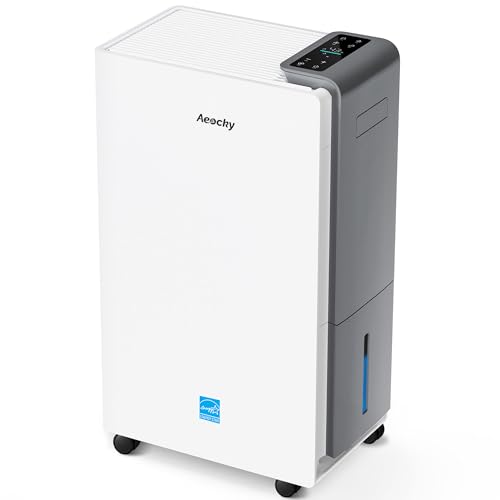
AEOCKY 80 Pint Energy Star Most Efficient dehumidifier
80 pint capacity5,500 sq ft claimEnergy Star listedDrain hose ready
Check price on Amazon
Best for: Warm, damp basements where realistic capacity figures matter.

The AEOCKY is a large compressor unit whose listing is unusually open about conditions. It states 80 pint per day at 95F and 95 percent humidity, and 56 pint per day at 86F and 80 percent humidity, which is closer to what a damp basement looks like. That second figure is the more honest guide for sizing.

The tradeoff is the same as any big compressor unit: it is heavy, takes floor space and needs a drain plan. Compared with the Waykar, it gives you more detail on test conditions and an efficiency designation, but not the swing outlet. Compared with the 105 pint commercial AEOCKY, this is the more reasonable size for a home and avoids the noise and power draw of an industrial unit.

In use, run it with the hose attached to a floor drain or a pump so it can work continuously through humid weeks. Clean the filter every few weeks, because a clogged filter reduces airflow and makes the coils work harder, and check the coils for ice if the room is cool. If the basement stays below roughly 65F, expect lower removal and watch the defrost cycle.

What works

  • Listing states capacity at two test conditions for honest sizing
  • Large 5,500 sq ft claim suits open basements
  • Efficiency listing helps with continuous running costs
  • Drain hose option avoids constant bucket emptying

Watch out for

  • Heavy and bulky with no swing outlet for air spread
  • Removal drops in cool rooms below about 65F
  • Needs a drain or pump plan to be convenient

Specs

Capacity
80 pint at 95F, 56 pint at 86F
Coverage claim
Up to 5,500 sq ft
Certification
Energy Star Most Efficient 2025 claim
Drainage
Bucket or hose
Best use
Warm damp basements
03
VEAGASO 34 to 36 Pint dehumidifier with drain hose
34 to 36 pint2,500 sq ft claim3 modesLED touch panel
Check price on Amazon
Best for: Damp bedrooms, laundry rooms and finished basements of moderate size.

The VEAGASO is the sensible middle size. It is a compressor unit rated at 34 to 36 pint per day, with three modes for everyday control, faster clothes drying and continuous running, and it can drain either to its 0.53 gallon bucket or through a hose. The touch panel adjusts the humidity target, fan speed and timer.

The bucket is the limitation. At 0.53 gallon it fills quickly in a very humid room, so the hose option is what makes it practical. Compared with the 80 pint Waykar, it is cheaper, lighter and easier to carry, but it will struggle in a genuinely wet basement. Compared with the ToLife 95 oz, it removes far more water and works better in cool rooms.

Day to day, it suits a damp bedroom, a laundry room or a finished basement in a moderate climate. Clean the filter regularly, empty the bucket or run the hose, and keep the coils clear of dust. If the room is cold, make sure the unit has an automatic defrost feature before relying on it.

What works

  • Compressor design removes far more water than small tank units
  • Clothes drying mode helps with indoor laundry in humid weather
  • Hose option allows continuous drainage without a bucket
  • Touch panel sets humidity target, fan speed and timer

Watch out for

  • Small bucket fills quickly without the drain hose
  • Cannot keep up with a genuinely wet basement
  • Rated coverage assumes light dampness, not standing moisture

Specs

Capacity
34 to 36 pint per day (maker rating)
Coverage claim
Up to 2,500 sq ft
Modes
Everyday, clothes drying, continuous
Drainage
0.53 gallon bucket or hose
Controls
LED touch panel
04
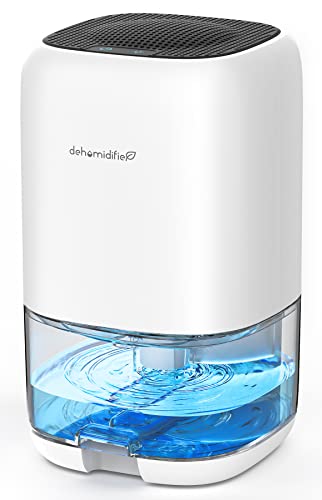
ToLife 95 oz tank semiconductor dehumidifier with sleep mode
95 oz tank1,000 sq ft claimSleep modeAuto shutoff
Check price on Amazon
Best for: Small closed bedrooms and closets where quiet matters more than capacity.

This is a small semiconductor, or Peltier, dehumidifier. Instead of a compressor, it cools a plate to condense water, which keeps it quiet and light but limits how much water it can remove. The 95 oz tank is the larger of the tank-style units here, and it has a powerful mode, a sleep mode and an automatic shutoff when the tank is full.

The listing says it covers 1,000 sq ft, but treat that as marketing. Semiconductor units remove a small fraction of what a compressor machine does, and they work best in small, closed rooms like bedrooms, closets and bathrooms. Compared with the TABYIK 35 oz, the ToLife has a larger tank and a bigger rated area, while the TABYIK is more compact. Compared with the VEAGASO, it is quieter but far weaker.

In ownership terms, there is no compressor to wear out, and cleaning is a wipe of the tank and the filter. Empty the tank daily, because a full tank turns the unit off, and keep the door closed in the room. Do not expect it to fix a musty basement.

What works

  • Semiconductor design is quiet enough for a bedroom at night
  • Sleep mode reduces noise and light during the night
  • Large 95 oz tank for a unit in its class
  • Automatic shutoff prevents overflow when the tank fills

Watch out for

  • Removes far less water than a compressor machine
  • Coverage claim is optimistic for rooms above closet size
  • Tank needs emptying frequently in damp weather

Specs

Type
Semiconductor condensation
Tank
95 oz (about 2.8 L)
Coverage claim
Up to 1,000 sq ft
Modes
Powerful and sleep
Safety
Auto shutoff when tank is full
05
TABYIK 35 oz tank mini dehumidifier for closets and RVs
35 oz tank280 sq ft claimAuto shutoffColored light
Check price on Amazon
Best for: Closets, small bathrooms and RVs with light dampness.

The TABYIK is the smallest machine here, a mini semiconductor unit with a 35 oz transparent tank and a rated area of about 280 sq ft. The transparent tank lets you see how much water has been collected, which is a useful reality check on how much it is actually removing. A separate light button controls the colored lamp.

The rating is the honest part. At 280 sq ft it is aimed at a closet, a small bathroom or an RV, and that is where it should stay. It is the cheapest and quietest option, though it is also the weakest in water removal. Compared with the ToLife 95 oz, it has a smaller tank and area, so it needs emptying more often.

Ownership is simple. Empty and wipe the tank daily, keep the room closed, and replace the unit rather than repairing it, since it is a low cost appliance. If you see no water in the tank after a day, the room is probably too dry or too large for it, so do not keep running it blindly.

What works

  • Compact and light enough to move between small rooms
  • Transparent tank shows the real amount of water collected
  • Quiet operation suits a closet or a bedroom corner
  • Automatic shutoff protects against overflow

Watch out for

  • Smallest tank and weakest water removal in the lineup
  • Cannot dry anything larger than a closet or small bathroom
  • Tank must be emptied almost daily in humid weather

Specs

Type
Semiconductor condensation
Tank
35 oz (1,000 ml)
Coverage claim
Up to 280 sq ft
Safety
Auto shutoff when tank is full
Best use
Closets, bathrooms, RVs

Spec decoder

What the listing measurements really mean

The numbers brands lead with, translated into what they tell you about fit, comfort and wear at home.

Pint per day

This is the amount of water the machine can remove in 24 hours under a stated condition. A higher number means a bigger machine, not necessarily a better one for your room.

Watch forThe AEOCKY 80 pint is stated at 95F, and its 56 pint figure at 86F is more realistic.

Square feet coverage

Coverage claims estimate the floor area a machine can treat in a moderately damp space. Wet or open spaces need more capacity than the claim suggests.

Watch forThe ToLife lists 1,000 sq ft, but it is a semiconductor unit suited to a small closed room.

Energy Star listing

Energy Star certifies a model that removes more water per unit of energy than standard models. It matters most for machines that run for weeks at a time.

Watch forThe Waykar and AEOCKY both carry Energy Star claims, so compare actual wattage as well.

Humidity control range

The range is the target humidity the unit can hold. Many stop at 40 percent, and a lower floor helps in very damp rooms.

Watch forThe Waykar reaches 30 to 80 percent, which is wider than many competitors.

Tank size

The tank holds the water before the machine shuts off. A bigger tank means fewer trips but does not change how much water the unit can remove.

Watch forThe VEAGASO bucket holds 0.53 gallon, and the TABYIK holds 35 oz, so hose drainage matters.

Methodology

How We Evaluated These Dehumidifiers

Specification review

We compared type, capacity, drainage and humidity range as published by each maker. We treated pint ratings and sq ft claims as claims, not measurements. The AEOCKY and Waykar were compared on listed test conditions.

Owner feedback patterns

We read for repeated themes such as noise, bucket size and whether small units actually collect water. Patterns carried more weight than single complaints. Basement owners and bedroom owners reported very different experiences.

Fit to room and dampness

We matched each machine to a closet, bedroom, finished basement or wet basement. A semiconductor unit cannot dry a flooded floor, and an 80 pint unit is wasteful in a bedroom. This is why we separate the lineup by type.

Ownership and drainage

We considered filter care, bucket handling and hose options over a long damp season. Continuous drainage turns a chore into a background task. We also noted cold-room defrost behavior.

Ranking logic

Rank reflects fit and honesty of capacity claims, not the largest number on a listing. Our scores are editorial assessments, not measurements. A relative price tier is used for ordering only.

Decision guide

How to Choose the Right Dehumidifiers

By Space and Dampness

SituationPickWhy
Large damp basementWaykar 80 PintHigh capacity, swing outlet and a wide humidity range
Warm, humid basementAEOCKY 80 PintCapacity stated at realistic test conditions
Damp bedroom or laundry roomVEAGASO 34 to 36 PintCompressor power with a hose option
Closet or small bathroomTABYIK 35 ozCompact and quiet for tiny spaces

By Budget

SituationPickWhy
Lowest cost, tiny roomTABYIK 35 ozCheapest unit here for closets and RVs
Low cost, quiet bedroomToLife 95 ozLarge tank for a semiconductor unit
Mid cost, real capacityVEAGASO 34 to 36 PintCompressor machine at a moderate tier
Higher cost, basementsWaykar 80 PintLarge capacity with Energy Star listing

Compressor vs Semiconductor

Compressor

The Waykar, AEOCKY and VEAGASO chill coils to remove large amounts of water. They are louder and heavier but they actually dry a room.

Semiconductor

The ToLife and TABYIK condense water on a small cooled plate. They are quiet and light but remove only a small amount.

Choose compressor for any room with real dampness, and semiconductor for closets and light humidity.

By Drainage and Placement

SituationPickWhy
Floor drain availableAEOCKY 80 PintHose drainage suits continuous running
Need to move between roomsVEAGASO 34 to 36 PintLighter than the 80 pint units
Bedroom at nightToLife 95 ozSleep mode and auto shutoff
Wall-adjacent cornerWaykar 80 PintSwing outlet spreads air from a corner

For Basements Specifically

Look for

A compressor machine with a drain hose or pump, a capacity figure stated at a realistic condition and a wide humidity range.

In this comparison

The AEOCKY 80 Pint and Waykar 80 Pint are the two basement-class machines, and the VEAGASO suits a finished basement.

When to Spend More

Spend more if

Your basement has visible dampness or musty smells, or you run the machine for most of the year.

Save if

You only need to dry a closet or a small bathroom, where the TABYIK or ToLife is enough.

Ownership

Maintenance schedule

The upkeep that decides whether a piece still looks good in year five.

TaskIntervalWhy it matters
Empty the bucket or check the hoseDaily for bucket unitsA full bucket turns the machine off, and standing water grows odor. A hose with a downward slope avoids the chore.
Wash the air filterEvery 2 to 4 weeksA dusty filter cuts airflow and makes the coils work harder. Let it dry fully before reinstalling.
Wipe the tank and drain pathWeeklyDamp surfaces grow mold if left alone. A mild vinegar rinse keeps the tank fresh.
Check coils for iceWhen the room is coolIced coils stop removing water. If ice returns, raise the room temperature or let the defrost cycle complete.
Vacuum the intake and coilsSeasonallyDust blocks the coil surface and reduces efficiency. Unplug the unit before cleaning.

FAQ

Frequently Asked Questions

Do small tank dehumidifiers work?

They work in closets, bathrooms and small bedrooms. They cannot dry a wet basement because they remove only a small fraction of what a compressor unit does.

How much should I spend?

Spend by room size and dampness. A small semiconductor unit handles a closet, a mid-size compressor machine such as the VEAGASO suits a bedroom, and an 80 pint unit is for basements.

How long do dehumidifiers last?

Compressor models typically last several years with filter care. Keeping the coils and filter clean extends the life of the compressor.

Does the sq ft claim mean it will dry that area?

No. Coverage claims assume moderate dampness, and a wet or open space needs more capacity than the claim suggests.

What humidity should I aim for?

Most guidance points to about 30 to 50 percent indoors. Above 60 percent encourages mold and dust mites.

Why does my dehumidifier collect no water?

The room may already be dry, too cool for the compressor, or too large for a small semiconductor unit. Check the temperature and room size before assuming a fault.

Bottom line

The short version

Browse more dehumidifierson Amazon →
Brianna Cole, Lead Product Editor

About the author

Brianna Cole

Lead Product Editor, SenseiReview

Brianna Cole leads SenseiReview's buying guides, turning published specifications, documentation and owner feedback patterns into clear verdicts across home, tech, fitness, outdoor and DIY products.

More from Brianna →

Keep reading

Related guides