
Amazon affiliate links - we earn a commission.Affiliate disclosure

Buying guide · 14 min read · Updated 2026-11-26

Best Dust Collectors for Small Shops (2026)

Seven dust collectors and separators compared on real airflow, filter micron rating, bag size, mount style and noise, with picks for garage and basement shops.

Brianna Cole, Lead Product EditorBy Brianna ColeLead Product Editor7 picks comparedSpec-sheet verified
Best Dust Collectors for Small Shops

At a glance

Our top picks

Side by side

Spec comparison

A dust collector pulls chips and sawdust from a machine through a hose and into a bag or canister. A small shop usually needs one for a table saw, planer or jointer, where a shop vacuum cannot move enough air.

Listings advertise peak airflow numbers that no shop will see once a hose is attached. This guide compares five small collectors and two cyclone separators, and explains how hose size and filter quality matter more than the headline number.

Before you buy

6 Criteria to Look For Before Buying a Dust Collector for Small Shops

  1. 01

    Real airflow versus listed CFM

    Listed CFM is free air with no hose attached. A collector rated at 650 CFM may move closer to 420 through a few feet of 4 inch flexible hose. A single machine usually needs 350 to 450 CFM at the port, and larger tools need more. Treat the listed figure as a ceiling. The POWERTEC lists 800 and the WEN 7.4 amp lists 600, and neither delivers that at the tool.

  2. 02

    Hose size and duct length

    Hose diameter and length cause the biggest airflow losses. Use 4 inch hose where possible, keep runs short and avoid sharp bends. A small hose at the tool can cut airflow sharply. Flex hose is worse than smooth duct. All the collectors here use a 4 inch port, so plan the layout.

  3. 03

    Filter rating and fine dust

    Fine dust under 10 microns stays airborne, and bag filters pass some of it. A 1 micron claim is better than 2.5 microns, though ratings are maker figures. Wear a respirator while sanding, and consider an ambient air filter. The POWERTEC lists 1 micron and the VEVOR lists 2.5 micron.

  4. 04

    Motor type and noise

    Induction motors run quieter and last longer than brushed motors, which are loud. Collectors often run at 80 to 90 decibels, so hearing protection is wise. In a garage shared with a household, noise matters. The WEN 7.4 amp uses an induction motor, and the WEN DC3401 uses a brushed one.

  5. 05

    Bag capacity and emptying

    A full bag cuts airflow, so a larger bag means fewer interruptions. Bags range from 12 to 21 gallons. Empty before the bag is two thirds full and wear a mask while doing so. The VEVOR has a 21 gallon bag and the WEN DC3401 has 12.

  6. 06

    Mobile, wall mount or separator

    Mobile bases move between machines, wall mounts save floor space and separators work with a shop vacuum. Choose by shop size and the tools you run. Separators suit handheld tools and sanders only. The WEN and POWERTEC are mobile, the VEVOR is wall mounted, and the DEWALT and Mullet are separators.

Detailed reviews

The 7 best dust collectors for small shops, explained

01
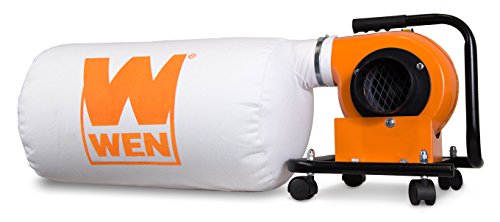
WEN 7.4 amp induction motor dust collector, 15 gallon bag, mobile base
7.4 amp induction600 CFM15 gal bag9 in impeller
Check price on Amazon
Best for: Small shops that run a table saw or planer and want quieter operation.

This WEN uses a 7.4 amp induction motor with a 9 inch impeller, a 4 inch port and a 15 gallon collection bag. The listing states up to 600 cubic feet per minute, which is a free air figure that falls once you attach hose.

Induction motors run quieter and last longer than brushed motors, which is a significant advantage in a small shop where noise adds up. The bigger bag also means fewer trips to empty it. Compared with the WEN DC3401, the extra impeller diameter and the induction motor justify the higher cost tier. Compared with the POWERTEC 800 CFM, it moves less listed air but runs more quietly.

Ownership is about the bag. Empty it before it fills, because a packed bag cuts airflow, and wear a respirator when you do so. Keep the 4 inch hose short and smooth, check that the impeller is clear of debris and mount it on the base or on a wall.

What works

  • Induction motor runs quieter and lasts longer
  • Fifteen gallon bag reduces emptying trips
  • Four inch port fits most woodworking tools
  • Mobile base or wall mount options

Watch out for

  • Listed 600 CFM is free air, not at the tool
  • Bag filtration is basic for very fine dust

Specs

Motor
7.4 amp induction
Airflow
Up to 600 CFM, free air
Impeller
9 inch
Bag
15 gallon
Port
4 inch, mobile base or wall mount
02
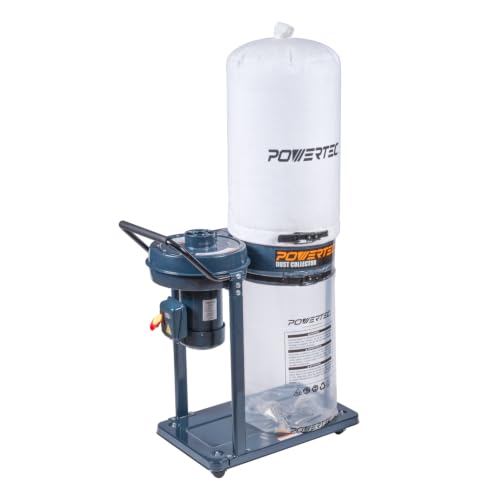
POWERTEC 1 HP 800 CFM dust collector with mobile base and 1 micron bag
1 HP800 CFM1 micron bagMobile base
Check price on Amazon
Best for: Shops that need the most airflow per cost for planers and saws.

The POWERTEC 800 CFM collector uses a 1 HP motor with a mobile base and a 1 micron upper filter bag. The listed 800 CFM is the highest in the lineup, but it is a free air number, so expect much less at the end of a hose.

The 1 micron bag is a maker claim for filtration, and bags of this type pass some fine dust unless they are sealed well. Compared with the WEN 7.4 amp, the POWERTEC offers higher listed airflow at a lower cost tier, but the motor will be louder. Compared with the VEVOR wall unit, it sits on the floor and takes more space but can move between machines.

Ownership requires attention to the bag and seals. Check the clamps, shake the bag out before it packs, and keep the base level. Wear hearing protection since this class of motor is loud.

What works

  • Highest listed airflow in the lineup
  • One micron upper bag is included
  • Mobile base moves between machines
  • Lower cost tier than the WEN induction unit

Watch out for

  • Brushed or universal style noise is a likely tradeoff
  • Free air rating overstates real performance

Specs

Motor
1 HP
Airflow
Up to 800 CFM, free air
Filter
1 micron upper bag
Base
Sturdy base, 15 1/4 x 25 1/2 inches
Mobility
Casters
03
SHOPMAX 20 gallon 6.3 amp dust collector, 677 CFM, 12 inch impeller
6.3 amp677 CFM12 in impeller20 gal
Check price on Amazon
Best for: Shops that want a larger bag and impeller without moving to a full cyclone.

The ShopMax pairs a 6.3 amp motor with a 12 inch impeller and a 20 gallon capacity. A bigger impeller moves air with less motor speed, which can improve efficiency and reduce noise relative to a small impeller at the same airflow.

The 677 CFM figure is again a maximum free air number. The 20 gallon capacity is large for a small shop, and it means a full bag holds a lot of chips before airflow suffers. Compared with the WEN DC3401, the ShopMax has a larger impeller and bag, and costs more. Compared with the VEVOR, it is smaller on paper but offers a larger impeller.

Ownership is about space and emptying. The unit takes more floor area than the smaller models, so measure first, and empty the bag at half full for best airflow. Check the impeller housing for debris.

What works

  • Twelve inch impeller moves air efficiently
  • Twenty gallon capacity cuts emptying trips
  • Six point three amp motor at a moderate cost
  • Suited to planers and table saws

Watch out for

  • Larger footprint than compact collectors
  • Maximum CFM is a free air figure

Specs

Motor
6.3 amp
Airflow
677 CFM maximum
Impeller
12 inch
Capacity
20 gallon
Use
Woodworking dust and chips
04
VEVOR 1 HP 560 CFM wall mount dust collector, 21 gallon bag, 2.5 micron
1 HP560 CFM21 gal bagWall mount
Check price on Amazon
Best for: Cramped garages where floor space is more valuable than mobility.

The VEVOR is a wall mounted 1 HP collector with a 21 gallon non woven bag and a 2.5 micron filter rating. Hanging it on a wall frees the floor, which makes a real difference in a one car garage.

A 560 CFM maximum is modest, and a 2.5 micron filter is coarser than the 1 micron bags on the POWERTEC. The large bag helps, but the unit must be hooked to a wall stud, and a full bag adds substantial weight. Compared with the POWERTEC floor unit, the VEVOR saves space but is fixed in one spot, so you must run a hose to each tool.

Ownership centers on mounting. Fasten to studs with lag screws and keep the bag accessible for emptying. Use the largest hose you can and keep the run short.

What works

  • Wall mounting frees up the floor
  • Twenty one gallon bag holds a lot of chips
  • Lower cost tier for a 1 HP unit
  • Compact footprint

Watch out for

  • Fixed location, so hoses must reach each tool
  • Two and a half micron filter is coarser than 1 micron

Specs

Motor
1 HP
Airflow
560 CFM maximum
Bag
21 gallon non woven
Filter
2.5 micron
Mount
Wall mounted
05
WEN DC3401 dust collector, 5.7 amp, 660 CFM, 12 gallon bag, mobile base
5.7 amp660 CFM12 gal bag6 in impeller
Check price on Amazon
Best for: Small shops with a table saw or miter saw and a limited budget.

The WEN DC3401 is the popular entry level collector, with a 5.7 amp brushed motor, a 6 inch impeller, a 4 inch port and a 12 gallon bag. It sits on a mobile base and can also be hung on a wall.

A brushed motor is louder and wears faster than the induction motor in the other WEN, and the smaller bag fills sooner. Where it makes sense is a shop with one or two stationary tools used one at a time, such as a table saw and a miter saw. Compared with the 7.4 amp WEN, it is cheaper and lighter but louder. Compared with the Dewalt separator, it is a collector and not a pre filter.

Ownership requires emptying the bag often and listening for motor brush wear. Check the impeller for debris and keep the hose short.

What works

  • Low cost tier for a 4 inch port collector
  • Mobile base and wall mount options
  • Compact enough for a single car garage
  • Twelve gallon bag is easy to empty

Watch out for

  • Brushed motor is louder and wears faster
  • Six inch impeller has limited airflow for planers

Specs

Motor
5.7 amp brushed
Airflow
Up to 660 CFM, free air
Impeller
6 inch
Bag
12 gallon
Port
4 inch, optional wall mount
06
DEWALT dust separator with 10 gallon stainless steel tank and casters
10 gal tankStainless steel99.5% separationCaster base
Check price on Amazon
Best for: Sanding and handheld tool work with a shop vacuum already on hand.

This DEWALT is not a dust collector. It is a cyclone style pre separator that sits between a tool and a shop vacuum, dropping most chips into a 10 gallon stainless steel tank before the air reaches the vacuum filter.

The maker claims 99.5 percent separation, a figure we treat as a claim, but the principle is sound: less dust reaches the vacuum filter, so suction stays steady. It suits sanders, routers and small bench tools. Compared with the WEN collectors, it cannot feed a planer or a drum sander because the vacuum hose is small. Compared with the Mullet, it has a larger steel tank and a caster base.

Ownership is simple. Empty the tank when it is half full, check the seal on the lid and clean the vacuum filter now and then. A stainless tank does not crack like plastic ones.

What works

  • Keeps the vacuum filter cleaner and suction steady
  • Ten gallon stainless tank holds a lot of debris
  • Caster base moves with the vacuum
  • Works with wood, drywall and other dusts

Watch out for

  • Cannot supply the airflow a planer needs
  • Separation figure is a maker claim

Specs

Type
Pre separator for a shop vacuum
Tank
10 gallon stainless steel
Separation
99.5 percent, maker claim
Base
Caster base
Use
Sanders, routers, handheld tools
07
Mullet cyclone separator for shop vacuums with cut to fit PVC connection
CycloneShop vac add onPVC connection99% claim
Check price on Amazon
Best for: Budget shop vacuum setups for sanders, routers and small tools.

The Mullet is a compact cyclone separator for a shop vacuum, using a one piece parabolic design and a cut to fit PVC connection. The maker claims it pre separates more than 99 percent of debris, again a claim to weigh against owner experience.

Its rigid PVC connection avoids the long loop of hose that adds airflow loss, and the compact body fits on top of a bucket or a vacuum. Compared with the DEWALT separator, it is much cheaper and lighter, but smaller in capacity. Like the DEWALT, it only works with a shop vacuum, so it cannot run a planer.

Ownership centers on the seal and bucket. Make sure the lid fits snugly, empty the bucket before it fills and replace the connection hose if it cracks. It suits a one person shop with sanders and small tools.

What works

  • Low cost way to keep vacuum filters clean
  • Rigid connection avoids extra hose loss
  • Compact and easy to mount on a bucket
  • Works with most shop vacuums

Watch out for

  • Small capacity needs frequent emptying
  • Cannot handle large machine airflow

Specs

Type
Cyclone separator for a shop vacuum
Design
Parabolic, one piece
Connection
Rigid, cut to fit PVC
Separation
Over 99 percent, maker claim
Use
Shop vac pre filtering

Spec decoder

What the listing measurements really mean

The numbers brands lead with, translated into what they tell you about fit, comfort and wear at home.

CFM

Cubic feet per minute, the volume of air moved. Listed CFM is measured with no hose attached.

Watch forThe POWERTEC 800 and WEN 600 are free air figures that fall at the tool.

Impeller diameter

The size of the fan wheel. Larger impellers can move more air at lower speed.

Watch forThe ShopMax uses 12 inches, the WEN 7.4 amp 9 inches and the DC3401 6 inches.

Micron rating

The particle size a filter is said to capture. Smaller numbers mean finer filtration.

Watch forThe POWERTEC lists 1 micron and the VEVOR lists 2.5 micron, both maker claims.

Induction motor

An electric motor without brushes that runs quieter and lasts longer than a brushed motor.

Watch forThe WEN 7.4 amp uses one, while the DC3401 does not.

Static pressure

The resistance the collector can overcome, mostly from hose and ducts. It limits how long a run can be.

Watch forFew small collectors list it, so keep hose runs short.

Methodology

How We Evaluated These Dust Collectors for Small Shops

Spec sheet review

We evaluated motor type, impeller size, listed airflow, filter rating and bag capacity from each listing. We compared them with what small shops need at a 4 inch port. The WEN and POWERTEC collectors anchored the comparison.

Owner feedback patterns

We looked for repeating comments about noise, bag filtration, airflow after hose loss and assembly. These issues decide how a collector feels in daily use. Noise and fine dust leakage came up most.

Fit for shop size

A garage bay, a basement and a one tool corner need different units. We graded each product on footprint, mobility and airflow, with separators as a separate tier.

Cost relative to the lineup

We used relative cost tiers and quote no listing prices. The Mullet and WEN DC3401 sit at the low end, while the WEN 7.4 amp and DEWALT sit higher.

Claims we discounted

Free air CFM, micron ratings and percent separation figures appear on every listing. We treat them as maker claims and rank on design and fit.

Decision guide

How to Choose the Right Dust Collectors for Small Shops

By Tool

SituationPickWhy
Table saw and planerWEN 7.4 ampInduction motor and large bag
Highest airflow per costPOWERTEC 800 CFMListed 800 CFM and 1 micron bag
Large bag, large impellerShopMax 20 gallonTwelve inch impeller
Single tool cornerWEN DC3401Low cost 4 inch collector
Sanders and routersDEWALT separatorKeeps vacuum filter clean

By Budget

TierPickWhy
LowestMullet cycloneCheap vacuum separator
LowWEN DC3401Entry level collector
Low to middleVEVOR wall mountLarge bag, floor saving
MiddleShopMax and POWERTECLarger impeller or higher airflow
HighestWEN 7.4 amp and DEWALTInduction motor or steel separator

Collector vs Shop Vacuum Separator

Dust collector

The WEN, POWERTEC, ShopMax and VEVOR move large volumes through a 4 inch hose. They suit table saws, planers and jointers.

Shop vacuum separator

The DEWALT and Mullet add a cyclone to a shop vacuum. They suit sanders and handheld tools but cannot feed a planer.

Choose a collector for stationary machines, and a separator for sanding and small tools.

By Shop Layout

SituationPickWhy
One car garage, tight floorVEVOR wall mountFrees the floor
Moving between machinesPOWERTEC mobileCasters and 4 inch port
Quiet basement shopWEN 7.4 ampInduction motor runs quieter
Bench with handheld toolsMullet separatorSmall and light

For Table Saw and Planer Use Specifically

Look for

A 4 inch port, at least 600 CFM listed, a large bag and a short smooth hose. Plan for losses and consider an upgrade to larger duct.

In this comparison

The WEN 7.4 amp is the first choice, with the POWERTEC as a higher airflow alternative.

When to Spend More

Spend more if

You run a planer or work long sessions. An induction motor and a larger bag are worth the cost.

Save if

You cut occasionally. The WEN DC3401 or a Mullet separator is enough.

Ownership

Maintenance schedule

The upkeep that decides whether a piece still looks good in year five.

TaskIntervalWhy it matters
Empty the bag or bucketAt half to two thirds fullA packed bag cuts airflow and strains the motor. Wear a respirator when you empty it.
Shake out or clean the filterAfter heavy sanding sessionsFine dust clogs bag pores and reduces suction. A bag cleaner or gentle shake restores flow.
Inspect hoses and clampsMonthlyCracks and loose clamps leak air and lower suction. Replace damaged hose.
Check the impeller for debrisEvery few monthsChips or metal cause imbalance and noise. Unplug the unit before opening the housing.
Check motor brushes on brushed modelsYearlyWorn brushes cause hesitation. Replace them as the maker advises.

FAQ

Frequently Asked Questions

How much CFM do I need?

About 350 to 450 CFM at the port for a single stationary tool, and more for planers and drum sanders. Listed CFM is free air, so expect less after hose loss.

Is a 1 micron bag really 1 micron?

It is a maker claim, and bag filters usually pass some very fine dust. Wear a respirator while sanding and consider an air filter.

Single stage or cyclone?

Single stage collectors cost less and fit small shops. A cyclone separator keeps the filter clean and holds airflow better, but adds cost and height.

Can a shop vacuum replace a collector?

For handheld tools and sanders, yes, especially with a separator. It cannot move enough air for a planer or drum sander.

What hose size should I use?

Use 4 inch hose where the tool allows, and keep the run short and smooth. Small hoses cut airflow sharply.

Are dust collectors loud?

Many run at 80 to 90 decibels, and brushed motors are louder. Wear hearing protection and consider an induction motor.

Bottom line

The short version

Browse more dust collectors for small shopson Amazon →
Brianna Cole, Lead Product Editor

About the author

Brianna Cole

Lead Product Editor, SenseiReview

Brianna Cole leads SenseiReview's buying guides, turning published specifications, documentation and owner feedback patterns into clear verdicts across home, tech, fitness, outdoor and DIY products.

More from Brianna →

Keep reading

Related guides