
Amazon affiliate links - we earn a commission.Affiliate disclosure

Buying guide · 12 min read · Updated 2026-11-21

Best Gardening Gloves (2026)

We evaluated six gardening gloves, coated knit, leather and long-cuff rose gloves, on grip, puncture resistance, breathability and fit for common yard jobs.

Brianna Cole, Lead Product EditorBy Brianna ColeLead Product Editor6 picks comparedSpec-sheet verified
Best Gardening Gloves

At a glance

Our top picks

Side by side

Spec comparison

Good gardening gloves protect your hands from thorns, splinters, soil bacteria and blisters without turning your fingers into clumsy sausages. The best pair is the one you actually wear, which usually means a glove that fits well, breathes and still lets you pick up a seed.

The category splits into three types. Coated knit gloves are light and nimble, leather gloves are tough and last longer, and long-cuff rose gloves protect the forearm from brambles. Each trades dexterity against protection, so match the glove to the task.

Before you buy

6 Criteria to Look For Before Buying a Gardening Glove

  1. 01

    Material: knit, leather or synthetic

    Coated knit gloves, like the WORKPRO, are light and breathable but thin. Leather, like the WZQH cowhide and HANDLANDY pigskin, is tough and lasts longer but is stiffer. Synthetic suedes sit between. The common mistake is wearing a thin knit glove for thorn work.

  2. 02

    Protection against thorns and cuts

    Puncture protection comes from thick leather and a long cuff, not from latex. For roses and brambles choose a long gauntlet, like the HANDLANDY. For general weeding, a coated knit is fine. Remember that no garden glove is cut-rated for sharp blades.

  3. 03

    Fit and dexterity

    A glove that is too large makes fine tasks clumsy and can slip, while a glove that is too tight tires your hand. Women's sizes like the COOLJOB are cut for smaller hands. Try for fingertips that sit snugly without bunching.

  4. 04

    Breathability and heat

    Hands sweat inside gloves, and a damp glove is a blister waiting to happen. Knit backs, as on the WORKPRO, and porous pigskin, as on the HANDLANDY, breathe best. Heavy leather and rubber coatings trap heat.

  5. 05

    Coating and grip

    A latex or foam coating gives wet-soil grip but wears at the fingertips. Eco latex and foamed latex are common. If you are allergic to latex, avoid latex-coated gloves and look for nitrile or leather.

  6. 06

    Cuff length and wrist closure

    A short knit cuff keeps soil out in general weeding, while a long gauntlet protects the forearm during pruning. Elastic wrists, like the Bamllum, stop dirt and debris. Choose the cuff to match the job.

Detailed reviews

The 6 best gardening gloves, explained

01
WORKPRO 6-Pair Eco Latex Palm-Coated Garden Gloves
6 pairsEco latex palmPolyester knitBreathable
Check price on Amazon
Best for: General yard work where dexterity, breathability and a spare pair matter.

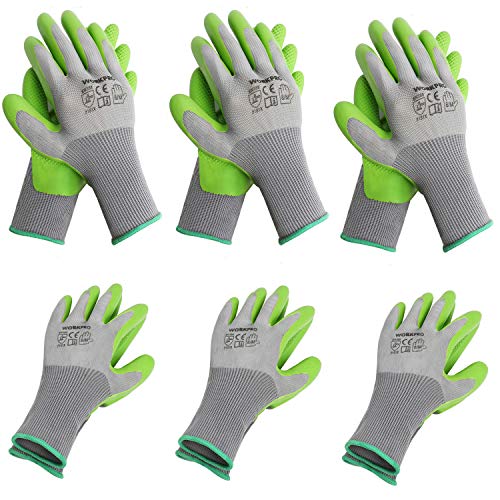
The WORKPRO set gives you six pairs of knit gloves with an eco latex coating on the palm and fingers and a breathable, stretchable polyester back. The coating adds grip and abrasion resistance for weeding, planting, raking and light carrying, while the knit back lets air through so hands do not sweat as much. A multi-pack means you can keep a pair by the door, one in the shed and one in the car.

The tradeoff is thorn and puncture protection. A thin latex coat resists abrasion, but a rose cane or a sharp thistle can still pass through, and the knit back offers little cut resistance. Compared with the HANDLANDY pigskin gloves, which have a long leather cuff, the WORKPRO is lighter and cooler but not suited to pruning brambles. It suits gardeners who value dexterity and a clean pair every week.

Wash them in cool water and air dry, because heat can crack the coating. Rotate pairs so they dry fully between uses, and retire a pair when the latex wears through at the fingertips or the knit thins out.

What works

  • Six pairs mean a clean, dry glove is always available
  • Latex palm gives grip for wet soil and tools
  • Stretch polyester back keeps hands cooler on hot days
  • Light, flexible knit allows fine work like seed sowing

Watch out for

  • Thin coating gives little protection against thorns
  • Latex can crack with heat and wear through at the fingertips

Specs

Quantity
Six pairs
Palm coating
Eco latex
Back
Breathable stretch polyester
Fit
Men and women sizing options
Strengths
Abrasion resistance and flexibility
02
COOLJOB 6-Pair Women's Rubber Coated Gardening Gloves
6 pairsWomen's fitFoamed latexKnit base
Check price on Amazon
Best for: Gardeners with smaller hands who want a snug, breathable multi-pack.

COOLJOB's six-pair set is designed for women's hands, with a lightweight breathable knit base and a foamed latex coating that the listing says reduces fatigue and grips well. A smaller cut avoids the baggy fingertips that make fine tasks awkward, and the multiple colours help you tell pairs apart.

The tradeoff is the same as other coated knit gloves: limited protection from thorns and sharp tools. Compared with the WORKPRO, which comes in both men's and women's sizing, the COOLJOB is aimed squarely at smaller hands, so the fit is better for many women but not for larger hands. The foamed latex is flexible and gripping but wears at the fingertips with heavy use.

Hand wash in cool water, air dry flat, and avoid hot dryers that crack the coating. Replace pairs when the fingertips thin out.

What works

  • Cut for women's hands, so fingertips are not baggy
  • Foamed latex coating gives grip and cushions the palm
  • Breathable knit base keeps hands comfortable in warm weather
  • Six pairs in different colours are easy to tell apart

Watch out for

  • Limited protection from thorns, glass and sharp tools
  • Fingertips wear first with heavy digging

Specs

Quantity
Six pairs
Fit
Designed for women's hands
Coating
Foamed latex palm
Base
Lightweight breathable knit
Grip
Non-slip palm
03
Bamllum Microfiber Leather Gardening Gloves for Women
Microfiber leatherBreathable backElastic wristWomen's fit
Check price on Amazon
Best for: Women gardeners who want a durable, close-fitting glove for varied tasks.

The Bamllum gloves use microfiber leather on the palm for abrasion resistance, with a breathable fabric back, an elastic wrist and a close fit sized for women. The listing positions them for weeding, digging, planting, raking and pruning, and the leather feel gives more durability than a thin coating.

The tradeoff is that microfiber leather is a synthetic that resists scratches but not as well as real leather or a long cuff. It protects against scrapes and light thorns but not against dense brambles. Compared with the COOLJOB coated knit, the Bamllum lasts longer in rough use but is a little warmer and less supple. It suits gardeners who want a durable, close-fitting glove for general tasks.

Wipe clean or hand wash gently, air dry away from heat, and check seams where the palm meets the fingers. Retire the glove when the palm wears through.

What works

  • Microfiber leather palm resists abrasion longer than thin coatings
  • Breathable back panel keeps hands from overheating
  • Elastic wrist keeps soil and debris out
  • Close fit gives good control for pruning and planting

Watch out for

  • Not suited to dense thorns or heavy brambles
  • Warmer and less supple than thin coated knit gloves

Specs

Palm material
Microfiber leather
Back
Breathable fabric
Wrist
Elastic closure
Fit
Close-fitting for women
Tasks
Weeding, digging, planting, raking, pruning
04
WZQH Split Cowhide Leather Work Gloves
Split cowhideCotton liningHeavy dutyMulti-task
Check price on Amazon
Best for: Heavy digging, hauling, fencing and farm work where durability matters.

The WZQH gloves are made from 100 percent split cowhide with a soft cotton lining, and are marketed for garden work, welding, construction, farm and ranch tasks. Split cowhide is tougher than synthetic coatings and shrugs off splinters, rough stone and general abrasion, which is why leather is the traditional choice for heavy jobs.

The tradeoff is dexterity and heat. Leather gloves are stiffer, especially when new, and hold heat and sweat on warm days. Compared with the WORKPRO knit, the WZQH is far more protective but harder to do fine work in, so it suits digging, hauling and fence work more than seed sowing. Wet leather also dries stiff if not treated.

Break them in with a few hours of use, let them dry naturally if wet and apply a leather conditioner now and then. Replace them when the palm wears through or the seams open.

What works

  • Split cowhide stands up to rough stone, splinters and wire
  • Cotton lining adds comfort against the skin
  • Versatile enough for garden, farm and construction jobs
  • Lasts longer than coated knit gloves under hard use

Watch out for

  • Stiff when new and less suited to fine tasks
  • Holds heat and sweat on warm days

Specs

Material
100 percent split cowhide leather
Lining
Soft cotton fibres
Weight class
Heavy duty
Tasks
Garden, welding, construction, farm
Sizing
Men or women, size options
05
HANDLANDY Pigskin Rose Pruning Gloves with Long Cuff
Pigskin leatherLong gauntlet cuffThorn resistantBreathable
Check price on Amazon
Best for: Rose pruning, bramble clearing and any thorny cutting job.

The HANDLANDY gloves are built for roses and brambles: premium pigskin on the palm and back for wear and puncture resistance, plus an elbow-length synthetic leather gauntlet that guards the forearm. The listing notes that pigskin is the most breathable of the common leathers because of its porous hide.

The tradeoff is bulk and dexterity. A long cuff blocks thorns but adds warmth and limits wrist movement, and leather is less nimble than knit. Compared with the COOLJOB thorn-proof glove, the HANDLANDY uses real pigskin rather than faux suede, which usually lasts longer but costs more. It suits anyone who regularly prunes roses, blackberries or other thorny plants.

Condition the leather occasionally and let it dry naturally if it gets wet. Check the cuff seams and replace the gloves when thorns begin to penetrate the palm.

What works

  • Elbow-length cuff protects forearms from thorns and scratches
  • Pigskin is breathable and durable for hard use
  • Puncture-resistant palm handles thorny stems
  • Good grip for handling pruners and cut canes

Watch out for

  • Long cuff and leather limit dexterity and add warmth
  • Not suited to fine tasks like seed sowing

Specs

Material
Natural pigskin palm and back
Cuff
Elbow-length synthetic leather gauntlet
Protection
Puncture and scratch resistance
Breathability
Porous pigskin
Use
Rose pruning and brambles
06
COOLJOB Thorn-Proof Long Cuff Rose Pruning Gloves
Faux suedeLong cuffReinforced fingertipsPuncture resistant
Check price on Amazon
Best for: Occasional rose pruning at a gentler tier, with a long protective cuff.

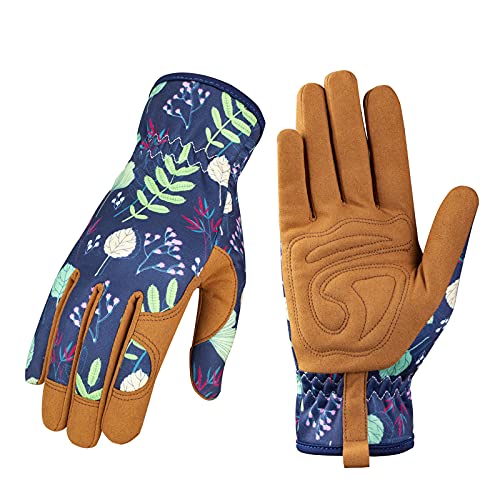
The COOLJOB thorn-proof glove is a long-sleeve design in faux suede with reinforced fingertips, meant to protect hands and forearms from rose thorns and brambles. It comes in a range of colours and patterns, and the listing stresses puncture resistance and comfort for long pruning sessions.

The tradeoff is material. Faux suede is lighter and cheaper than pigskin but does not last as long under heavy use, and it can wear through at the palm in a season of hard pruning. Compared with the HANDLANDY, the COOLJOB is more affordable and available in more styles, but less durable. It suits gardeners who prune thorny plants occasionally.

Wipe clean and air dry, avoid soaking, and check the fingertips for wear. Replace them when thorns begin to get through.

What works

  • Long cuff protects forearms from thorns
  • Reinforced fingertips resist punctures where they hit first
  • Available in many colours and prints
  • Light and cheaper than leather alternatives

Watch out for

  • Faux suede wears faster than real pigskin or cowhide
  • Thorns can eventually penetrate with heavy use

Specs

Material
100 percent faux suede
Cuff
Long sleeve, forearm protection
Reinforcement
Reinforced fingertips
Protection
Thorn and puncture resistant
Styles
Floral prints and solid colours

Spec decoder

What the listing measurements really mean

The numbers brands lead with, translated into what they tell you about fit, comfort and wear at home.

Palm coating

A thin layer of latex, foam or nitrile that adds grip and some abrasion resistance. It does not stop thorns.

Watch forThe WORKPRO uses eco latex and the COOLJOB uses foamed latex, both thin coatings.

Leather type

Split cowhide is tough and stiff, pigskin is breathable and supple, and microfiber leather is synthetic and lighter.

Watch forThe WZQH uses split cowhide, the HANDLANDY uses pigskin and the Bamllum uses microfiber.

Cuff length

The extension past the wrist, from a short knit cuff to an elbow-length gauntlet. Longer cuffs protect more skin.

Watch forThe HANDLANDY has an elbow-length gauntlet, and the WORKPRO has a short knit cuff.

Breathable back

A knit or spandex panel on the back of the hand lets air through to reduce sweat.

Watch forThe WORKPRO and Bamllum both list breathable backs.

Pack count

How many pairs come in the box, which changes the value and how often you wash them.

Watch forThe WORKPRO and COOLJOB women's set each include six pairs.

Methodology

How We Evaluated These Gardening Gloves

Protection level

We compared materials and cuff length from published specifications. Leather and long gauntlets scored best for thorns, while coated knit scored best for dexterity. We did not treat any garden glove as cut-rated.

Fit and dexterity

We looked at sizing options and the material's flexibility. The COOLJOB's women's cut and the WORKPRO's knit allow fine work. Stiff leather was noted for reduced dexterity.

Breathability and comfort

We considered backing material and lining, using owner feedback patterns on sweat and heat. Knit backs and pigskin breathe well. Heavy leather and rubber coating were noted for heat.

Durability

We researched how each material wears, with latex coatings wearing at the fingertips and leather lasting longer. The WZQH and HANDLANDY scored well for life. Thin coated gloves were judged as consumables.

Value and pack size

We asked how many pairs and what material each purchase delivers. A six-pair pack gives a clean pair for each task. Single leather pairs were judged on lifespan.

Decision guide

How to Choose the Right Gardening Gloves

By Task

SituationPickWhy
Weeding, planting, general yard workWORKPRO 6-PairBreathable knit with latex grip
Smaller handsCOOLJOB 6-Pair Women'sCut for women's fit
Digging, hauling and fencingWZQH Split CowhideHeavy-duty leather
Rose pruning and bramblesHANDLANDY Pigskin Long CuffElbow-length gauntlet
Light thorn work at a gentle tierCOOLJOB Thorn-ProofLong cuff in faux suede

By Budget

SituationPickWhy
Lowest cost entryWORKPRO 6-PairSix pairs at an entry tier
Mid-range women'sCOOLJOB 6-Pair Women'sBetter fit for smaller hands
Mid-range leatherBamllum MicrofiberDurable close-fitting leather feel
Higher tier for heavy workWZQH Split CowhideYou pay for toughness

Knit vs Leather

Coated knit

A glove like the WORKPRO is light, cool and nimble, ideal for weeding and planting.

Leather

A glove like the WZQH or HANDLANDY is tough and protective, ideal for pruning, digging and fence work.

Own a pair of each: knit for fine work and leather for rough jobs.

By Season

SituationPickWhy
Hot summer weedingWORKPRO 6-PairBreathable stretch back
Spring bed preparationCOOLJOB 6-Pair Women'sLight, grippy and easy to wash
Autumn pruning and clearingHANDLANDY Pigskin Long CuffForearm protection for brambles
Winter fence repairWZQH Split CowhideTough leather for rough materials

For Rose Gardens Specifically

Look for

A long gauntlet cuff, thick leather and a snug fit at the fingertips. Faux suede is acceptable for light pruning.

In this comparison

The HANDLANDY gives the best protection, and the COOLJOB thorn-proof glove is a lighter option.

When to Spend More

Spend more if

You prune brambles, haul stone or garden daily. Leather gloves like the WZQH and HANDLANDY justify it.

Save if

You garden occasionally. A six-pair knit pack is plenty.

Ownership

Maintenance schedule

The upkeep that decides whether a piece still looks good in year five.

TaskIntervalWhy it matters
Wash coated knit glovesEvery 2 weeks of useSoil and sweat break down fibres and cause odour. Cool water and air drying protect the coating.
Condition leatherOnce or twice a seasonLeather dries and stiffens after getting wet. A little conditioner keeps it supple.
Dry naturallyAfter every wet useHeat cracks coatings and shrinks leather. Air dry away from direct heat.
Inspect fingertips and seamsMonthlyFingertips and seams wear first. Replace the glove before thorns or glass get through.
Rotate pairsEach useAlternating pairs lets each dry fully, which extends life and reduces odour.

FAQ

Frequently Asked Questions

Are leather gardening gloves better than coated ones?

For protection and durability, yes, but they are stiffer and hotter. Coated knit gloves give better dexterity and breathability for light work. Many gardeners keep one pair of each, using knit for seed sowing and weeding and leather for pruning, hauling and clearing brush, which also spreads the wear across both pairs.

How much should I spend on gardening gloves?

A multi-pack of knit gloves costs little and suits most tasks. Spend more for leather if you do heavy or thorny work. Buying a multi-pack of knit gloves and one good pair of leather gloves usually covers every job for less than buying several mid-priced pairs, and a spare pair means you never skip gloves because the first pair is wet.

How long do gardening gloves last?

Thin coated gloves may last a season or two, while leather can last several years with care. Fingertips and seams wear first. You can stretch the life of any pair by rinsing off soil, drying them away from direct heat, and not wearing coated gloves for tasks like pulling nails or carrying sharp edged rubble, which strips the coating quickly.

Do thorn-proof gloves really stop thorns?

They resist most rose thorns, but dense brambles or very long thorns can still penetrate with enough pressure. A long cuff helps protect the forearm. Wearing a long cuff over a sleeve also helps, and keeping branches at arm's length with a pole pruner reduces the amount of thorn contact in the first place.

Are latex gloves safe for people with allergies?

Not for latex-allergic users. Choose nitrile-coated or leather gloves, and check the label if you are unsure. Symptoms such as itching or redness after wearing gloves are a sign to stop and switch material, and anyone with a known sensitivity should check with a clinician before choosing coatings.

Can I use garden gloves for chemicals or sharp tools?

No. Garden gloves are not rated for pesticides, solvents or sharp blades, so use gloves designed for those hazards and follow the product label. For spraying, use gloves rated for the chemical named on the product label, and wash your hands after removing any glove, since residue can sit on the cuff.

Bottom line

The short version

Browse more gardening gloveson Amazon →
Brianna Cole, Lead Product Editor

About the author

Brianna Cole

Lead Product Editor, SenseiReview

Brianna Cole leads SenseiReview's buying guides, turning published specifications, documentation and owner feedback patterns into clear verdicts across home, tech, fitness, outdoor and DIY products.

More from Brianna →

Keep reading

Related guides