
Amazon affiliate links - we earn a commission.Affiliate disclosure

Buying guide · 13 min read · Updated 2026-11-26

Best Meat Grinders for Home Use (2026)

Six electric meat grinders for home use compared on rated power, grinder size, gears, throughput and sausage stuffing, from burgers to venison batches.

Brianna Cole, Lead Product EditorBy Brianna ColeLead Product Editor6 picks comparedSpec-sheet verified
Best Meat Grinders for Home Use

At a glance

Our top picks

Side by side

Spec comparison

PieceMotorThroughputPlatesPeak claim
LEM Products BigBite #8 Electric Meat Grinder, 0.5 HP StainlessBest OverallLEM Products BigBite #8 Electric Meat Grinder, 0.5 HP Stainless0.5 HPAbout 7 lb per minute, claimedThree platesn/a
Cuisinart Electric Meat Grinder, Stainless Steel, 300WBest ValueCuisinart Electric Meat Grinder, Stainless Steel, 300W300 WUp to 3 lb per minuteMedium and coarse metal platesn/a
Weston #12 Electric Meat Grinder and Sausage Stuffer, 750W 1 HPBest for Heavy UseWeston #12 Electric Meat Grinder and Sausage Stuffer, 750W 1 HP750 W, 1 HPAbout 4 lb per minuten/an/a
FOHERE Electric Meat Grinder, 500W Rated, 3 Plates, 3 Stuffing TubesBest Mid-Power SetFOHERE Electric Meat Grinder, 500W Rated, 3 Plates, 3 Stuffing Tubesn/an/a3 grinding plates3200 W max, marketing figure
Sinyder Electric Meat Grinder, Stainless Body, Metal Gears, 3000W MaxBest Simple ControlsSinyder Electric Meat Grinder, Stainless Body, Metal Gears, 3000W Maxn/an/a2 stainless sizes3000 W max marketing figure
AAOBOSI Electric Meat Grinder, 3 Speed Touch Screen, 4 lb/min, Auto-ReverseBest Touch-Screen SetAAOBOSI Electric Meat Grinder, 3 Speed Touch Screen, 4 lb/min, Auto-Reversen/a4 lb per minute, claimedn/a3000 W max marketing figure

Grinding meat at home gives you control over the cut, the fat ratio and the freshness, which is why a home grinder pays for itself for anyone who makes burgers, sausage or ground venison. A good grinder cuts the meat cleanly, which is the main reason homemade burgers taste better.

Home grinders vary mainly in motor power, head size and how long they run before they bog down. Listings quote enormous peak wattages that mean little, so the six grinders below are compared on rated power, size number, gears and what they actually make easy.

Before you buy

6 Criteria to Look For Before Buying a Meat Grinder for Home Use

  1. 01

    Rated power, not peak watts

    Listings quote peak or locked-rotor wattage such as 2500, 3000 or 3200 watts, but sustained power is the rated figure, usually 300 to 750 watts. The Cuisinart lists 300 W, the FOHERE 500 W and the Weston 750 W or 1 HP. The LEM lists 0.5 HP, which is about 370 watts. Buyers who shop by peak watts end up comparing marketing numbers.

  2. 02

    Grinder size number

    The numbers #5, #8 and #12 refer to the head and plate size, and larger numbers move meat faster. Most home machines are #5 or #8, and #12 suits heavier work. The LEM is #8 and the Weston is #12. A bigger head costs more and needs more space, so size it to your batches.

  3. 03

    Gears and body

    Metal gears resist stripping on gristle and sinew, while plastic gears are cheaper and can wear. The Weston has metal gears in a die-cast aluminum body, and the Sinyder lists metal gears and a stainless body. Stainless parts that touch food are easier to keep clean.

  4. 04

    Throughput and batch size

    Claims range from 3 to about 7 pounds per minute, and real speed depends on chilled meat and the plate size. The Cuisinart claims 3 lb, the Weston and AAOBOSI about 4 lb and the LEM about 7 lb. Match throughput to the pounds you grind per session.

  5. 05

    Plates, blades and stuffing kit

    Plates set the grind coarseness, typically coarse for sausage and medium for burgers, and a stuffing kit adds sausage tubes. The LEM and FOHERE include three plates. A stuffing job runs better at a slow speed, which the Weston's two-speed design supports.

  6. 06

    Cleaning and rust care

    Meat grinders are a cleaning job because fat sets in the plates and blade. Carbon steel plates rust if left wet, so dry them and wipe with food-safe oil. Detachable parts and built-in storage help, but only hand washing and drying keep plates sharp.

Detailed reviews

The 6 best meat grinders for home use, explained

01
LEM Products BigBite #8 Electric Meat Grinder, 0.5 HP Stainless
#8 grinder0.5 HP motorAbout 7 lb/min claim3 plates
Check price on Amazon
Best for: Home cooks who make burgers and sausage in regular batches.

The LEM BigBite #8 is built like a small commercial grinder for the home kitchen, with a stainless steel build and a 0.5 horsepower motor. The #8 head is the size most home grinders use for regular batches, and the listing claims it processes about 7 pounds of meat per minute for burgers and sausage. It includes three plates, a knife, a stomper and stuffing tubes, so it is ready to use out of the box.

Compared with the Weston #12, the LEM is smaller and lighter, but it is easier to store and quieter, and it handles the family batches most home cooks make. Against the Cuisinart it has more than twice the claimed throughput and a stainless build, while the Cuisinart is a lighter tool for occasional use. The pace claim is a best case figure with chilled meat.

In ownership, chill the meat and parts before grinding so the fat does not smear, and clean and dry the plates right away to prevent rust. A light film of food-safe oil on the plate and knife helps. Replacement parts are widely sold. For a cook who makes sausage or buys primals in bulk, this is the most balanced machine.

What works

  • 0.5 HP motor handles regular family batches
  • Stainless build with three plates included
  • Claimed 7 lb per minute for fast work
  • Parts and accessories are widely sold

Watch out for

  • Heavier than the compact grinders
  • Throughput figure is a listing claim
  • Needs disciplined cleaning to avoid rust

Specs

Motor
0.5 HP
Size
#8
Throughput
About 7 lb per minute, claimed
Plates
Three plates
Includes
Knife, stomper and stuffing tubes
02
Cuisinart Electric Meat Grinder, Stainless Steel, 300W
300W motorUp to 3 lb/min2 metal plates34 in cord
Check price on Amazon
Best for: Occasional burger makers who want a simple, known-brand grinder.

The Cuisinart grinder is a mainstream, no-nonsense machine with a 300 watt motor that the listing says grinds up to 3 pounds of meat per minute. It comes with two metal cutting plates, medium and coarse, and a 34 inch cord, and it handles beef, chicken, turkey and venison in typical home quantities.

Compared with the LEM BigBite, the Cuisinart is smaller and cheaper, with less than half the claimed throughput, so it suits a couple of pounds of burgers rather than a deer. Against the Sinyder it has a more straightforward rated power figure and a known brand, while the Sinyder advertises a peak wattage number that means little. Some owners report that the head lock can feel loose, so check the fit each time.

To get good results, cut meat into small cubes, chill it until firm and grind in short bursts. Wash the metal parts by hand, dry them completely and oil them lightly. If you grind occasionally and want a trusted name and simple parts, this is a sensible and fair-priced choice.

What works

  • 300 W motor handles typical burger batches
  • Medium and coarse metal plates included
  • Known brand with straightforward ratings
  • Compact size stores in a cabinet

Watch out for

  • Lower throughput than the larger grinders
  • Head lock can feel loose to some owners
  • Only two plates, no sausage-stuffing set

Specs

Motor
300 W
Throughput
Up to 3 lb per minute
Plates
Medium and coarse metal plates
Cord
34 in
Meats
Beef, chicken, turkey, venison
03
Weston #12 Electric Meat Grinder and Sausage Stuffer, 750W 1 HP
#12 grinder750 W, 1 HPAbout 4 lb/minMetal gears
Check price on Amazon
Best for: Hunters and sausage makers who grind large batches regularly.

The Weston #12 is the heaviest-duty grinder here, with a 750 watt, 1 horsepower motor, a #12 head and metal gears inside a die-cast aluminum body. It has two speeds and a reverse, and the slow first speed is meant for stuffing sausages, while the second speed does the grinding. The listing gives about 4 pounds per minute, which is a more modest and believable figure than some rivals.

Compared with the LEM #8, the Weston has a larger head and a stronger motor, so it handles large volumes like deer processing with less strain. The tradeoff is size and weight, since it needs counter space and a firm grip to move. Against the AAOBOSI it lacks a touch screen but has metal gears and a cam action headlock that clamps the head securely.

Use it for large jobs: chill the meat, cube it and feed it steadily. Hand wash the head, plates and knife and dry them thoroughly. The cam headlock makes assembly quick, and metal gears resist stripping on gristle. For hunters and sausage makers who process pounds at a time, this is the right tool.

What works

  • 750 W, 1 HP motor for heavy batches
  • Metal gears resist stripping on gristle
  • Two speeds plus reverse for stuffing and grinding
  • Cam action headlock locks the head firmly

Watch out for

  • Bulky and heavy for small kitchens
  • Overkill for a couple of burgers
  • Needs counter space and a firm grip to move

Specs

Motor
750 W, 1 HP
Size
#12
Throughput
About 4 lb per minute
Speeds
2 speeds plus reverse
Build
Die-cast aluminum, metal gears, cam action headlock
04
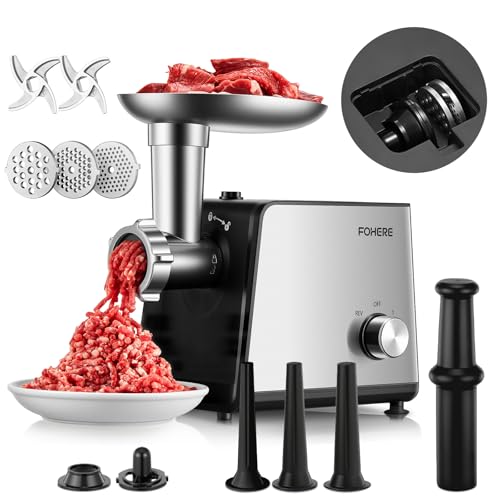
FOHERE Electric Meat Grinder, 500W Rated, 3 Plates, 3 Stuffing Tubes
500 W ratedCopper motor claim3 plates3 sausage tubes
Check price on Amazon
Best for: Cooks who want a full accessory set for burgers and sausage at a modest cost.

The FOHERE grinder lists a 500 watt rated motor, which is the figure to trust, alongside a 3200 watt max claim that is a peak number and not a working power. It ships with two blades, three grinding plates and three sausage tubes, and an on-board compartment keeps the accessories tidy. The listing describes a pure copper motor, a claim that is common at this tier.

Compared with the Cuisinart's 300 watts, the FOHERE has more rated power and more accessories, but it is a lesser-known brand with less established spare parts. Against the LEM, it offers a lower motor power and lighter build at a smaller outlay. The detachable parts are described as easy to clean, which matters because meat grinders are a cleaning chore.

Treat it as a home-use machine for burgers and a few batches of sausage, and keep the batches modest. Chill the meat first, hand wash the metal parts and dry them, and use the stuffing tubes at the slower setting. If you want a lot of accessories at a low cost, it is a fair pick as long as you ignore the peak wattage number.

What works

  • 500 W rated motor is a real working figure
  • Three plates and three stuffing tubes included
  • Built-in storage keeps parts together
  • Detachable parts clean easily

Watch out for

  • 3200 W max is a peak claim, not working power
  • Lesser-known brand with fewer spare parts
  • Not built for large venison jobs

Specs

Rated power
500 W
Peak claim
3200 W max, marketing figure
Plates
3 grinding plates
Accessories
2 blades, 3 sausage tubes
Storage
Built-in accessory storage
05
Sinyder Electric Meat Grinder, Stainless Body, Metal Gears, 3000W Max
Stainless bodyMetal gearsOne-button control2 plates
Check price on Amazon
Best for: Cooks who want metal gears and a simple one-button machine.

The Sinyder is a stainless steel bodied grinder with metal gears, which is the feature that matters for gristle and fat. A single button handles on, off and hold, and the listing advertises a 3000 watt max output, a peak claim that tells you little about sustained power. Two stainless plates cover coarse and medium grinds.

Compared with the FOHERE, the Sinyder uses metal gears and a stainless body, but it offers fewer accessories. Against the Cuisinart it has a bolder power claim, though the Cuisinart's 300 watts is the more honest figure. If you mostly grind chicken, pork and beef trimmings for burgers and meatballs, either will work.

Grind in small amounts, keep the meat very cold and clean the parts the moment you finish, since fat sets in the plates. Oil the metal parts lightly before storing. The one-button control is easy to learn, but there is no reverse button, so a jam means turning it off and clearing it by hand. For people who want metal gears and a simple control at a mid-low cost, it is a reasonable choice.

What works

  • Stainless body with metal gears
  • One-button on, off and hold control
  • Two stainless plates for medium and coarse
  • Compact enough for a cabinet

Watch out for

  • 3000 W max is a peak claim only
  • Fewer accessories than the bundle sets
  • Jams need clearing by hand

Specs

Body
Stainless steel
Gears
Metal
Controls
On, off and hold button
Peak claim
3000 W max marketing figure
Plates
2 stainless sizes
06
AAOBOSI Electric Meat Grinder, 3 Speed Touch Screen, 4 lb/min, Auto-Reverse
Touch screen3 speeds4 lb/min claimAuto-reverse
Check price on Amazon
Best for: Cooks who want speed settings and auto-reverse on a tidy countertop unit.

The AAOBOSI trades traditional buttons for a touch screen with three speed settings and an auto-reverse function that clears jams for you. The listing claims 4 pounds per minute, and a built-in storage compartment keeps plates and tubes tidy. The 3000 watt max is again a peak claim, so judge it by the throughput claim instead.

Compared with the Weston #12, which has a similar claimed 4 pounds per minute, the AAOBOSI adds the screen and the auto-reverse but lacks the Weston's metal gears and #12 head. Against the Sinyder it adds speed settings and a reverse, which helps with sinew and fatty trim. It is a tidy, modern-looking machine for a countertop that stays out.

Touch controls need dry hands, so wipe your hands before reaching for them, and keep the screen away from raw meat. Chill and cube the meat, wash the metal parts by hand and dry them thoroughly. For someone who values features like auto-reverse over raw durability, it is a good fit, but expect it to be a lighter-duty machine than the LEM or the Weston.

What works

  • Auto-reverse clears jams automatically
  • Three speeds suit grinding and stuffing
  • Built-in storage keeps parts together
  • Claimed 4 lb per minute is a believable rate

Watch out for

  • Touch screen near raw meat needs care
  • Lighter duty than the LEM or the Weston
  • 3000 W figure is a peak marketing claim

Specs

Controls
Touch screen, 3 speeds
Throughput
4 lb per minute, claimed
Safety
Auto-reverse function
Peak claim
3000 W max marketing figure
Storage
Built-in accessory storage

Spec decoder

What the listing measurements really mean

The numbers brands lead with, translated into what they tell you about fit, comfort and wear at home.

Rated power versus max locked power

Rated power is what the motor sustains. Max locked power is a short peak under a stall and says little about grinding.

Watch forThe FOHERE lists 500 W rated and 3200 W max, and the Sinyder lists only a 3000 W max.

Horsepower

A motor power unit, where 1 HP is about 746 watts. Bigger numbers mean more torque for dense meat.

Watch forThe LEM lists 0.5 HP and the Weston lists 1 HP.

Grinder size (#5, #8, #12)

The nominal size of the head and plates. Larger heads feed more meat per minute.

Watch forThe LEM is #8 and the Weston is #12.

Auto-reverse

A function that runs the auger backward to clear a jam. It saves you from stopping and clearing by hand.

Watch forThe AAOBOSI lists auto-reverse, while the Weston has a manual reverse switch.

Throughput

Pounds of ground meat per minute under ideal conditions. Chilled, cubed meat gives the best rate.

Watch forThe LEM claims about 7 lb and the Cuisinart claims up to 3 lb.

Methodology

How We Evaluated These Meat Grinders for Home Use

Motor and power

We compared rated power and horsepower and discounted peak watt claims. The Weston 1 HP and the LEM 0.5 HP were credited for real ratings. The Cuisinart 300 W was judged for occasional use.

Build and gears

We looked at gear material, body and head lock design. The Weston metal gears and cam headlock and the Sinyder metal gears earned credit. Plastic parts lost points.

Throughput and size

We compared grinder size numbers and claimed pounds per minute. The LEM #8 and Weston #12 lead on speed. Smaller units were judged on batch size.

Accessories and features

We counted plates, stuffing tubes, reverse and storage. The FOHERE and LEM ship full sets. The AAOBOSI auto-reverse was credited.

Ownership and cleaning

We weighed owner feedback patterns on jams, head locks and rust. Stainless parts and metal gears earned credit. A loose head lock noted on some units cost points.

Decision guide

How to Choose the Right Meat Grinders for Home Use

By Batch Size

SituationPickWhy
A couple of pounds of burgersCuisinart300 W, compact
Regular family batchesLEM BigBite #80.5 HP, #8 head
Large venison jobsWeston #121 HP, #12 head
Sausage plus burgersFOHERE3 plates, 3 tubes
Quick ground meat with featuresAAOBOSISpeeds and auto-reverse

By Budget

SituationPickWhy
Lowest tierSinyderMetal gears at a low tier
Low tier setFOHEREFull accessory kit
Middle tier known brandCuisinartTrusted name
Middle-upper featuresAAOBOSIScreen and auto-reverse
Top tier powerLEM or WestonReal motor ratings

#8 vs #12 Grinder

#8 (LEM)

Fits most home kitchens, grinds family batches quickly and is easier to store.

#12 (Weston)

Handles larger volumes with a stronger motor. Heavy and needs counter space.

Choose the #8 for regular home use; choose the #12 only if you process large amounts of meat.

By Control and Features

SituationPickWhy
Jam clearingAAOBOSIAuto-reverse
Manual reverse and 2 speedsWeston #12Slow speed for stuffing
Simplest controlSinyderOne button on, off, hold
Built-in storageFOHEREOn-board accessory space
Heavy-duty feelLEM BigBite #8Stainless build

For Venison and Game Specifically

Look for

A strong motor, metal gears, a #8 or #12 head and a reverse for sinew, with plates you can keep sharp.

In this comparison

The Weston #12 for large volumes, and the LEM BigBite #8 for smaller batches.

When to Spend More

Spend more if

You grind pounds of meat regularly, make sausage or process game. The LEM and Weston have the motors and parts to last.

Save if

You grind a few pounds a month, because the Cuisinart or the Sinyder will manage burgers.

Ownership

Maintenance schedule

The upkeep that decides whether a piece still looks good in year five.

TaskIntervalWhy it matters
Chill meat and partsBefore each useNear-frozen meat and cold parts cut cleanly. Warm fat smears and clogs the plate.
Hand wash and dryAfter each useFat and meat set in the plate holes. Drying prevents rust.
Oil metal partsAfter washingA thin film of food-safe oil protects plates and the knife from rust during storage.
Sharpen or replace the knifeYearly with regular useA dull knife smears the meat. A sharp pair of knife and plate gives cleaner grinds.
Check the head lockMonthlyA loose head lets the auger shift. Tighten or replace worn locks.

FAQ

Frequently Asked Questions

Do I need a #12 grinder?

Not for most home use. A #8 handles burgers and sausage batches, while a #12 suits large volumes like venison.

What do the max watt numbers mean?

They are peak figures under stall and do not describe working power. Look for rated watts or horsepower.

Why is my ground meat mushy?

The meat or parts were too warm, or the knife and plate were dull. Chill everything and sharpen the knife.

Can I grind bones?

No, most home grinders are not rated for bones. Check the manual and trim bones off.

Is a stand mixer attachment enough?

For small, occasional batches, yes. A dedicated grinder is faster and handles larger volumes.

Can I put the parts in the dishwasher?

Avoid it. Dishwashers can dull plates and corrode aluminum, so hand wash and dry them.

Bottom line

The short version

Browse more meat grinders for home useon Amazon →
Brianna Cole, Lead Product Editor

About the author

Brianna Cole

Lead Product Editor, SenseiReview

Brianna Cole leads SenseiReview's buying guides, turning published specifications, documentation and owner feedback patterns into clear verdicts across home, tech, fitness, outdoor and DIY products.

More from Brianna →

Keep reading

Related guides