
Amazon affiliate links - we earn a commission.Affiliate disclosure

Buying guide · 12 min read · Updated 2026-11-21

Best Reciprocating Saws (2026)

Six cordless reciprocating saws compared on one handed compact design, stroke length, brushless motors, pivoting shoe, blade change and runtime.

Brianna Cole, Lead Product EditorBy Brianna ColeLead Product Editor6 picks comparedSpec-sheet verified
Best Reciprocating Saws

At a glance

Our top picks

Side by side

Spec comparison

A reciprocating saw drives a long blade back and forth to cut wood, nails, pipe and metal in rough situations such as demolition, pruning and plumbing repairs. It is the tool you reach for when a circular saw cannot get into the space.

The split in the category is between compact one handed saws and full size two handed saws, with stroke length, motor type and battery system as the key features. We evaluated six models from the candidate pool using spec sheets, listing details and owner feedback patterns, then ranked them by fit for common jobs. Many cordless listings are bare tools, so check the battery cost.

Before you buy

6 Criteria to Look For Before Buying a Reciprocating Saw

  1. 01

    Compact versus full size

    Compact one handed saws like the DCS369B and Hackzall fit between studs and weigh little, but their strokes are shorter. Full size saws like the DCS380B remove material faster and cost less. Choose compact for tight work and full size for demolition. The usual buyer mistake is choosing a compact saw for heavy demolition and then wondering why it stalls in thick lumber.

  2. 02

    Stroke length and speed

    Stroke length is how far the blade travels, such as 1-1/8 inches on the DCS380B or 1 inch on the RYOBI. Strokes per minute is how fast it moves, up to 3,000 or 3,400. A longer stroke cuts more per pass, and a high speed helps in wood. Think about the blades you will use, because a good blade matters more than a few extra volts of power.

  3. 03

    Brushless motor and runtime

    Brushless saws like the ATOMIC and XR run cooler and longer per charge than brushed saws. The XR listing claims up to 2.5 times more runtime, a maker figure. See our guide on brushed versus brushless motors. Look for a saw with a metal shoe, since plastic shoes wear quickly when pressed against rough surfaces.

  4. 04

    Blade change and shoe

    A tool free blade clamp saves time, and a four position clamp allows flush cuts. A pivoting shoe controls depth and spreads wear across the blade. Check that the clamp holds firmly. Check how well the saw balances with a battery fitted, as a top heavy tool tires the wrist on long cuts.

  5. 05

    Battery platform

    Choose a platform you already own, since batteries are costly. DEWALT 20V MAX, Milwaukee M18, RYOBI ONE+ and BLACK+DECKER 20V MAX are popular. A larger battery gives more runtime and some extra weight. See our guide on battery voltage and amp hours. Consider how the vibration feels in your hand, because a saw that numbs your grip is slower to use for long periods.

  6. 06

    Vibration, weight and safety

    A reciprocating saw vibrates and can kick, so use both hands where you can and keep the shoe on the work. A lighter saw is easier to hold overhead. Use blades matched to the material and eye protection. Variable speed triggers are worth having, since starting slowly helps you set a cut without the blade skipping.

Detailed reviews

The 6 best reciprocating saws, explained

01
DEWALT ATOMIC 20V MAX reciprocating saw DCS369B, one handed, brushless, 12.5 inch
12.5 in longBrushless motorOne handedTool only
Check price on Amazon
Best for: Tight spaces, overhead work and repair jobs.

The ATOMIC DCS369B is a compact, brushless reciprocating saw that measures 12.5 inches front to back and is described as 37 percent lighter than DEWALT's DCS367 model. It is built for one handed use in awkward spots, though a two handed grip is safer for hard cuts.

A short, light saw reaches between studs and works above your head with less fatigue. The tradeoff is a shorter stroke and less aggressive cutting than a full size saw, so it removes material more slowly. Against the DCS380B, it is smaller and brushless. Against the Milwaukee Hackzall, it competes in the compact class.

Use the right blade for the material and let the saw do the work. Keep the shoe pressed against the surface for control. Owners who use it for plumbing and electrical rough in work say the short body is the feature that earns its place in the tool bag, since a full size saw will not fit between joists.

What works

  • 12.5 inch body fits between studs and in tight spaces
  • Brushless motor boosts runtime
  • Light enough for overhead cutting
  • Uses 20V MAX batteries shared with other tools

Watch out for

  • Shorter stroke cuts slower than a full size saw
  • Tool only means batteries are extra
  • Less suitable for heavy demolition

Specs

Length
12.5 inches front to back
Motor
Brushless
Weight
37 percent lighter than the DCS367 per the listing
Platform
DEWALT 20V MAX
Best for
Tight spaces and overhead work
02
DEWALT 20V MAX XR brushless reciprocating saw, compact, pivoting head, LED light, tool only
14.5 in longBrushlessPivoting headLED light
Check price on Amazon
Best for: General remodelling where runtime and control matter.

This DEWALT XR saw is 14.5 inches long and weighs about 5 lb as a bare tool, with a brushless motor, a pivoting head and an LED light. The listing claims up to 2.5 times more runtime than a brushed version, which is a manufacturer figure.

A slightly longer body than the ATOMIC gives more leverage and a bit more cutting power. A pivoting head allows flush cuts and different blade angles, and the LED helps in dark crawl spaces. Against the DCS369B, it is bigger and more capable. Against the Milwaukee Hackzall, it is a more conventional shape.

Check the blade clamp and keep the shoe adjusted. Remove the battery when changing blades. The pivoting head also lets you rotate the blade for cuts close to a wall, which a fixed head cannot reach without a different blade.

What works

  • Brushless motor with a stated runtime gain
  • Pivoting head allows flush cutting
  • LED light helps in dark spaces
  • About 5 lb is light for a full function saw

Watch out for

  • Bare tool means batteries are extra
  • Upper price tier compared with brushed saws
  • Runtime claims assume ideal use

Specs

Length
14.5 inches
Weight
About 5 lb tool only
Runtime
Up to 2.5x per the listing
Features
Pivoting head, LED light
Best for
Longer sessions in tight spots
03
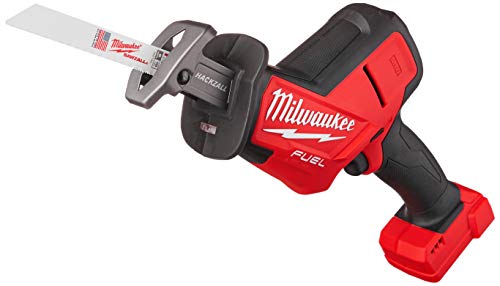
Milwaukee 2719-20 M18 FUEL Hackzall reciprocating saw, bare tool
M18 FUELPOWERSTATE motorREDLINK PlusBare tool
Check price on Amazon
Best for: Contractors and M18 owners who need a compact pro saw.

The Hackzall is Milwaukee's compact, one handed reciprocating saw, sold as a bare tool with a POWERSTATE brushless motor and REDLINK Plus electronics that protect the tool from overload. It is designed for demolition, plumbing and electrical work in tight spaces.

The electronics adjust power to prevent stalling and overheating, which helps in demanding work. It costs more than the DEWALT and Black and Decker saws, and it makes sense mainly for M18 owners or professionals. Against the DCS369B, it targets heavier use.

Hold it with both hands whenever possible and keep the shoe on the work. Keep the vents clear. Because the tool is a bare unit, many contractors pair it with a mid sized battery so the saw stays light for long overhead work.

What works

  • POWERSTATE brushless motor is built for hard use
  • REDLINK Plus protects against overload
  • Compact one handed design
  • M18 battery system has wide range

Watch out for

  • Upper price tier
  • Bare tool means batteries are extra
  • Less value without M18 batteries

Specs

Platform
Milwaukee M18 FUEL
Motor
POWERSTATE brushless
Electronics
REDLINK Plus intelligence
Battery
REDLITHIUM
Best for
Contractors and M18 owners
04
DEWALT 20V MAX reciprocating saw DCS380B, 3,000 strokes per minute, tool only
3,000 SPM1-1/8 in stroke4 position clampTool only
Check price on Amazon
Best for: General demolition and framing cuts at a modest tier.

The DCS380B is a full size cordless reciprocating saw with a 1-1/8 inch stroke, up to 3,000 strokes per minute, a four position blade clamp and a pivoting adjustable shoe. A rubber overmolded grip adds comfort.

A longer stroke removes more material per pass, which helps in framing and pipe. The four position clamp allows flush cutting by flipping the blade. It is a brushed saw, so runtime and motor life are lower than the brushless saws. Against the DCS369B, it is bigger and cheaper but heavier.

Use the shoe for control and keep the blades sharp. Clean dust from the vents. A longer stroke does most of its work in thick framing and green wood, where compact saws tend to stall and chatter.

What works

  • 1-1/8 inch stroke removes material quickly
  • 4 position blade clamp for flush cuts
  • Pivoting shoe extends blade life
  • Shares 20V MAX batteries

Watch out for

  • Brushed motor is less efficient
  • Bigger and heavier than compact saws
  • Tool only means batteries are extra

Specs

Stroke speed
0 to 3,000 per minute
Stroke length
1-1/8 inch
Blade clamp
4 position, tool free
Shoe
Pivoting adjustable
Best for
General demolition and cutting
05
RYOBI ONE+ 18V cordless reciprocating saw, 3,400 SPM, 1 inch stroke, tool only
3,400 SPM1 in stroke18V ONE+Tool only
Check price on Amazon
Best for: Occasional DIY on the affordable RYOBI platform.

The RYOBI ONE+ saw runs at up to 3,400 strokes per minute with a 1 inch stroke on the 18V ONE+ platform, sold as a tool only. RYOBI's ONE+ system is among the most affordable and broadest for homeowners.

A 1 inch stroke is shorter than the DEWALT 1-1/8 inch, so cutting is slightly slower, though a high stroke speed compensates in wood. It suits occasional work such as pruning and light demolition. Against the DEWALT saws, it costs less and has a simpler build.

Check the blade clamp and keep the shoe adjusted. Charge the battery before use. If you already own other tools on this platform, the saw usually pays for itself in the first season by replacing hand saws for pruning.

What works

  • Up to 3,400 strokes per minute for fast cutting
  • Low price tier on a broad homeowner platform
  • Variable speed trigger
  • ONE+ batteries are shared with many tools

Watch out for

  • 1 inch stroke is shorter than premium saws
  • Battery not included
  • Built for lighter duty

Specs

Stroke speed
Up to 3,400 per minute
Stroke length
1 inch
Platform
RYOBI ONE+ 18V
Kit
Tool only, battery not included
Best for
Occasional DIY
06
BLACK+DECKER 20V MAX cordless reciprocating saw kit BDCR20C, tool free blade change
20V MAX kitTool free bladePivoting shoeVariable speed
Check price on Amazon
Best for: First time buyers who want a complete kit.

The BDCR20C is a kit with a battery and charger, a tool free blade change, a pivoting shoe and a variable speed trigger. It is aimed at homeowners who want to start cutting without buying a battery separately.

A complete kit is a strong value for a first saw, though the tool is lighter duty than the DEWALT and Milwaukee models. It is suitable for pruning, plastic pipe and light demolition. Against the RYOBI, it includes a battery. Against the DEWALT, it has less power.

Use sharp blades and avoid forcing the saw. Charge the battery before use. Treat the included battery as a starter pack and consider a second one if you plan to cut for more than a short time.

What works

  • Kit includes a battery and charger
  • Tool free blade change is quick
  • Pivoting shoe improves control
  • Low price tier

Watch out for

  • Lighter duty than premium saws
  • Shorter runtime on heavy cuts
  • Brushed motor

Specs

Kit
Saw, battery and charger
Blade change
Tool free
Shoe
Pivoting
Control
Variable speed trigger
Best for
First reciprocating saw

Spec decoder

What the listing measurements really mean

The numbers brands lead with, translated into what they tell you about fit, comfort and wear at home.

Stroke length

The distance the blade moves in each cycle. A longer stroke removes more material per cycle.

Watch forThe DCS380B lists 1-1/8 inches and the RYOBI 1 inch.

SPM

Strokes per minute, the number of blade cycles per minute.

Watch forThe RYOBI lists up to 3,400 and the DCS380B 3,000.

Pivoting shoe

A foot that rotates to rest against the work. It controls depth and improves stability.

Watch forMost saws here have one, but check that it locks securely.

Brushless motor

A motor without carbon brushes, more efficient and longer lived.

Watch forThe ATOMIC, XR and Hackzall are brushless.

Flush cut

A cut that lies against a surface, such as a pipe against a wall. It needs a blade clamp that can flip.

Watch forThe DCS380B has a four position clamp for it.

Methodology

How We Evaluated These Reciprocating Saws

Size and handling

We compared compact one handed saws with full size ones and weighed weight against cutting speed. We did not cut with any of the saws. Owner feedback patterns about vibration, clamp wear and battery runtime shaped our scores.

Cutting capacity

We looked at stroke lengths of 1 to 1-1/8 inches and speeds of 3,000 to 3,400 strokes per minute. Longer and faster scored higher for demolition. Where a saw was sold as a bare tool we treated the battery as part of the real price.

Motor and runtime

We considered brushless against brushed motors and claimed runtime gains. We treated maker claims as ideal figures. We compared stated stroke lengths and speeds as a rough guide to cutting character.

Features

We weighed pivoting shoes, tool free clamps and LED lights. Practical features scored higher. Weight was checked with the stated figure and compared across the six models. Where a listing mentions an LED light we noted it, since a light is useful in dark crawl spaces and under floors.

Ownership

We reviewed battery platform, blade clamp wear and owner feedback patterns about vibration. Established platforms scored higher. We weighed how many listings mention a pivoting shoe, a tool free clamp and an LED light. Owners of the compact saws often mention a trade off between size and power, which we weighed in every ranking.

Decision guide

How to Choose the Right Reciprocating Saws

By Job

SituationPickWhy
Tight spaces and overheadDEWALT ATOMIC12.5 inch compact body
General remodellingDEWALT XR brushlessPivoting head and LED
Heavy demolitionDEWALT DCS380B1-1/8 inch stroke
Trade useMilwaukee HackzallFUEL durability

By Budget

SituationPickWhy
Lowest tierBLACK+DECKER kitBattery included
Low tierRYOBI ONE+Bare tool on ONE+
Mid tierDEWALT DCS380BFull size
Upper tierATOMIC, XR or HackzallBrushless

Compact vs Full Size

Compact

The ATOMIC and Hackzall fit tight spots and are light, but their strokes are shorter.

Full size

The DCS380B and RYOBI cut faster but are heavier and harder to use overhead.

Choose compact for tight work and full size for demolition.

By Platform

SituationPickWhy
Own DEWALT 20VATOMIC or XRSame batteries
Own Milwaukee M18HackzallSame batteries
Own RYOBI ONE+RYOBI sawSame batteries
No platformBLACK+DECKER kitBattery included

For Demolition Specifically

Look for

A long stroke, a robust blade clamp, a pivoting shoe and a battery with enough capacity. Use blades designed for nail embedded wood.

In this comparison

The DCS380B has the long stroke, and the Hackzall has pro level durability.

When to Spend More

Spend more if

You work on jobs daily or need brushless runtime. The DEWALT XR and Hackzall are built for that.

Save if

You cut occasionally. The BLACK+DECKER kit or RYOBI are enough.

Ownership

Maintenance schedule

The upkeep that decides whether a piece still looks good in year five.

TaskIntervalWhy it matters
Replace bladesAs cuts slowA dull blade strains the motor and wanders. Choose a blade for the material. Spray a little oil on the blade clamp every season.
Clean the blade clampAfter each useDust and metal filings jam the clamp. Blow it out and check it locks. Check the pivot pin for play and tighten as needed.
Blow dust from ventsMonthlyDust overheats the motor. Use compressed air. Wipe the shoe to keep the surface smooth.
Check the shoe pivotEach seasonA loose pivot rattles and wears. Tighten it. Replace worn rubber boots that protect the gearbox.
Store batteries coolOff seasonHeat shortens battery life. Store at partial charge. Keep the vents free of sawdust and metal chips. Wipe the battery contacts with a dry cloth every few months, because dust and metal filings can cause intermittent power loss.

FAQ

Frequently Asked Questions

Compact or full size?

Compact saws like the DEWALT ATOMIC fit tight spots and weigh less. Full size saws like the DCS380B cut faster and suit heavy demolition. Many owners say a pack of mixed demolition and metal blades is the best accessory to buy with a reciprocating saw.

What blade should I use?

A coarse tooth blade for wood and demolition, a fine tooth blade for metal and pipe. Match the blade to the material. Let the shoe rest against the work to cut vibration and keep the blade from jumping.

Do I need brushless?

It gives more runtime and a longer motor life, which helps on a battery saw. For occasional use, brushed is fine. Pruning blades are coarse and quick, which is useful for branches and green wood.

How do I control a reciprocating saw?

Keep the shoe pressed against the work, use both hands and let the saw reach full speed before cutting. The shoe controls vibration and kick. Clamp small items before cutting, because a loose workpiece will vibrate and bind the blade.

Can it cut metal pipe?

Yes, with a metal cutting blade and slower speed. Check that the blade is rated for the pipe material. Wear eye protection and gloves, as the saw throws chips and the blade gets hot.

Are bare tools a good deal?

Only if you own batteries on the same platform. Otherwise add the cost of a battery and charger. Pull the trigger gently at the start of a cut, then increase speed as the blade bites. Keep spare blades in a labelled case so you can swap quickly between wood, metal and pruning work without wasting time.

Bottom line

The short version

Browse more reciprocating sawson Amazon →
Brianna Cole, Lead Product Editor

About the author

Brianna Cole

Lead Product Editor, SenseiReview

Brianna Cole leads SenseiReview's buying guides, turning published specifications, documentation and owner feedback patterns into clear verdicts across home, tech, fitness, outdoor and DIY products.

More from Brianna →

Keep reading

Related guides