
Amazon affiliate links - we earn a commission.Affiliate disclosure

Buying guide · 12 min read · Updated 2026-11-21

Best Respirators for Sanding (2026)

Seven respirators for sanding compared on N95, P100 and P2 filters, reusable versus disposable design and fit, with honest notes on seals and filters.

Brianna Cole, Lead Product EditorBy Brianna ColeLead Product Editor7 picks comparedSpec-sheet verified
Best Respirators for Sanding

At a glance

Our top picks

Side by side

Spec comparison

Sanding turns wood, drywall and old finishes into fine dust that hangs in the air and goes deep into the lungs. A proper respirator filters that dust, but only if it carries the right marking, fits your face and gets its filters replaced when they clog.

This guide compares disposable valved masks, reusable half-mask respirators with high-efficiency particulate filters and European dual-filter kits on filtration class, approval marking, fit and ongoing cost. We stay with published specifications and are clear about what each filter can and cannot do.

Before you buy

6 Criteria to Look For Before Buying a Respirator for Sanding

  1. 01

    Filter class

    N95 filters at least 95 percent of 0.3 micron non-oil particles and P100 filters at least 99.97 percent. For power sanding and heavy dust, P100 is the safer choice. For short hand sanding, an N95 is a common minimum. Start from the job. Light hand sanding of a small project is a different exposure from a weekend of power sanding a ceiling, and the respirator you choose should match the longer, dustier job if you do both. A mask that is fine for an hour of hand sanding is not necessarily fine for a day of drywall work.

  2. 02

    NIOSH or European mark

    NIOSH-approved respirators, such as the 3M models here, carry markings on the product itself. P2 filters on the AirGearPro and BEESAFETY kits are European classes, roughly comparable to N95 but not NIOSH approved. Check which standard applies where you work. Take fit as seriously as filter class. Try a few sizes if the maker offers them, and check the seal with the mask on and your head turned side to side. If you feel air at the edge, adjust the straps, change size or try another model.

  3. 03

    Reusable or disposable

    Disposable masks are cheap and quick but seal less well. Reusable half masks seal better and cost less over time because you replace only filters. Choose by how often you sand. Consider the rest of the setup. Safety glasses, a hearing protector and a hat all share space with the mask, and a poor combination can break the seal or fog the lenses. A respirator that works with your eyewear is one you will keep on.

  4. 04

    Fit and seal

    A respirator only works if it seals. Facial hair under the edge, the wrong size or loose straps let dust in. Do a seal check every time you put it on. Plan the filters as an ongoing cost. A reusable mask is cheap to run, but a clogged filter must be replaced, and some jobs clog filters quickly. Keep a spare set so you never skip protection because the filters are used up.

  5. 05

    Vapors and finishes

    Particulate filters do not stop vapors. If you sand and then finish, you need an organic vapor cartridge, such as the A1 filters in the AirGearPro and BEESAFETY kits. Carbon layers only reduce odor. Dust control reduces how much your respirator has to do. A sander with a vacuum port, a shop vacuum and an air filter in the room cut the cloud that reaches your face. A respirator is the last line of defense, not the only one.

  6. 06

    Eye protection and comfort

    Goggles or glasses can lift the mask edge or fog. Valves reduce heat but valved masks do not protect others from exhaled breath. Consider your full setup. If you sand old paint on an older home, stop and check for lead before you start. A basic respirator is not enough for lead work, and local rules may apply.

Detailed reviews

The 7 best respirators for sanding, explained

01
3M P100 Performance Mold and Lead Paint Removal Respirator Medium NIOSH Approved
P100NIOSH approvedCarbon layerReusable
Check price on Amazon
Best for: Power sanding and heavy dust where a P100 half mask is worth the setup.

This 3M respirator pairs a reusable half facepiece with a P100 particulate filter, which the maker states captures at least 99.97 percent of solid and liquid particles. A carbon layer helps reduce the smell of nuisance organic vapors, which makes it more comfortable around finishes. It is NIOSH approved and aimed at jobs such as mold, lead paint removal, woodworking and fiberglass insulation.

The tradeoff is bulk and cost compared with a disposable. A half facepiece takes time to put on and seal, and the carbon layer is not a substitute for a true organic vapor cartridge. Compared with the 3M 8511 N95, P100 offers a higher filtration class and a better seal, but costs more and needs cleaning. It suits power sanding, drywall dust and any job that raises a lot of fine dust.

Do a seal check each time by covering the filters and inhaling, and keep facial hair away from the sealing edge. Replace the filters when breathing gets harder. Store the respirator in a sealed bag between uses.

What works

  • P100 filter stated at least 99.97 percent for particles
  • NIOSH approved reusable half facepiece
  • Carbon layer reduces nuisance odors
  • Reusable, so ongoing cost is mainly filters

Watch out for

  • Slower to put on than a disposable mask
  • Carbon layer does not replace organic vapor cartridges

Specs

Filter
2097 P100 particulate, at least 99.97 percent
Approval
NIOSH approved
Extra
Carbon layer reduces nuisance organic vapor odor
Type
Reusable half facepiece
Price position
Lower-middle of the group
02
3M 8511 Drywall Sanding N95 Cool Flow Valved Disposable Respirator 10 Pack
N95Cool Flow valve10 packNIOSH approved
Check price on Amazon
Best for: Occasional hand sanding and short jobs where a disposable is enough.

The 3M 8511 is a disposable N95 with a Cool Flow exhalation valve and electrostatic media that the maker says captures particles while keeping breathing easy. It is NIOSH approved for at least 95 percent filtration of certain non-oil-based particles. The ten-pack makes it practical for the weekend sander.

The tradeoff is seal and filtration class. Disposable masks seal less well than a reusable half facepiece, and N95 is a lower class than P100 for power sanding or heavy dust. Compared with the 3M P100, it is quicker to use but less protective. It suits hand sanding, drywall dust and short jobs.

Pinch the nose clip and do a seal check every time. Throw the mask away if it is damaged, soiled or breathing becomes difficult. Facial hair under the seal reduces protection.

What works

  • NIOSH approved N95 filtration
  • Cool Flow valve helps with heat and moisture
  • Ten-pack covers many jobs
  • Quick to put on and discard

Watch out for

  • Disposable masks seal less well than half facepieces
  • N95 is a lower class than P100 for heavy dust

Specs

Filter
N95, at least 95 percent for non-oil particles
Approval
NIOSH approved
Valve
Cool Flow exhalation valve
Pack
10 disposable respirators
Price position
Lower-middle of the group
03
3M All-In-One Respirator N95 with Exhalation Valve for Sanding Fiberglass Drywall
N95ValvedNIOSH approvedDisposable
Check price on Amazon
Best for: Everyday shop and yard jobs where a valved N95 is enough.

The 3M All-In-One is a valved N95 disposable, marketed for sanding, drywall cutting, sweeping, sawing, woodworking, fiberglass and yard work. An exhalation valve helps direct warm exhaled breath away from the face. Electrostatic filter media is meant to ease breathing.

The tradeoff is that it is a particulate mask only, with no protection from vapors, and a disposable seal depends on how well you fit it. Compared with the 8511, it is a similar class of mask in a different shape and pack count. It suits yard and shop use where a single, multi-purpose disposable is enough.

Check the seal and replace the mask when it is dirty or hard to breathe through. Do not reuse a mask that is damaged. Keep unused masks in their original packaging.

What works

  • NIOSH approved N95 filtration
  • Exhalation valve reduces heat build-up
  • Multi-purpose for sanding, sawing and yard work
  • Disposable and quick to wear

Watch out for

  • No protection against vapors
  • Seal depends on fit and facial hair

Specs

Filter
N95, at least 95 percent for non-oil particles
Approval
NIOSH approved
Valve
Exhalation valve directs breath away
Use
Sanding, drywall, fiberglass, painting
Price position
Middle of the group
04
3M Half Facepiece Reusable Respirator 6300 Large NIOSH Four-Point Harness
LargeReusable4-point harnessNIOSH
Check price on Amazon
Best for: Users who want a reusable base to pair with chosen filters and cartridges.

The 3M 6300 is a reusable half facepiece in size large with a four-point harness and a storage bag. It is NIOSH approved when used with matching 3M cartridges and filters, which are chosen separately for dust, vapors or both. A soft, lightweight facepiece is meant for comfortable all-day wear.

The tradeoff is that the facepiece alone is not a complete solution. You must buy the correct particulate filters or cartridges for sanding, and confirm what ships in the box. Compared with the 3M P100 kit, it gives you a base to build a custom setup but requires choices. It suits people who want to pick filters and cartridges for dust and finish work.

Choose the size by facepiece fit, not by guess, and do a seal check. Clean the facepiece after use and store it in the supplied bag. Replace filters on schedule.

What works

  • Reusable facepiece with a four-point harness
  • NIOSH approved with matching 3M cartridges
  • Soft, lightweight body for long wear
  • Second lowest price position in this comparison

Watch out for

  • Filters and cartridges are chosen separately
  • Large size does not fit every face

Specs

Type
Reusable half facepiece
Size
Large
Harness
Four-point headstrap
Approval
NIOSH approved with 3M cartridges
Price position
Second lowest here
05
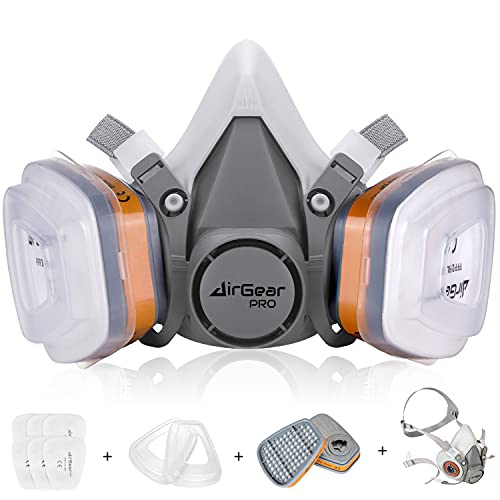
AirGearPro M-500 Reusable Respirator Mask with A1P2 Vapor and Dust Filters
A1P2 filtersReusableCE certifiedDual filtration
Check price on Amazon
Best for: Sanding and finishing in one session where vapor and dust filters are both needed.

The AirGearPro M-500 is a reusable half mask with dual A1P2 filtration, where A1 stops organic vapors and P2 filters particles. The listing describes the product as CE certified, a European marking. It suits painting, woodworking and sanding because it handles dust and some finish vapors in one set.

The tradeoff is the standard. P2 is a European class roughly comparable to N95 but is not a NIOSH approval, so check which standard applies where you work. Compared with the 3M P100, it gives vapor protection but a lower particle class. It suits sanding and finishing in the same session when a NIOSH mark is not required.

Do a seal check and replace filters when breathing gets harder. Store the mask sealed. Keep spare filters on hand.

What works

  • A1P2 dual filtration covers dust and organic vapors
  • Reusable mask with replaceable filters
  • CE certified per the listing
  • Middle price position for a reusable kit

Watch out for

  • P2 is not a NIOSH approval
  • Lower particle class than P100

Specs

Filters
A1P2 dual filtration
Standard
CE (European) certification
Type
Reusable half mask
Use
Painting, woodworking, sanding, construction
Price position
Middle of the group
06
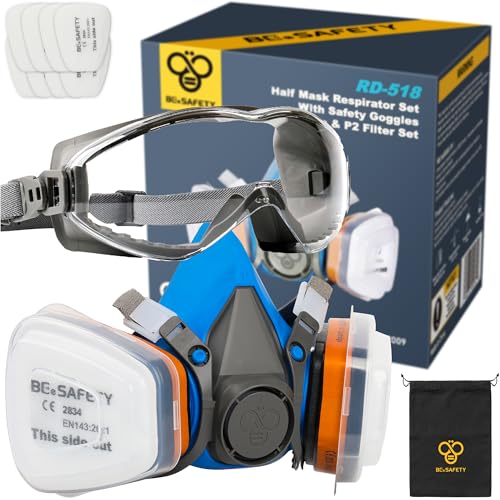
BEESAFETY RD-518 Half Face Respirator with Safety Goggles 2 A1 and 8 P2 Filters
Half faceGoggles included2 A1 + 8 P2 filtersReusable
Check price on Amazon
Best for: Shop users who want goggles and spare filters in one kit.

The BEESAFETY RD-518 combines a half-face respirator with safety goggles, two A1 organic vapor filters and eight P2 dust filters. The extra filters make it a good long-term kit for a shop that sands often. The goggles add eye protection to a single purchase.

The tradeoff is that the goggles and respirator are separate pieces that must work together, and the goggles can lift the mask edge or fog. P2 is not a NIOSH approval. Compared with the AirGearPro, it adds goggles and more filters. It suits shop owners who want one kit with spare filters.

Check how the goggle strap sits against the mask edge. Do a seal check and replace filters on schedule. Store the filters sealed.

What works

  • Goggles included for eye protection
  • Eight P2 and two A1 filters give long-term supply
  • Reusable half face mask
  • Covers dust and organic vapors

Watch out for

  • P2 is not a NIOSH approval
  • Goggles can disturb the mask seal or fog

Specs

Type
Reusable half face respirator
Eye protection
Safety goggles included
Filters
2 A1 organic vapor and 8 P2 dust
Standard
European A1 and P2 classes
Price position
Upper end of the group
07
LAUCO Premium Respirator Kit Reusable Half Face with Safety Glasses
Half faceSafety glassesDual filterReusable
Check price on Amazon
Best for: Hobby users who want a combined mask and safety glasses kit.

The LAUCO kit pairs a reusable half-face respirator with safety glasses and a dual filter system. The maker states it blocks about 97 percent of airborne contaminants, a claim that is not tied to a named standard in the listing. It targets painting, polishing and sanding.

The tradeoff is documentation. The listing gives less standard detail than the 3M NIOSH products, so it is harder to match to a protection class. Compared with the BEESAFETY kit, it uses glasses rather than goggles, which are more comfortable but seal less well. It suits hobby users who want a combined mask and eyewear kit.

Check the filter marking and replace filters when breathing gets harder. Do a seal check each time. Keep the glasses clean.

What works

  • Reusable half face mask with glasses included
  • Dual filtration system
  • Covers painting, polishing and sanding
  • Upper-middle price position for a kit

Watch out for

  • Filtration claim is not tied to a named standard
  • Less documentation than NIOSH-approved products

Specs

Type
Reusable half face respirator
Eye protection
Safety glasses included
Filtration
Dual filtration, maker claims 97 percent of airborne particles
Use
Painting, polishing, sanding
Price position
Upper-middle of the group

Spec decoder

What the listing measurements really mean

The numbers brands lead with, translated into what they tell you about fit, comfort and wear at home.

N95

A NIOSH class for filters that capture at least 95 percent of 0.3 micron non-oil particles.

Watch forNot for oil-based aerosols. Match the class to the dust, not to the price.

P100

A NIOSH class for filters that capture at least 99.97 percent of particles, oil resistant.

Watch forNeeds a well-fitted facepiece. Check that the mark is printed on the product, not only in the listing.

A1P2

A European rating combining A1 organic vapor and P2 particle protection.

Watch forNot a NIOSH approval. Facepiece size changes fit more than filter class does.

Exhalation valve

A valve that lets exhaled air out easily, reducing heat and moisture.

Watch forIt does not filter exhaled breath. Ask whether filters ship in the box or are sold separately.

Seal check

A quick test where you cover the filters and inhale or exhale to feel leaks.

Watch forDo it every time. A valve is for comfort, not extra filtration.

Methodology

How We Evaluated These Respirators for Sanding

Specification review

We compared published filter classes, approvals, pack contents and facepiece types. We read each listing for NIOSH markings and filter details. We set the 3M P100 against the 3M 8511 N95. We also looked at how each listing describes its approval or standard.

Owner feedback patterns

We looked at recurring themes in owner feedback such as fit, comfort, fogging and filter availability. Single complaints were set aside. We did not use star ratings. We also noted whether filters ship with the facepiece.

Design approach

We considered how each product seals and filters, from disposable valved masks to reusable half masks and kits with eyewear. We also noted vapor protection. We also considered how each design fits with eyewear.

Value and price position

We ordered the products by relative price tier and asked what each step up adds. We did not quote prices. We also compared which products cover vapors as well as dust.

What we did not do

We did not wear these respirators or run fit checks. Scores are editorial judgments built on published information. Filtration percentages remain makers' and standards' figures. We also avoided drawing conclusions from slogans.

Decision guide

How to Choose the Right Respirators for Sanding

By Dust Level

SituationPickWhy
Light hand sanding3M 8511 N95Disposable and quick
Power sanding3M P100P100 filter
Drywall dust3M P100Higher class
Mixed shop use3M All-In-One N95Multi-purpose

By Budget

SituationPickWhy
Low base3M 6300Second lowest
Lower-middle, disposable3M 8511Ten-pack
Lower-middle, reusable3M P100Reusable kit
Upper end, kitBEESAFETY RD-518Goggles and filters

Disposable vs Reusable

Disposable

The 3M 8511 and All-In-One are quick and cheap, but seal less well and are thrown away after use.

Reusable

The 3M P100, 3M 6300 and the A1P2 kits seal better and need only new filters, but take longer to set up.

Pick disposable for occasional jobs. Pick reusable if you sand often.

By Standard

SituationPickWhy
NIOSH required3M P100 or 8511NIOSH marking
Dust and vaporAirGearPro M-500A1P2
Kit with eyewearBEESAFETY RD-518Goggles included
Hobby kitLAUCO kitGlasses included

For Drywall Sanding Specifically

Look for

At least N95 for hand sanding and P100 for power sanding, a good seal and a plan for dust control.

In this comparison

The 3M 8511 suits hand sanding, and the 3M P100 suits power sanding and heavy dust.

When to Spend More

Spend more if

You sand often, need P100 or want vapor cartridges and eye protection in one kit.

Save if

You sand a few times a year, in which case the 3M 8511 pack is enough.

Ownership

Maintenance schedule

The upkeep that decides whether a piece still looks good in year five.

TaskIntervalWhy it matters
Do a seal checkEvery time you put it onA leaking seal gives far less protection than the filter rating suggests. Cover the filters and inhale or exhale. A soft brush clears dust from the outside of the filters.
Replace filtersWhen breathing gets harderClogged filters make breathing difficult and lose effectiveness. Replace on schedule. Never rinse a particulate filter, since water ruins the electrostatic media.
Clean the facepieceAfter useSweat and dust degrade the seal. Wash with mild soap and air dry. Write the filter start date on the cartridge with a marker.
Store sealedAfter useDust and humidity ruin filters. A sealed bag keeps them fresh. Replace head straps when the elastic goes slack.
Inspect straps and valvesMonthlyLoose straps and warped valves cause leaks. Replace worn parts. Keep the facepiece away from solvents that can degrade the rubber.

FAQ

Frequently Asked Questions

Is an N95 enough for sanding?

For light hand sanding, many sources treat N95 as a minimum. For power sanding or heavy dust, P100 is the safer choice. If breathing feels easy only because the mask leaks, it is not protecting you. A good seal gives a little resistance when you inhale.

What is the difference between N95 and P100?

N95 filters at least 95 percent of 0.3 micron particles. P100 filters at least 99.97 percent and resists oil. Wash your hands and face after sanding, and change clothes before you go into living areas, because dust on clothes carries into the house.

Are P2 kits as good as NIOSH respirators?

P2 is a European class roughly comparable to N95, but it is not a NIOSH approval. Check which applies to you. Store spare disposable masks in a clean bag, not loose in a toolbox where they pick up dust before use.

Can I wear a respirator with a beard?

Facial hair under the seal leaks. A clean-shaven sealing edge gives the best fit. If you sand hardwoods often, treat the dust seriously, because long exposure to some wood dusts is linked to breathing problems.

How often do I replace filters?

When breathing gets harder or the filter is damaged. Follow the maker's schedule. A disposable mask can usually be reused for a short time if it is clean and holds its shape, but replace it if it is damp, soiled or hard to breathe through.

Do I need vapor cartridges for sanding?

Not for dust. For finishes and solvents, add organic vapor cartridges. If you have a medical condition that affects breathing, ask a clinician before using a respirator, since some people find them hard to wear.

Bottom line

The short version

Browse more respirators for sandingon Amazon →
Brianna Cole, Lead Product Editor

About the author

Brianna Cole

Lead Product Editor, SenseiReview

Brianna Cole leads SenseiReview's buying guides, turning published specifications, documentation and owner feedback patterns into clear verdicts across home, tech, fitness, outdoor and DIY products.

More from Brianna →

Keep reading

Related guides