
Amazon affiliate links - we earn a commission.Affiliate disclosure

Buying guide · 12 min read · Updated 2026-11-21

Best Volume-Limiting Kids Headphones (2026)

Compare six volume-limiting kids headphones by dB cap, wired or Bluetooth design, headband fit and durability, with honest notes on how limiters really work.

Brianna Cole, Lead Product EditorBy Brianna ColeLead Product Editor6 picks comparedSpec-sheet verified
Best Volume-Limiting Kids Headphones

At a glance

Our top picks

Side by side

Spec comparison

Kids headphones with a volume limiter cap the maximum output so a child cannot turn the sound up past a chosen level, even by accident. Most makers target about 85 dB, a common reference for long listening, and some offer a second, higher setting for noisy places like planes.

The limiter is only one part of the buy. Headband fit, hinge strength, a wired fallback, microphone quality and whether the cap is fixed or switchable decide how well a set survives school, travel and the backseat. This guide compares those points across the lineup.

Before you buy

6 Criteria to Look For Before Buying a Volume-Limiting Kids Headphone

  1. 01

    Limiter level and type

    A limiter caps output at a set decibel level, with 85 dB the common reference for long listening. A fixed cap, as on the JBL Junior 320, cannot be changed, while switchable sets like the Acer OHW355 at 74 or 85 dB and the Acer OHR668 at 85 or 94 dB give flexibility. The mistake is assuming 94 dB is safe for hours, because it is only meant for short bursts such as a noisy flight.

  2. 02

    Wired or Bluetooth

    Wired sets have no battery, no pairing and no charging, so they outlast Bluetooth models. Bluetooth sets like the JoySpark at a stated 60 hours free a child from a cord but add a battery that ages after a couple of years. A wired fallback, as on the Belkin SoundForm Mini, covers the case where the battery dies.

  3. 03

    Headband and fit

    Kids grow, so the headband should adjust widely and the earcups should swivel. The Acer OHW355 has 90 degree rotatable earcups and the JBL Junior 320 has a soft 12 mm padded band. Buyers often pick a size for a toddler and find it too small by school age, so check the age range rather than the colour.

  4. 04

    Durability and hinges

    Kids headphones get dropped, sat on and stuffed into backpacks. A reinforced hinge as on the Acer OHR668 and a braided cable as on the Acer OHW355 are the practical durability features. A thin plastic hinge on a budget set is usually the first part to crack.

  5. 05

    Microphone for school

    Online classes and video calls need a microphone, and a headset without one forces a separate mic. The JBL, iClever and Belkin models all include one. Check that the mic works with the device, because a 3.5 mm jack with an inline mic needs a four-pole plug that some tablets expect.

  6. 06

    Limiter accuracy

    A listing's cap is a design target, and real output varies with the source device volume and the audio file. The JBL claims it is designed to never exceed 85 dB, but no independent number is given in the listing. Treat any cap as a safeguard, not a guarantee, and keep an eye on listening time as well as level.

Detailed reviews

The 6 best volume-limiting kids headphones, explained

01
JBL Junior 320 Wired 85 dB Kids Headphones with Mic
85 dB capWired 3.5 mmBuilt-in micPadded band
Check price on Amazon
Best for: Parents who want a simple wired set with a fixed 85 dB cap for school.

The Junior 320 is a wired set with a fixed 85 dB limit that the maker designs to never be exceeded. It adds a built-in microphone for chatting with teachers, a soft 12 mm padded headband and round earcups that the listing says reduce sound leakage and grip the head better. A wired design means no battery, no pairing step and no charging cable to forget.

The tradeoff is that the cap is fixed, so there is no 94 dB mode for a loud aircraft, and the cord can snag on a school bag. Against the Acer OHW355, which adds a 74 dB mode, the JBL is less flexible but simpler. Compared with the iClever HS19, it sits higher in the price order and relies on the JBL brand rather than a larger driver size.

In ownership, the wear points are the cable near the plug and the pad covers. Coil the cord loosely, do not yank it from the device and check the headband adjustment every few months as a child grows. With no battery to degrade, a wired set like this tends to outlast Bluetooth models.

What works

  • Fixed 85 dB limit means no setting a child can change or forget
  • Built-in mic works for online lessons and video calls from the start
  • Wired design avoids battery, pairing and charging problems entirely
  • Soft 12 mm headband padding suits long classroom sessions

Watch out for

  • No higher volume mode for planes or noisy car rides
  • Cord can snag or tug on a device when a child moves around

Specs

Volume cap
85 dB, JBL Safe Sound
Connection
Wired, 3.5 mm
Microphone
Built-in for class calls
Headband padding
12 mm soft pad
Earcups
Round, for grip and less leakage
02
Acer OHW355 Kids Headphones, 74/85 dB Switchable, Nylon Cable
74/85 dB modesFoldableBraided cord90° earcups
Check price on Amazon
Best for: Younger or sensitive-eared kids who benefit from a lower 74 dB mode.

The OHW355 adds a 74 dB mode below the usual 85 dB cap, which the listing offers for sensitive ears. It uses a braided nylon cable that the maker says has several times the tensile strength of a plain cord, 90 degree rotating earcups and a foldable frame. That mix suits a younger child who tends to drop and tug on things.

The tradeoff is that a switch means there is a setting to manage, and a child can move it to 85 dB. Against the JBL Junior 320 the Acer gives more control but less simplicity. Compared with the Acer OHW328 at 85 and 94 dB, this one trades the higher mode for a lower one, so it fits quiet homes better than aircraft.

In ownership, check the cable strain relief and the swivel hinges as these are the first to fail on kids headphones. Wipe the pads with a damp cloth and let them dry. The braided cord reduces tangling in a bag, but it can still twist around fingers, so teach younger children to unplug by the connector.

What works

  • 74 dB mode gives a lower ceiling than the usual 85 dB cap
  • Braided nylon cable resists tugs and tangles in a school bag
  • 90 degree earcups swivel to fit various head shapes
  • Foldable frame packs flat for a backpack or a seat pocket

Watch out for

  • Switchable limit means a child could move to the higher setting
  • Wired only, so a cord is always between the child and the device

Specs

Volume modes
74 dB or 85 dB
Connection
Wired, 3.5 mm
Cable
High-density braided nylon
Earcup swivel
90° rotatable
Folding
Foldable for a school bag
03
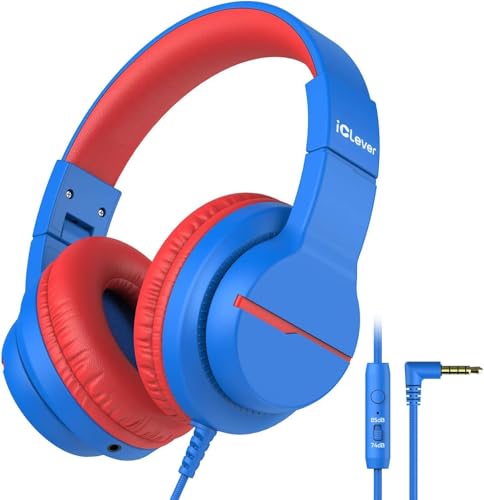
iClever HS19 Wired Kids Headphones, 85 dBA, 40mm Drivers
85 dBA cap40 mm driversInline micWired
Check price on Amazon
Best for: Budget buyers who want a capped wired set with decent drivers for a child.

The HS19 is a wired kids set built on 40 mm drivers with an 85 dBA limit and an inline microphone. It sits second cheapest of the twelve candidates we reviewed, yet it covers the basics: a capped output, a mic for online classes and a cord. The larger drivers give fuller sound for games and stories than the small drivers in cheaper sets.

The tradeoff is build quality, which is plainer than the JBL. The cap is fixed at one level, and the listing does not describe a reinforced hinge like the Acer OHR668. Against the Acer OHW355, the HS19 is cheaper but lacks the 74 dB mode and the braided cord.

In ownership, treat it as a low-cost set you may replace every year or two. Check the headband adjustment regularly, keep the cord untangled and replace the set if the volume cap sounds inconsistent between ears. It is a fair choice when you want two sets, one for home and one for school.

What works

  • 85 dBA cap and mic at one of the lowest positions in the price order
  • 40 mm drivers give fuller sound than small drivers in cheaper sets
  • Inline mic suits online classes and video calls without a separate mic
  • Cost makes a second set for school or the car easy to justify

Watch out for

  • Plain build with no reinforced hinge or braided cable
  • Only one volume level, so no lower mode for sensitive ears

Specs

Volume cap
85 dBA, SafeSound
Drivers
40 mm
Connection
Wired with inline mic
Use
Online courses and games
Position in price order
Second cheapest of twelve
04
Acer OHR668 Kids Bluetooth Headphones, 85/94 dB, 60H
85/94 dB modes60 h batteryFoldableMic
Check price on Amazon
Best for: Families who travel and want a wireless set with a switchable 85 or 94 dB cap.

The OHR668 is a Bluetooth over-ear set with two volume limits, 85 and 94 dB, a stated 60 hour battery and memory foam cushions. The listing highlights a reinforced hinge meant to survive school bags and a foldable frame. That combination suits long trips, where a child can switch to the higher 94 dB mode for a loud plane and back to 85 dB at home.

The tradeoff is that Bluetooth adds a battery that ages and a pairing step that younger children find fiddly. It also costs more than the wired Acer OHW328 and the iClever HS19. Compared with the JoySpark Bluetooth set, it offers the hinge reinforcement but not Bluetooth 5.3 in the listing.

Ownership centers on battery and charging. Keep the cable in the travel bag, charge every few weeks even when unused and expect the battery capacity to shrink after a couple of years. Wipe the memory foam cushions and let them dry to prevent them flaking, which is the most common wear item on over-ear models.

What works

  • Stated 60 hour battery covers long trips between charges
  • Switchable 85 and 94 dB modes help in quiet rooms and on planes
  • Reinforced hinge is built for school bags and rough handling
  • Memory foam cushions suit long wear on younger heads

Watch out for

  • Bluetooth adds pairing and a battery that will age over time
  • Higher 94 dB mode is easy for a child to enable at home

Specs

Volume modes
85 dB or 94 dB
Battery
60 hours stated
Connection
Bluetooth over-ear
Hinge
Reinforced headband hinge
Ear cushions
Memory foam
05
JoySpark Kids Bluetooth 5.3 Headphones, 85/94 dB, 60 Hours
Bluetooth 5.385/94 dB60 h batteryMemory foam
Check price on Amazon
Best for: Buyers who want Bluetooth 5.3 and a long battery at a mid-range position in the price order.

The JoySpark Bluetooth set pairs 40 mm drivers with a stated 60 hours of playback, Bluetooth 5.3 and two limits of 85 and 94 dB. Memory foam cushions and a one-button connection are the comfort and ease-of-use points in the listing. On paper it matches the Acer OHR668, with a newer Bluetooth version added.

The tradeoff is that JoySpark is a lesser-known brand, so long-term hinge strength and warranty service are less proven than for JBL or Acer. Bluetooth 5.3 mainly helps connection stability and power use, not sound. Compared with the iClever BTH12 it offers a shorter stated battery, but it is cheaper to run than the wired-plus-wireless Belkin.

In ownership, test the limiter by playing a loud track and checking it stays below a comfortable level. Charge it before trips and wipe the foam cushions. The wired jack, if present on your unit, is a useful fallback when the battery runs flat, so check the box before a flight.

What works

  • Bluetooth 5.3 gives a stable connection and efficient battery use
  • Stated 60 hours of playback covers weeks of school use
  • Two limits of 85 and 94 dB suit quiet rooms and planes
  • 40 mm drivers give fuller sound for audiobooks and shows

Watch out for

  • Lesser-known brand with less proven hinge and warranty history
  • Switchable limit means a child may move to the higher mode

Specs

Bluetooth
Version 5.3
Volume modes
85 dB or 94 dB
Battery
60 hours stated
Drivers
40 mm
Ear cushions
Memory foam
06
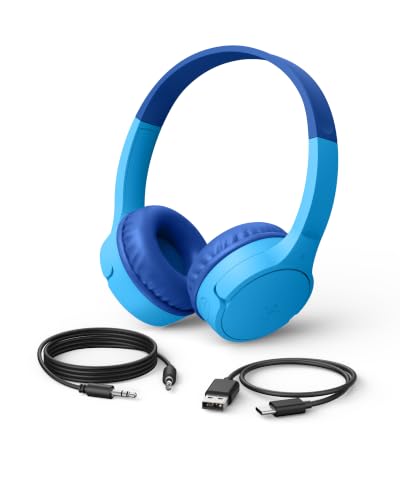
Belkin SoundForm Mini Kids Headphones, Wireless and Wired, 30H
Wired and wireless30 h batteryBluetooth 5.0Mic
Check price on Amazon
Best for: Families who want one set that works wirelessly and with a cable.

The SoundForm Mini is the only set here sold as both wireless and wired, which means it works with Bluetooth for freedom and a cable when the battery dies. It has Bluetooth 5.0, a stated 30 hour battery, a built-in microphone for video calls and an over-the-ear design. The listing refers to Belkin Signature Sound for its safe volume approach.

The tradeoff is that it is the highest in the price order of the twelve candidates, and its 30 hour battery is half the Acer OHR668 and JoySpark figure. It is aimed at a child who moves between a tablet at home and a school laptop. Against the wired JBL Junior 320 it costs more for the wireless option, which only matters if you will use it.

Ownership is a mix of both worlds: you have a battery to charge and a cable to keep. Keep the cable in the bag so the wired mode is always available, and check the volume on the device is not turned to maximum. The wired fallback means a flat battery never ends a flight or a lesson.

What works

  • Works over Bluetooth or a cable so a flat battery never stops use
  • Built-in mic suits school laptops and video calls without extras
  • Over-the-ear design gives a more secure fit than on-ear sets
  • Brand support and wide device compatibility reduce setup problems

Watch out for

  • Highest position in the price order among the twelve candidates
  • Stated 30 hour battery is half that of the Acer and JoySpark sets

Specs

Connection
Bluetooth 5.0 and wired
Battery
30 hours stated
Microphone
Built-in for calls
Design
Over-the-ear
Position in price order
Highest of twelve

Spec decoder

What the listing measurements really mean

The numbers brands lead with, translated into what they tell you about fit, comfort and wear at home.

85 dB limit

A common reference for safe long listening, equal to loud traffic heard from inside a car. Output at or below this level reduces risk over long sessions.

Watch forThe JBL, iClever and Acer sets cite 85 dB, but the way each measures it is not documented in the listing.

94 dB mode

A louder setting meant for noisy places such as planes. It is safe only for short periods.

Watch forThe Acer OHR668 and JoySpark offer it, so a child can switch to it at home.

74 dB mode

A lower setting for sensitive ears or quiet rooms. It reduces maximum output further than the standard cap.

Watch forOnly the Acer OHW355 in this lineup lists it.

Stated battery life

The manufacturer's figure for Bluetooth models at moderate volume. Real playback is lower at maximum volume.

Watch forThe Acer OHR668 and JoySpark quote 60 hours, while the Belkin quotes 30 hours.

Driver size

A larger driver, such as 40 mm, usually moves more air and gives fuller bass. It does not determine overall quality alone.

Watch forThe iClever HS19 and JoySpark list 40 mm drivers, but tuning matters more than size.

Methodology

How We Evaluated These Volume-Limiting Kids Headphones

Limiter design

We evaluated how each listing describes its cap, whether it is fixed or switchable and at what level. The JBL Junior 320 is fixed at 85 dB and the Acer OHW355 offers 74 and 85 dB. We favoured clearer, lower caps.

Durability for school use

We looked at hinge, cable and headband design based on the listings and owner feedback patterns. The Acer OHR668 has a reinforced hinge and the Acer OHW355 a braided cable. Plain builds ranked lower.

Connection and battery

We compared wired and Bluetooth sets and their stated battery life. The JoySpark and Acer OHR668 quote 60 hours, and the Belkin adds a wired fallback. Wired sets avoided the battery risk.

Fit and comfort

We reviewed padding, earcup movement and headband range, since a poorly fitting set is not used. The JBL has 12 mm padding and the Acer OHW355 rotates 90 degrees. We checked for adjustability across ages.

Mic and compatibility

We checked for a built-in microphone because school calls need one. The JBL, iClever and Belkin sets include one. We did not rank a set higher for its mic quality because the listings give no numbers.

Decision guide

How to Choose the Right Volume-Limiting Kids Headphones

By Connection Type

SituationPickWhy
Simple school set, no batteryJBL Junior 320Wired with a fixed 85 dB cap
Wired with extra controlAcer OHW35574 dB mode and braided cable
Wireless for long tripsAcer OHR668Stated 60 hours and a reinforced hinge
Both wired and wirelessBelkin SoundForm MiniCable fallback when the battery dies

By Budget

SituationPickWhy
Lowest cost capped setiClever HS19Second cheapest of twelve with a mic
Mid-range BluetoothJoySpark Bluetooth 5.3Stated 60 hours at a mid position
Trusted brand wiredJBL Junior 320Higher in the price order for the brand
Premium flexibilityBelkin SoundForm MiniHighest in the price order

Wired vs Bluetooth

Wired sets

The JBL Junior 320, Acer OHW355 and iClever HS19 have no battery or pairing and tend to outlast wireless models. The cord can snag and limits movement.

Bluetooth sets

The Acer OHR668, JoySpark and Belkin free a child from a cord. They add a battery that will age and a pairing step that younger children find fiddly.

Pick wired for school and young children, and Bluetooth for older kids who move around or travel often.

By Child Age and Use

SituationPickWhy
Toddler and preschoolAcer OHW35574 dB mode for the youngest ears
Primary school classroomJBL Junior 320Fixed 85 dB with a mic
Long flights and road tripsAcer OHR66894 dB mode and 60 hours battery
Older child with a tabletBelkin SoundForm MiniWireless freedom plus wired backup

For School and Travel Specifically

Look for

A built-in mic, a hinge that survives a bag, a cable you can replace and a cap at or below 85 dB for everyday use. Foldable frames pack better.

In this comparison

The JBL Junior 320 and Acer OHW355 are best at school, while the Acer OHR668 and JoySpark are the better travel pair.

When to Spend More

Spend more if

You want a brand with a hinge and warranty record, a lower dB mode or a wired and wireless set for years of use.

Save if

The set will live in a school locker. The iClever HS19 is a sensible low-cost buy that you can replace.

Ownership

Maintenance schedule

The upkeep that decides whether a piece still looks good in year five.

TaskIntervalWhy it matters
Wipe ear cushionsWeeklySkin oil and sweat degrade foam and leatherette over months. A damp cloth keeps them from cracking early.
Check headband and hingeEvery few monthsKids grow, and a stretched headband loosens. Cracks in plastic hinges start small and grow with use.
Inspect the cable and plugMonthlyThe plug end is the most common failure on wired sets. Replace the cable or set if the sound cuts in and out.
Charge Bluetooth setsEvery few weeksA flat lithium battery that sits unused for months ages faster. A top-up keeps it healthy.
Check the limiter by earEvery few monthsA set that suddenly sounds louder than before may have a failing limiter. Compare it against a known level and replace it if in doubt.

FAQ

Frequently Asked Questions

What is a safe volume for kids headphones?

A level at or below about 85 dB is a common reference for long listening, with shorter sessions allowing slightly more. Keeping sessions short and taking breaks matters as much as the limiter.

Are wired or Bluetooth headphones better for kids?

Wired sets avoid batteries and pairing and tend to last longer, which suits school. Bluetooth sets suit travel and older children who want freedom from a cord.

Are volume limiters reliable?

They reduce maximum output, but real levels depend on the source device and the track. Treat a limiter as a safeguard, and keep device volume reasonable.

Should I choose 94 dB mode?

Use it only for short bursts such as a noisy flight, and switch back to 85 dB at home. Children can enable it themselves, so consider a fixed cap for young kids.

How long do kids headphones last?

Wired sets often last a school year or more with care. Bluetooth sets last as long as the battery, usually a couple of years of regular use.

Do I need a built-in microphone?

Yes for online classes and video calls, since a set without a mic needs a separate one. Check that the plug type matches your device.

Bottom line

The short version

Browse more volume-limiting kids headphoneson Amazon →
Brianna Cole, Lead Product Editor

About the author

Brianna Cole

Lead Product Editor, SenseiReview

Brianna Cole leads SenseiReview's buying guides, turning published specifications, documentation and owner feedback patterns into clear verdicts across home, tech, fitness, outdoor and DIY products.

More from Brianna →

Keep reading

Related guides