
Amazon affiliate links - we earn a commission.Affiliate disclosure

Buying guide · 13 min read · Updated 2026-11-26

Best Wire Crimping Tools (2026)

Seven wire crimping tools compared on terminal type, AWG range, ratcheting action and hydraulic force, with picks for car wiring, heat shrink and battery lugs.

Brianna Cole, Lead Product EditorBy Brianna ColeLead Product Editor7 picks comparedSpec-sheet verified
Best Wire Crimping Tools

At a glance

Our top picks

Side by side

Spec comparison

A crimping tool squeezes a metal terminal around a stripped wire so the two form a gas tight, mechanically strong joint. Done right, a crimp is more reliable than solder in anything that vibrates, which is why cars, boats and electrical panels depend on it.

The tool must match the terminal. Insulated terminals, heat shrink connectors, open barrel contacts and heavy battery lugs each need a different die shape and force. This guide compares seven tools so you can match one to your work.

Before you buy

6 Criteria to Look For Before Buying a Wire Crimping Tool

  1. 01

    Terminal type and die shape

    Insulated vinyl or nylon terminals, heat shrink connectors, open barrel contacts and heavy lugs each need a different die. A tool with the wrong die produces weak or damaged crimps. The most common mistake is using a plier crimper on heat shrink terminals. The Klein 3005CR suits insulated terminals and the Plustool suits heat shrink.

  2. 02

    AWG wire range

    AWG numbers fall as wire gets thicker. Most hand tools cover 10 to 22 AWG, and fine electronics wire needs a smaller die. Large battery cable from 6 to 2/0 AWG needs hydraulic force. Check the range against your jobs. The Solsop covers 12 to 2/0 and the Klein tools cover 10 to 22.

  3. 03

    Ratcheting action

    A ratchet will not release until the crimp completes, so every crimp gets the same pressure. Plain pliers vary with grip strength. Ratcheting tools cost more but give more reliable results. The Klein 3005CR, Plustool and haisstronica are ratcheting.

  4. 04

    Combo functions versus dedicated

    A combo tool cuts, strips and crimps, so one tool covers small jobs. The tradeoff is shorter leverage and less precision than a dedicated crimper. Electricians often carry both. The Knipex and Klein 1005 are combo tools.

  5. 05

    Handle comfort and leverage

    Long handles and non slip grips reduce hand strain on a run of crimps. Compound action adds force on thick wire. Test the squeeze effort if you can. The Klein 3005CR uses compound action.

  6. 06

    Hydraulic tools for heavy lugs

    Lugs on 6 AWG wire and above need far more force than hand tools can deliver. Hydraulic crimpers with hex dies make a uniform, gas tight crimp. Do not try to crimp them with pliers or a hammer. The Solsop is built for this job.

Detailed reviews

The 7 best wire crimping tools, explained

01
Klein Tools 3005CR ratcheting crimper for insulated terminals, 10 to 22 AWG
Ratcheting10 to 22 AWG3 cavitiesCompound action
Check price on Amazon
Best for: Automotive, marine and panel work with red, blue and yellow insulated terminals.

The Klein 3005CR is a ratcheting crimper built for insulated terminals, with three color coded cavities for the common red, blue and yellow sizes. A ratchet means the tool will not release until it completes the crimp cycle, so every crimp gets the same pressure no matter who squeezes.

The adjustable compound action puts more force into each squeeze, which helps with 10 AWG wire where a plain plier tires your hand. Compared with the Klein 1005, the 3005CR is dedicated to crimping and does not cut or strip, so you carry a separate cutter. Compared with the Plustool, it works with insulated terminals and not heat shrink ones.

Ownership is simple. Match the wire gauge to the cavity color, insert the terminal barrel seam toward the die opening and tug the wire after crimping. Wipe the dies clean, oil the pivot occasionally and replace the tool if the ratchet fails to release.

What works

  • Ratchet repeats the same crimp every time
  • Color coded cavities match common terminals
  • Compound action reduces hand effort on 10 AWG
  • Trusted tool brand with a long record

Watch out for

  • Does not handle heat shrink or open barrel terminals well
  • No cutter or stripper built in

Specs

Wire range
10 to 22 AWG stranded copper
Cavities
22-16 red, 16-14 blue, 12-10 yellow
Action
Ratcheting, adjustable compound
Terminals
Insulated
Brand
Klein Tools
02
WORKPRO 9.5 inch wire cutter and crimper, 10 to 22 AWG, Cr-V steel
9.5 in10 to 22 AWGCr-V steelCuts and crimps
Check price on Amazon
Best for: General household and hobby wiring with mixed terminal types.

The WORKPRO is a plier style combo tool, 9.5 inches long, that cuts wire and crimps both insulated and non insulated terminals across 10 to 22 AWG. The maker claims 63 to 65 HRC hardness, a number that would be very hard for a crimper, so we treat it as a marketing figure.

It is a toolbox tool: cheap, versatile and good enough for occasional household and automotive wiring. A plier crimper depends on your grip, so crimps vary more than from a ratchet, and the crimp pocket is a single shape. Compared with the Klein 1005, it costs less and has the same general features but with less proven quality. Compared with the Klein 3005CR, it is less repeatable but handles more terminal types.

Ownership is basic. Test each crimp by pulling the wire, keep the dies clean and oil the pivot. If crimps pull out, step up to a ratcheting tool.

What works

  • Cuts wire and crimps in one tool
  • Covers insulated and non insulated terminals
  • Long handles give leverage on 10 AWG
  • Low cost tier for a first crimper

Watch out for

  • Plier action gives less repeatable crimps
  • Hardness claim is unverified marketing

Specs

Length
9.5 inches
Wire range
10 to 22 AWG
Steel
Cr-V, 63 to 65 HRC claimed
Functions
Cut and crimp insulated and non insulated terminals
Cost tier
Low
03
Klein Tools 1005 crimping and cutting tool, 9.6 inch, made in USA
9.6 in10 to 22 AWGMade in USATapered nose
Check price on Amazon
Best for: Electricians and homeowners who want a durable combo tool.

The Klein 1005 is a 9.6 inch plier style combo tool that crimps 10 to 22 AWG insulated and non insulated terminals and also cuts wire with a hardened cutter in the nose. The tapered nose reaches into tight spaces like a junction box.

It is a durable general purpose tool that electricians carry, built in the United States with a good reputation for consistent dies. Compared with the WORKPRO, it costs more and holds up better for daily use. Compared with the Knipex, it is less refined and less adjustable. As with any plier crimper, the result depends on grip strength, so check each crimp with a pull test.

Ownership is simple. Keep the dies clean and free of debris, oil the pivot and replace it if the die faces become worn or misaligned.

What works

  • Hardened cutter in the nose handles small wire
  • Tapered nose reaches tight junction boxes
  • Made in the USA with consistent dies
  • Handles insulated and non insulated terminals

Watch out for

  • Plier action varies with hand pressure
  • Costs more than basic combo pliers

Specs

Length
9.6 inches
Wire range
10 to 22 AWG
Functions
Crimp insulated and non insulated, cut wire
Nose
Tapered, for tight spaces
Origin
Made in USA
04
Knipex 97 22 240 crimping pliers for insulated and non insulated terminals
240 mmCuts and stripsCrimpsScrew cutter
Check price on Amazon
Best for: Electricians who want cutting, stripping and crimping in one tool.

The Knipex 97 22 240 is a German made combination pliers that cuts cable, strips wire and crimps terminals. Threaded holes in the jaws cut copper and brass screws, a feature that electricians use for trimming screws.

It does more than most combo tools, and the finish and fit of the dies are better than budget options. Compared with the Klein 1005, the Knipex adds stripping and screw cutting, while the Klein is a simpler crimper and cutter. Compared with the Klein 3005CR, it is less repeatable for crimping but far more versatile as a single tool.

Ownership centers on the cutting edges. Use them for copper wire only, avoid steel, and keep the jaws oiled. A plier crimper should still be verified with a pull test, since the crimp depends on your grip.

What works

  • Cuts, strips and crimps in a single tool
  • Threaded holes cut small copper and brass screws
  • Strong steel and a precise finish
  • Handles insulated and non insulated terminals

Watch out for

  • Plier action gives less repeatable crimps than a ratchet
  • Costs more than basic combo pliers

Specs

Length
240 mm, about 9.5 inches
Functions
Cut cables, strip wire, crimp terminals
Terminals
Insulated and non insulated
Extra
Threaded holes for cutting copper and brass screws
Steel
Special steel, high strength
05
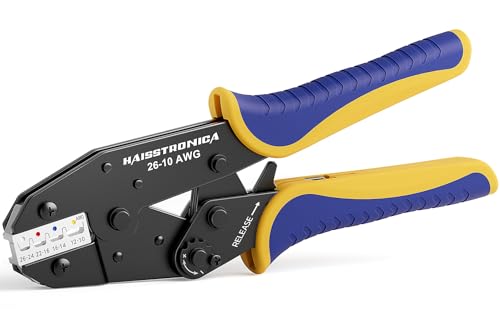
Plustool ratcheting crimper for heat shrink connectors, AWG 26 to 10
Heat shrinkAWG 26 to 10RatchetingErgonomic grip
Check price on Amazon
Best for: Automotive and marine wiring with heat shrink connectors.

The Plustool is a ratcheting crimper designed for heat shrink connectors, which have a sealed sleeve that shrinks around the joint when heated. The AWG 26 to 10 range is wide, covering fine electronics wire up to automotive gauges.

Heat shrink terminals need a die shaped for their thicker barrel, so a standard insulated terminal crimper does not do the same job. The ratchet gives a repeatable crimp, and the ergonomic handle helps over a long run of connections. Compared with the haisstronica HS-8327, the two are similar, and the choice is mostly about handle feel and cost. Compared with the Klein 3005CR, it is for a different connector family.

Ownership requires a heat gun after crimping to seal the sleeve. Test each joint with a gentle pull and keep the dies clean. Use it only on the terminal type it was made for.

What works

  • Dies shaped for heat shrink connector barrels
  • Ratchet delivers repeatable crimps
  • Wide AWG 26 to 10 range
  • Low cost tier for a ratcheting tool

Watch out for

  • Not suited to standard vinyl insulated terminals
  • Needs a heat gun to finish the joint

Specs

Terminals
Heat shrink connectors
Wire range
AWG 26 to 10
Action
Ratcheting
Grip
Ergonomic handle
Cost tier
Low
06
haisstronica HS-8327 ratchet crimper for heat shrink connectors, star wheel
Heat shrinkAWG 26 to 10Star wheelNylon handle
Check price on Amazon
Best for: Users who crimp several connector brands and want to adjust pressure.

The haisstronica HS-8327 is a ratchet crimper with an adjustable star wheel for heat shrink connectors across AWG 26 to 10. The star wheel lets you change the crimp pressure, which compensates for different connector brands and wire types.

Adjustable pressure is useful when a connector crimps too loosely or too tightly out of the box, and a ratchet gives you a repeatable cycle. Compared with the Plustool, the haisstronica adds that adjustment, which can matter when you switch between connector brands. Compared with the WORKPRO combo, it is a single purpose tool with better repeatability.

Ownership is about calibration. Test a few crimps with pull tests when you first adjust the wheel, then leave it alone. The nylon handle is comfortable but can wear at the grip over years.

What works

  • Star wheel adjusts the crimp pressure
  • Ratchet repeats the crimp cycle
  • Non slip nylon handle
  • Same wide AWG 26 to 10 range as other heat shrink tools

Watch out for

  • Adjustment takes trial and pull testing
  • Single purpose, not for open barrel terminals

Specs

Terminals
Heat shrink connectors
Wire range
AWG 26 to 10
Adjustment
Star wheel
Action
Ratcheting
Handle
Nylon, non slip
07
Solsop 10 ton hydraulic crimping tool with 9 hex dies, 12 to 2/0 AWG
10 ton9 hex dies12 to 2/0 AWG0.45 in stroke
Check price on Amazon
Best for: Battery cables, welding leads and large copper lugs.

The Solsop is a different class of tool. A hydraulic head gives a stated 10 tons of force with a 0.45 inch stroke, and nine hex dies cover wire sizes from 12 AWG up to 2/0 AWG for battery cables and heavy lugs.

This is the only tool here that can crimp large copper lugs, which plier tools cannot do. The listing includes a cable cutter, which handles the heavy cable these jobs involve. Compared with the plier crimpers above, it is overkill for 16 AWG terminals but necessary for starter and inverter cables. The 10 ton claim is a maker figure, so check the die fit and crimp quality by pull testing.

Ownership needs care of the hydraulic head. Keep the hydraulic oil level steady, store the dies in the case and wipe them clean. Use the right die for each lug size to avoid under or over crimping.

What works

  • Hydraulic force crimps heavy lugs that pliers cannot
  • Nine dies cover 12 to 2/0 AWG
  • Includes a cable cutter
  • Hex dies make a uniform crimp

Watch out for

  • Overkill and bulky for small terminals
  • Force rating is a maker claim

Specs

Force
10 tons hydraulic
Stroke
0.45 inch
Dies
9 hex dies, 12 to 2/0 AWG
Includes
Cable cutter
Use
Battery cables, welding cable, lugs

Spec decoder

What the listing measurements really mean

The numbers brands lead with, translated into what they tell you about fit, comfort and wear at home.

AWG

American Wire Gauge, where a smaller number means thicker wire. 10 AWG is much thicker than 22 AWG.

Watch forThe Klein 3005CR covers 10 to 22 AWG, and the Solsop reaches 2/0.

Ratcheting

A mechanism that locks closed until the crimp is complete. It ensures consistent pressure.

Watch forThe Plustool and haisstronica use it for heat shrink connectors.

Heat shrink connector

A terminal with a sleeve that shrinks and seals when heated. It needs a thicker die.

Watch forThe Plustool lists it, while the Klein 3005CR is for standard insulated terminals.

Hex die

A six sided die that compresses a lug evenly from all directions. It is common on hydraulic crimpers.

Watch forThe Solsop includes nine hex dies for different cable sizes.

Hardness in HRC

A scale of steel hardness. Very high values can mean brittle metal.

Watch forThe WORKPRO's 63 to 65 HRC claim is unusually high for a plier.

Methodology

How We Evaluated These Wire Crimping Tools

Spec sheet review

We evaluated terminal types, AWG ranges, ratchet mechanisms and listed forces from each listing. We compared them with the dies required for common terminals. The Klein 3005CR and Solsop anchored the comparison.

Owner feedback patterns

We looked for repeating comments on crimps pulling out, ratchets sticking and die alignment. These issues decide whether a tool gives reliable joints. Crimps pulling out on cheap pliers came up most.

Fit for the job

Car wiring, heat shrink connectors, household projects and battery cables need different tools. We graded each product against those jobs and noted which terminals it suits.

Cost relative to the lineup

We used relative cost tiers and quote no listing prices. The WORKPRO and Plustool sit at the low end, while the Knipex and Solsop sit higher.

Claims we discounted

Hardness and force numbers appear on many listings. We treat them as maker claims and judge the tools by die type and mechanism.

Decision guide

How to Choose the Right Wire Crimping Tools

By Terminal Type

SituationPickWhy
Insulated red, blue, yellow terminalsKlein 3005CRColor coded ratcheting cavities
Heat shrink connectorsPlustoolDies shaped for heat shrink barrels
Heat shrink, adjustable pressurehaisstronica HS-8327Star wheel adjustment
Mixed terminals and cuttingKlein 1005Combo tool
Battery lugs 12 to 2/0 AWGSolsop hydraulicTen tons and nine dies

By Budget

TierPickWhy
LowestWORKPRO comboCuts and crimps at a low cost
LowPlustool ratchetRatcheting heat shrink crimper
Low to middlehaisstronica HS-8327Adjustable ratchet
MiddleKlein 3005CR and Klein 1005Trusted brand tools
HighestKnipex and SolsopPrecision combo or hydraulic

Ratcheting Crimper vs Combo Pliers

Ratcheting crimper

The Klein 3005CR, Plustool and haisstronica give the same crimp each time and suit a run of connections. They do one job.

Combo pliers

The Klein 1005, Knipex and WORKPRO cut, strip and crimp in one tool. Crimp quality depends on your grip.

Pick a ratcheting crimper if you make many connections, and combo pliers for occasional work in a toolbox.

By Wire Size

WirePickWhy
22 to 16 AWG electronicsKlein 3005CRRed and blue cavities
14 to 10 AWG automotiveKlein 3005CR or PlustoolYellow cavity or wide range
6 to 2/0 AWG batterySolsopHydraulic force
Mixed small jobsWORKPRO10 to 22 AWG in one tool

For Car Wiring Specifically

Look for

A ratcheting crimper matched to the terminals you use, plus a way to test each crimp with a pull. Use heat shrink terminals for exposed or wet locations.

In this comparison

The Klein 3005CR for standard terminals and the Plustool for heat shrink terminals cover most cars.

When to Spend More

Spend more if

You crimp often or work on safety critical wiring. The Klein 3005CR and Knipex deliver reliable results.

Save if

You crimp a few terminals a year. The WORKPRO is enough.

Ownership

Maintenance schedule

The upkeep that decides whether a piece still looks good in year five.

TaskIntervalWhy it matters
Wipe and oil the pivotEvery few monthsDirt and rust stiffen the action and misalign the dies. A drop of light oil keeps it smooth.
Inspect the die facesBefore each jobChips or wear change crimp shape. Replace the tool if the dies are damaged.
Pull test sample crimpsWhen changing terminals or tool settingsA tug on the wire shows weak crimps before they cause failures. It is the simplest quality check.
Check the ratchet releaseEvery few monthsA ratchet that sticks or releases early gives bad crimps. Service or replace the tool if it fails.
Keep hydraulic oil topped upBefore heavy workLow oil reduces force and stroke. Follow the maker instructions for filling.

FAQ

Frequently Asked Questions

Can I use one crimper for every terminal?

No. Insulated terminals, heat shrink connectors, open barrel contacts and lugs each need a die shaped for them. A mismatched tool gives weak or damaged crimps.

What does a ratcheting crimper do?

It locks until the full crimp cycle is complete, so every crimp gets the same pressure. That makes results far more repeatable than plain pliers.

How do I check a crimp?

Give the wire a firm tug. A good crimp holds, and a poor one pulls out or shows a gap at the barrel.

Is a crimp better than solder?

In vibrating environments a proper crimp is often more reliable, because solder can crack. Use the right tool and terminal.

Can I crimp battery lugs with pliers?

No. Heavy lugs need hydraulic or hammer crimpers for enough force. Pliers give a weak joint that can overheat.

What does AWG mean?

It is a wire thickness scale where smaller numbers are thicker. Match your tool and terminal to the AWG you are using.

Bottom line

The short version

Browse more wire crimping toolson Amazon →
Brianna Cole, Lead Product Editor

About the author

Brianna Cole

Lead Product Editor, SenseiReview

Brianna Cole leads SenseiReview's buying guides, turning published specifications, documentation and owner feedback patterns into clear verdicts across home, tech, fitness, outdoor and DIY products.

More from Brianna →

Keep reading

Related guides