An umbrella that is too small for the table is the most common shade mistake outdoors. The canopy looks right in the shop, open over nothing, and then the sun moves and half the table, and half the diners, are back in full glare. An umbrella that is too big for its base is a different failure, and a more dangerous one, because a canopy catches wind like a sail and a light base turns it into a hazard.
This guide gives sizing rules for canopy diameter against table size, compares market, cantilever and offset styles, explains how base weight scales with canopy size, covers wind venting, fabric fade resistance and tilt mechanisms, and ends with storage. Figures are practical rules of thumb, as no source documents a single standard, and the manufacturer's stated requirements for your model take priority.
Canopy diameter against table size
The basic rule is that the canopy should overhang the table by at least 60 to 90 cm on every side. That margin covers the seated diners and the chairs pulled back, and it accounts for the sun's angle, since shade only falls straight under an umbrella at midday. As the sun drops, the shadow shifts to one side, so a bigger margin keeps more people in the shade for longer.
For a round table, add the overhang to the table diameter to get the canopy size. A 90 cm round table pairs with a canopy of about 2.1 m to 2.7 m, and a 1.2 m round table with 2.7 m to 3 m. For a rectangular table, the canopy needs to cover the length as well as the width, and a round umbrella leaves the ends exposed on a long table. A square or rectangular canopy suits a rectangular table better, and two umbrellas may suit a very long one.
| Table | Seats | Suggested canopy | Note |
|---|---|---|---|
| Small bistro, 60 to 75 cm round | 2 | 1.8 m to 2.1 m | Lean to one side as the sun moves |
| Round, 90 to 120 cm | 4 | 2.4 m to 2.7 m | Most common patio set |
| Round, 135 to 150 cm | 6 | 2.7 m to 3.3 m | Check the hole size in the table |
| Rectangular, about 180 cm | 6 | 2.7 m to 3 m round, or a rectangular canopy | Ends may need extra cover |
| Large dining, 210 cm or more | 8 or more | 3 m to 3.6 m, or two umbrellas | Consider a cantilever |
These ranges are guides, and they vary by how much sun you get and how long you sit outside. Measure the table and chairs, with chairs pulled out as they are in use, and compare the canopy diameter on the listing, which is often the open width and not the shade you will actually get. Remember that a tilted umbrella covers a smaller area directly under it, so allow extra if you plan to tilt.
Market umbrellas
The market umbrella is the classic type, with a central pole that passes through a hole in the table and a base on the ground or at the table leg. It is the simplest, cheapest and most stable design, because the pole is centred over the weight of the table and diners. Most are round or square, with a crank or pulley to open them.
Market umbrellas suit most dining tables that have an umbrella hole. The pole in the middle can be in the way of conversation, and the table needs a hole of the right diameter, usually around 4 to 5 cm, which varies. If the table has no hole, a freestanding base with a pole beside the table is an alternative, though it covers less evenly. They suit modest wind and a sheltered spot, and should be closed when the wind rises or when no one is using them.
Cantilever and offset umbrellas
Cantilever umbrellas, also called offset umbrellas, have a pole at the side and an arm that holds the canopy over the seating. The advantage is a clear space beneath with no central pole, and the ability to swing and tilt the canopy to follow the sun. They suit loungers, sofa sets and large tables, and any layout where a central pole would be in the way.
The tradeoffs are weight and cost. A cantilever umbrella has a large lever arm, so the base must be much heavier than for a market umbrella of the same canopy size, often several times heavier, and the base takes floor space. They are more expensive and more complicated, with more moving parts, and they catch more wind because of the offset. A cantilever also pivots in wind, so it should be closed and often rotated or lowered when not in use. Choose a good quality frame with a solid arm, since a flimsy one flexes.
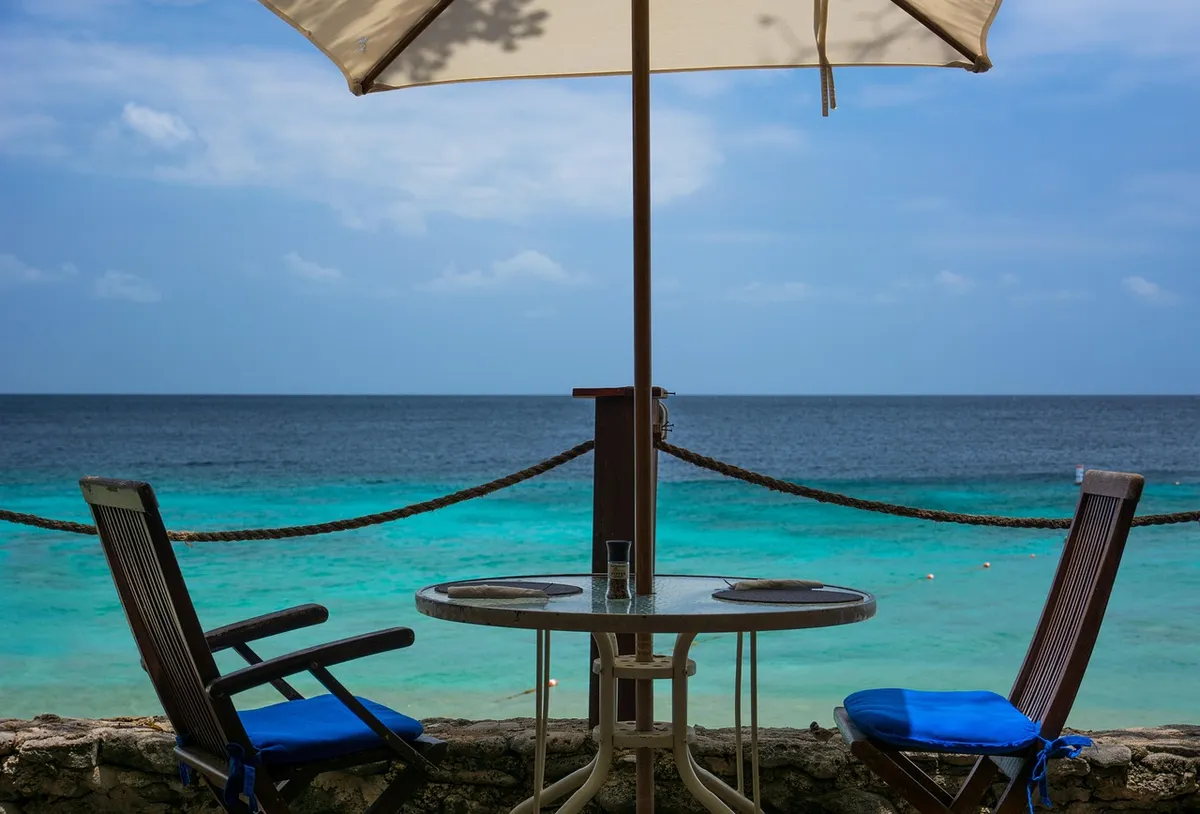
Base weight by canopy size
The base is what keeps the umbrella upright, and it matters more than most buyers expect. A larger canopy catches more wind and needs a heavier base. No source documents a universal weight, because it depends on pole height, wind exposure and whether the pole passes through a table, but manufacturers state minimum base weights for their models and those should be followed.
As a rough guide, a small market umbrella, around 2 m, sits in a base of about 10 kg, and a 2.7 m umbrella in a base of around 15 to 25 kg, particularly when the pole goes through a heavy table. A cantilever umbrella of 3 m or more commonly needs a base of 50 kg or more, often built from filled or stacked sections, and the manufacturer's figure should be used. The table itself adds stability for a market umbrella, but a light table does not.
Base types include concrete, sand or water filled plastic, steel plates and cross bases that can be weighted with paving slabs. Water or sand filled bases are heavy when full and light to move when empty. Choose a base with a wide footprint, since a narrow heavy base can still tip. Always close the umbrella in strong wind or when you leave, no matter how heavy the base, since no base is guaranteed in a gust.
Wind venting and frame strength
A vented canopy has a flap or a double layer at the top that lets wind pass through instead of lifting the canopy like a sail. Venting reduces lift and flapping, which makes an umbrella more stable in a breeze. It does not make it wind proof, and the umbrella should still be closed in stronger wind.
Frame material matters. Aluminium ribs are light and rust free, fibreglass ribs flex and spring back in wind without bending permanently, and steel ribs are strong but can rust. Thicker poles and more ribs, usually 6 or 8 on most sizes, make for a sturdier canopy. Check the stated wind tolerance if the maker gives one, and be sceptical of any claim that the umbrella can stay open in strong wind.
Practical habits protect the umbrella. Close it when you leave the table or when wind picks up, use the tie strap, and store it down in a gale warning. An umbrella left open and unattended is the usual cause of damage, and a broken umbrella can injure people and damage property. Position the table away from glass doors and parked cars if the area is windy.
Fabric and fade resistance
Canopy fabric faces constant sun, and it fades. Solution dyed acrylic has the colour in the fibre and resists fading much better than polyester, which is dyed on the surface. Solution dyed fabric also resists mildew and dries quickly, though it costs more. Polyester is cheaper and fine for shaded or occasional use, especially with a UV and water repellent coating, though the coating wears.
Look for the fabric type in the specification and not vague terms such as weather resistant. Fabric weight, given in grams per square metre, is a rough guide to thickness, and heavier fabric is generally more durable. A UV protection rating, often shown as UPF, tells you how much ultraviolet light the canopy blocks, but no source documents a standard rating that applies to every product, so check what the label says. Lighter colours stay cooler, and darker colours block more light.
Care extends life. Brush off dust, wash with mild soap and water, and let it dry before closing, since a damp folded canopy grows mildew. A fitted cover protects the canopy when not in use.
Tilt and crank mechanisms
A crank opens and closes the canopy smoothly, which is easier than a manual push up pole and safer for larger sizes. Check that the crank handle is sturdy and the gears are metal, not plastic. A tilt mechanism angles the canopy to follow the sun, either with a push button or a collar that you pull.
Tilt matters for keeping the table shaded as the sun moves in the afternoon. A simple tilt with a few positions is enough for most. Cantilever models rotate and tilt, which gives more control. Check that the tilt locks firmly, since a canopy that sags is annoying and unsafe. A cheap plastic tilt mechanism is the most common point of failure, so look for metal parts and owner feedback on durability.
Storage, winter and placement
Close the umbrella and fasten the strap after each use, and take the canopy off the frame for winter if it is removable. Store it dry, in a cover or a shed, since moisture breeds mildew and frost can damage mechanisms. Drain and store water filled bases, since freezing water cracks them.
Place the umbrella where its shade falls where you sit, considering the sun's path. Keep it away from a grill, since a hot grill and an umbrella canopy are a fire risk, and a gust can blow a canopy into the flames. Our guide on gas versus charcoal grills covers clearances. For the rest of the setting, see our outdoor furniture materials comparison and the Outdoor and Garden section.
Planning shade through the day
Shade is not a fixed patch, because the sun's height and direction change from morning to evening and from season to season. In summer, the midday sun is high and the shadow falls almost directly under the canopy, so a modest overhang works. In spring and autumn, and in the late afternoon of any season, the sun is lower, and the shadow stretches away from the sun, falling beyond the table and leaving the sun side of the seating exposed.
Watch where the sun sits at the hour you will actually use the space. If you mostly eat outdoors in the evening, the low western sun is the problem, and a tilting canopy or a cantilever that can swing to the west is worth the cost. If you use the patio at midday, a plain market umbrella with a generous overhang is enough. A simple trick is to stand a broom handle where the umbrella pole will be, and note the length and direction of its shadow at different times.
Mounting height matters as well. A low canopy gives more shade for a given diameter, because the shadow is closer to the umbrella's size, but it can bump heads and make the space feel closed in. A good clear height under the ribs is around 2 m to 2.1 m, which suits most adults. Check the pole length and the table height so that the clear height at the edge of the canopy is still comfortable for people sitting and standing.
Common mistakes and non-obvious failures
The first mistake is judging by the canopy alone. Listings quote the open diameter, but a six rib canopy tapers, and the real shade is smaller than the circle suggests, so size up where in doubt. The second is ignoring the table hole: a market pole will not fit a table with no hole or a hole that is too small, and a sleeve or adapter may be needed. Measure the hole and the pole diameter before buying.
Less obvious is the weight of the table itself. A glass top table with a thin frame offers little stability, and an umbrella through it can tip the whole table in a gust. Weight the table base as well as the umbrella base. Another failure is the umbrella that is left open overnight, when wind and dew do the damage. Many canopy tears and bent ribs happen when the umbrella is left unattended. A third failure is a base that is heavy enough in the shop but is placed on a slope or on loose gravel, where it can slide. Place the base on a flat, firm surface.
Finally, remember neighbours and sightlines. A large cantilever umbrella over a boundary fence can block a neighbour's light and, in some places, count as a structure, so check local rules if it is large or fixed in place. Position umbrellas away from trees with sharp branches, which can tear the fabric, and from overhead wires.
Canopies collect dust, pollen and bird droppings over a season. A gentle wash with a soft brush and mild soap is safer than a jet, and our pressure washer guide explains why a high pressure nozzle can strip the water repellent finish and fray the stitching of a fabric canopy.
Frequently asked questions
What size umbrella do I need for a four seat table?
A canopy of about 2.4 m to 2.7 m suits a typical round four seat table, giving enough overhang to shade the chairs. Measure your own table and allow 60 to 90 cm of overhang on each side.
How heavy should the base be?
Follow the manufacturer's minimum for your model. As a rough guide, a market umbrella of around 2.7 m wants a base of 15 to 25 kg, and a large cantilever often needs 50 kg or more. Always close the umbrella in strong wind.
Is a cantilever umbrella better than a market umbrella?
It leaves clear space beneath and tilts to follow the sun, but needs a much heavier base and costs more. A market umbrella is simpler, cheaper and more stable.
Does wind venting make an umbrella wind proof?
No. Venting reduces lift and flapping, but the umbrella should still be closed in strong wind. No umbrella is safe to leave open in a gale.
Why does my umbrella fade so quickly?
Polyester fabric is dyed on the surface and fades under strong sun. Solution dyed acrylic holds colour far better. Storing the umbrella closed and covered also extends its life.
The bottom line
Size the canopy to the table plus 60 to 90 cm of overhang on every side. Choose a market umbrella for simplicity and stability, or a cantilever for a clear space and sun tracking, and match the base weight to the canopy and the pole style.
Look for vented canopies, solution dyed fabric and metal mechanisms. Close the umbrella in wind and when you leave, and store it dry for winter.