A rowing machine is one of the few home cardio machines that works the legs, back and arms in one stroke, which is why it keeps appearing in home gym lists. It is also one of the most varied categories, because the way the machine creates resistance changes how it feels, how loud it is, how much space it needs and how long it lasts. Two rowers that look similar on a screen can feel nothing alike in use.
This guide compares the four resistance types: air, magnetic, water and hydraulic. It explains the resistance curve, which is the thing that makes a stroke feel natural or awkward, then covers noise, footprint and folding, monitor data, rail length for tall users and maintenance. If you have back or joint problems, a physiotherapist should advise on whether and how to row, because technique matters on this machine.
How a rowing stroke loads the machine
A rowing stroke has four parts: the catch, where the legs are bent and the arms are straight, the drive, where the legs push, then the body swings back and the arms pull, and the recovery, where you slide forward again. Most of the force comes from the legs in the first part of the drive, tapering as the body and arms finish the stroke. A good machine should respond to that surge of force without feeling like it fights you.
The machine resists the handle, and the way it does so is the whole difference between types. A rower that gives a lot of resistance at the start and drops off quickly feels natural, because it matches how a boat accelerates. A rower with an unchanging resistance feels more like lifting a weight. Understanding this helps you interpret listings, which usually just say quiet, smooth or realistic.
Air resistance rowers
Air rowers use a flywheel with fan blades inside a cage. You pull the handle, which spins the fan, and the faster you pull, the more air resistance you meet. Resistance is set both by your effort and by a damper lever that opens or closes the cage vents. The relationship is natural: harder pulling gives harder resistance, instantly and without steps.
The strengths are the realistic feel, a wide effort range from a gentle session to an all out sprint, and robust, simple construction. The drawbacks are noise, because the fan makes a loud whoosh, and the fact that the damper setting does not equal the same effort for every machine. Air rowers are the standard in competitive rowing and in most gyms, which means their monitors are often designed to compare between machines. They suit anyone who wants a serious workout and does not mind the sound. For apartments with thin walls, noise is a real consideration.
Magnetic resistance rowers
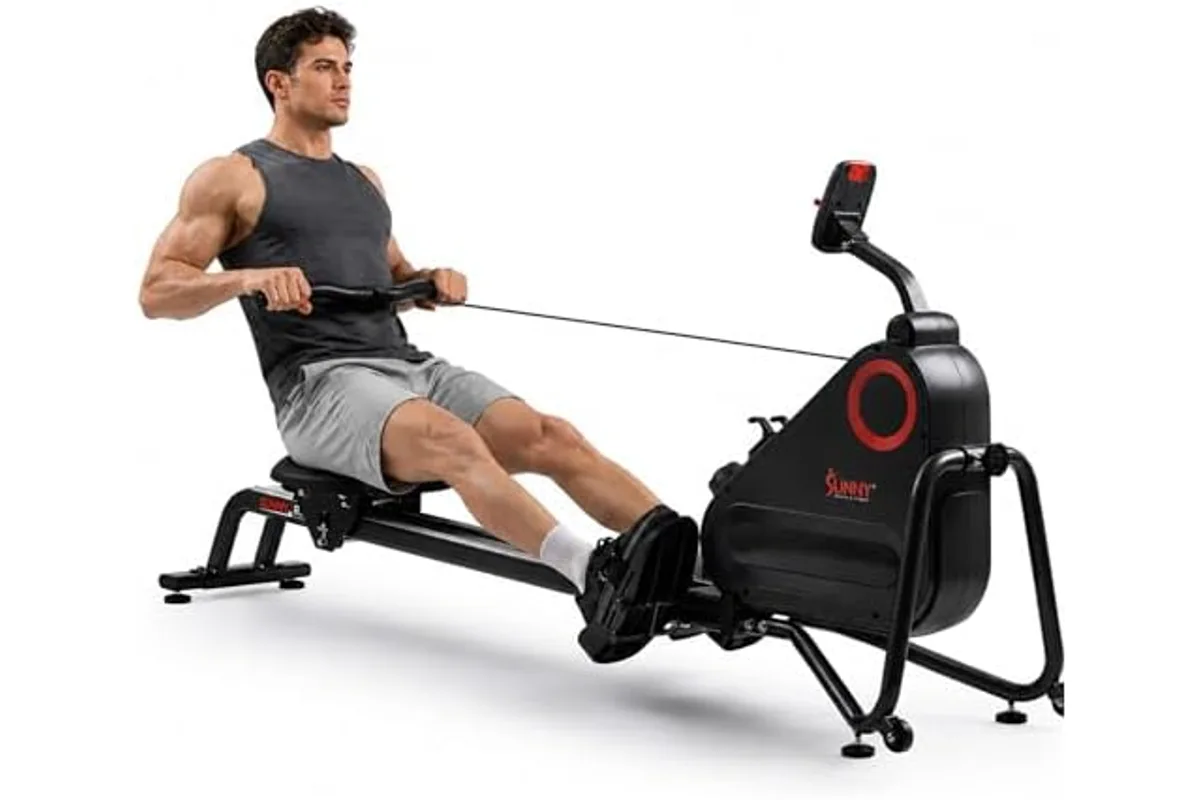
Magnetic rowers use magnets near a flywheel to create resistance by magnetic induction, adjusted by moving the magnets closer to or further from the wheel, often by a dial or an electronic control. They are quiet, smooth and need little maintenance, because nothing rubs against the wheel.
The stroke feel is smooth, but the resistance tends to follow a steadier curve than an air rower, so the catch can feel lighter and the finish heavier, or simply less lively. Many models offer several resistance levels and some adjust electronically, which allows programmed workouts. They suit shared homes, bedrooms and early or late sessions, because they hum rather than roar. Cheaper magnetic rowers can have limited top resistance, so check the number of levels and read owner feedback on whether strong users outgrow them.
| Type | Feel | Noise | Footprint and weight | Upkeep |
|---|---|---|---|---|
| Air | Responsive, scales with effort | Loud | Long, moderate weight | Occasional dust and chain care |
| Magnetic | Smooth, fixed levels | Quiet | Varies, often compact | Very low |
| Water | Natural, splashing sound | Moderate, watery | Heavy, bulky tank | Water treatment |
| Hydraulic | Short, piston based | Low | Very compact | Pistons can leak or soften |
Water rowers
Water rowers have a tank of water with paddles that spin as you pull, so the water itself provides resistance. The sound of the water, a rhythmic swish, is a draw for many people, and the resistance feels fluid and natural. Resistance depends on how fast you pull and on the amount of water in the tank, which you set when filling.
Tanks are heavy when full, and the machine is bulkier than other types, though many are designed to stand upright for storage, and wooden ones can double as furniture. They need care: the water should be treated with a purification tablet from time to time to stop algae and odours, and tanks should be drained if the machine will not be used for a long period. Water rowers are quieter than air rowers but not silent, and the sound some people love can irritate others. They suit people who want a look and a feel that are close to real rowing and have the space to accommodate them.
Hydraulic piston rowers
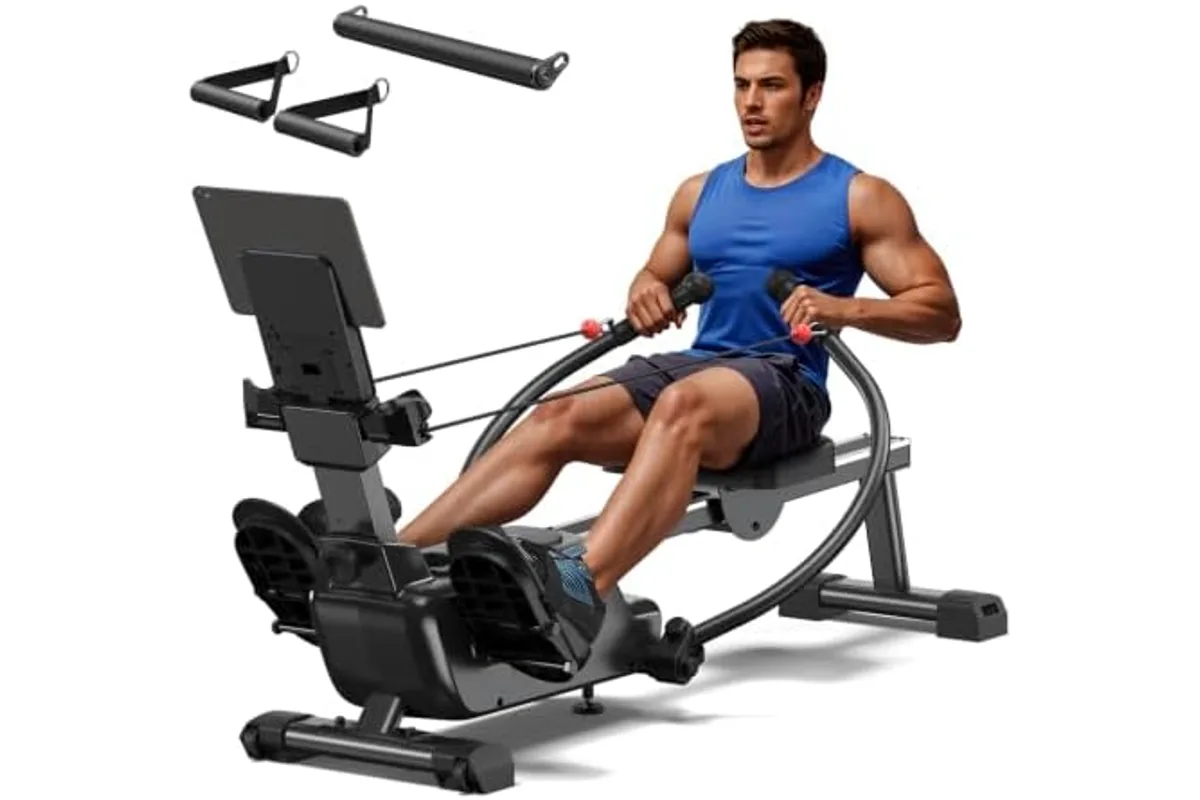
Hydraulic rowers use one or two fluid filled pistons attached to the handle arms, which you push and pull against. They are the cheapest and most compact type, and many fold flat. They suit small spaces, light exercise and occasional use.
The stroke is different from a flywheel rower, because the handles often move in an arc rather than a straight line, and the resistance is set by piston adjustment. The seat may slide on a short rail, so the movement can feel restricted and less like true rowing. The pistons can lose resistance or leak with time, and owner feedback often mentions this. If budget and storage drive the decision, a hydraulic rower is a fair entry point, but do not expect it to match the feel or the effort range of a flywheel machine.
Resistance curve and what it feels like
The curve describes how resistance changes during a stroke. Air and water rowers give resistance that rises with the speed of your pull, which means a surge of force meets a surge of resistance, and a slow pull meets little. This is why they feel natural: the faster you work, the harder it is, and the machine adapts to you.
Magnetic rowers hold resistance more constant for a given setting, and feel more like lifting a load. That can be a plus for steady, controlled work and a minus for people who want a lively catch. No source documents a single best curve, since it is a matter of preference and training goals. If you can, try one before buying. If not, read owner feedback for words like jerky, smooth or lifelike, which describe the curve better than the product page does.
Resistance settings across brands are not comparable, so do not assume a level 5 on one machine is the same effort as level 5 on another. Use the monitor and your own perceived effort as the guide.
Footprint, folding and storage
Rowing machines are long, typically about 2.1 m or more in length when in use and around 50 cm to 60 cm wide. Measure the room, allow space to sit and slide, and check the clearance at the front for the flywheel cage. Many models stand upright on their end for storage, taking up a fraction of the floor space, and some fold at the middle.
Check how the machine moves. Transport wheels at the front let you tilt and roll it, but a heavy water rower is awkward to shift. Check the stored footprint and height, because an upright rower can stand taller than a standard doorway. Stability matters too: a machine that rocks on an uneven floor is unpleasant, so look for adjustable feet and a solid frame. Put a mat under it, as with any exercise equipment, to protect the floor and reduce vibration and noise.
Monitor data
Rowing monitors show time, distance, stroke rate and a split time per 500 metres. The split is the main pace measure in rowing, showing how long it would take to row 500 metres at your current effort. Many monitors also estimate calories and heart rate if you connect a strap, and many connect to apps.
Treat the numbers with care. Distance and split are calculated from the flywheel speed through a formula, and formulas differ between brands, so comparisons between different machines are not reliable. Calorie figures are estimates and not measurements, and should be treated as rough. Comparing your own results on the same machine over time is the useful part. Check that the monitor is easy to read from the rowing position, and that its battery or power source suits your use. App connectivity is a convenience, not a necessity, and some apps need a subscription for full features.
Rail length and fit for tall users
The rail is the track the seat slides along. A tall person needs enough rail length for the legs to extend fully at the finish, or the stroke gets cut short. Many rails suit users up to a certain height, and manufacturers sometimes state a maximum inseam or height. If you are tall, look for a longer rail and check the stated figure.
Seat height matters for comfort and for getting on and off. A higher seat is easier for people with stiff knees, and a lower seat is more traditional. Footplates should adjust to your shoe size and have straps that hold the feet securely. The handle should be comfortable and the chain or strap smooth. A short rail can make a tall rower hit the end, while a long rail on a small machine is usually a sign of a larger, more stable frame. For the broader picture on cardio equipment, see our guides on exercise bikes and treadmill motors.
Maintenance and care
Air rowers need the flywheel cage cleaned of dust from time to time, and a chain, if fitted, lightly lubricated according to the manual. The rail should be wiped clean so the seat glides. Magnetic rowers need little more than a wipe, and a check of the bolts. Water rowers need tank treatment and attention to leaks. Hydraulic rowers need a check on the pistons and their mounts.
For all of them, wipe sweat off after use, because salt and moisture corrode metal and degrade foam. Tighten bolts periodically, because vibration loosens them. Check the straps and seat for wear, and replace them when they fray. A machine that is cared for will last for many years, and one that is neglected will creak and wear. Note the warranty for the frame and parts, as it signals how the maker expects the machine to hold up.
Technique and safety
Good technique protects the back and gets more from each stroke. Drive with the legs first, then swing the body back, then pull with the arms, and reverse the order on the way forward. Keep the back flat and avoid rounding at the catch or leaning far back at the finish. Beginners often pull with the arms first, which is tiring and inefficient.
Start with short sessions at a comfortable pace and build up gradually. Stop if you feel sharp pain, especially in the lower back, hips or knees. Anyone with a back problem, a heart condition or another medical concern should ask a doctor or physiotherapist before starting, and a coach or an instructional video can correct form. Visit our Health and Fitness section and the guide to weight benches for strength work that complements rowing.
Buying checks and what listings leave out
Start with the weight capacity, which is stated by most makers and tells you about frame strength. A rated capacity comfortably above your weight leaves margin, and a machine that wobbles or flexes at the rail joint under load will wear quickly. Look for a rail made from a single, thick extrusion, rollers that glide without clicking, and a seat that does not rock. These are details a photograph cannot show, so owner feedback about creaks and squeaks is useful.
Next, check the handle and the connection to the resistance unit. Air and magnetic rowers usually use a chain or a strap, and straps are quieter but wear out, while chains are durable but need oiling. Water rowers use a cord or strap through a pulley. A frayed strap is a safety item, so look for spares and a clear way to replace it. Check also how the footplates adjust and whether the straps hold your feet securely, since slipping feet change the stroke.
Consider the software side honestly. A monitor with Bluetooth and an app is a convenience, but some apps lock features behind a subscription, and a machine that depends on a screen for resistance control is less useful if the screen fails. A machine with a simple, readable display and manual resistance keeps working for years. If you want guided classes, check what the app costs before counting it as a benefit.
Finally, think about who else will use it. A shared machine needs a quick way to adjust footplates, a seat that suits different heights, and a monitor that stores separate profiles, or at least resets easily. If someone in the household has limited mobility, a taller seat and simple controls matter more than the headline resistance type. Delivery and assembly are worth noting too, since rowers arrive in large boxes and need a second pair of hands.
Frequently asked questions
Which type of rowing machine is quietest?
Magnetic rowers are the quietest, followed by hydraulic and water. Air rowers are the loudest because the fan moves a lot of air. If noise matters in your home, choose magnetic.
Are water rowers better than air rowers?
Neither is better overall. Water rowers have a pleasant sound and a natural feel but are heavy and need tank care. Air rowers are simpler and more scalable for hard training but louder.
Do I need a long rail if I am tall?
Yes. A short rail cuts the leg drive short and spoils the stroke. Check the stated maximum user height or inseam, and choose a longer rail if you are tall.
Can I compare my results with another machine?
Not reliably. Brands calculate distance, split and calories with different formulas. Compare your own results on the same machine over time instead.
Is rowing safe for my back?
Rowing can be gentle with good technique, but poor form can strain the back. If you have back problems, ask a doctor or physiotherapist first, and start with short, easy sessions.
The bottom line
Choose an air rower for a lively, scalable feel and hard training, a magnetic rower for quiet and low upkeep, a water rower for look and feel if you have space, and a hydraulic rower only for budget and tight storage. Check rail length for your height, and treat monitor numbers as personal trends, not universal measures.
Measure the room, plan storage, and put a mat underneath. Learn the stroke slowly, and see a professional about any back or health concern before you start.