
Amazon affiliate links - we earn a commission.Affiliate disclosure

Buying guide · 12 min read · Updated 2026-11-26

Best Budget Miter Saws (2026)

The best budget miter saws for 2026, with honest notes on blade size, bevel type, sliding capacity, laser guides and what cheap saws trade for their price.

Brianna Cole, Lead Product EditorBy Brianna ColeLead Product Editor5 picks comparedSpec-sheet verified
Best Budget Miter Saws

At a glance

Our top picks

Side by side

Spec comparison

A miter saw makes fast, accurate crosscuts and angle cuts in trim, framing lumber and moulding. Budget models cover the basics well, but they differ most in blade size, bevel design and whether the head slides for wider boards.

Treat the blade as part of the price, because the stock blade on a budget saw is the cheapest part of the package. Most budget saws ship with a coarse blade that tears finish trim, so plan to add a finer one. Check cut capacity against the lumber you use, and keep the fence square and the workpiece clamped.

Before you buy

6 Criteria to Look For Before Buying a Budget Miter Saw

  1. 01

    Blade size and capacity

    A 10 inch blade handles most 2x lumber crosscuts and baseboard. A 7-1/4 or 8-1/4 inch blade limits capacity. The common mistake is buying a smaller saw to save space and then being unable to cut a 2x12 or a taller crown. In this lineup the Metabo HPT, DEKOPRO and DOVAMAN are 10 inch saws while the SKIL and SEESII are smaller.

  2. 02

    Single versus dual bevel

    A single bevel saw tilts one way, so you flip the board for opposite bevels. A dual bevel saw tilts both ways and saves time on crown moulding and trim. Every pick here is single bevel. On a single bevel saw, cutting the left and right sides of an outside corner means flipping the board end for end and cutting from the opposite orientation, which is fine for baseboard and fine for a weekend of trim, but slows you down on a whole room of crown. If you do a lot of angled trim, a dual bevel saw is worth saving for.

  3. 03

    Slide or fixed head

    A sliding head extends capacity to wider boards, as on the DOVAMAN's 13 inch rail. Fixed heads are simpler and stiffer. Sliding rails on budget saws can develop play. Choose slide only if you need the width. A slider also needs clearance behind it for the rail to travel, so a saw against a wall must sit forward on the bench, which uses up the room you thought you would save.

  4. 04

    Blade quality and tooth count

    Stock blades are usually coarse, like the 24T on the Metabo HPT, and tear finish trim. A 60T or higher blade gives smoother cuts. The DOVAMAN ships with three blades at 40T and 48T. Plan to replace the blade on any budget saw. A good 60T or 80T blade costs a fraction of the saw and changes the quality of every cut, and a thin-kerf blade puts less strain on a small motor. Match the arbor size and the maximum rpm on the blade to the saw.

  5. 05

    Cut guides: laser or shadow line

    A laser is easy to see indoors but can be hard to see in sunlight and can drift. An LED shadow line, as on the SKIL, is generally more accurate. Neither replaces a test cut. Always confirm with a pencil mark. Line up the blade teeth with your mark by lowering the saw without power, and note which side of the line the kerf will remove, since a blade removes about an eighth of an inch of wood.

  6. 06

    Accuracy, fence and safety

    Check the fence for square and the miter detents for accuracy when the saw arrives. Always clamp the workpiece, keep hands clear of the blade path and wait for the blade to stop. Dust collection is limited on budget saws, and a dust bag catches only part of the chips. Wear eye and ear protection. Hold the workpiece firmly against the fence, never cut freehand, and keep any offcuts away from the blade until it stops.

Detailed reviews

The 5 best budget miter saws, explained

01
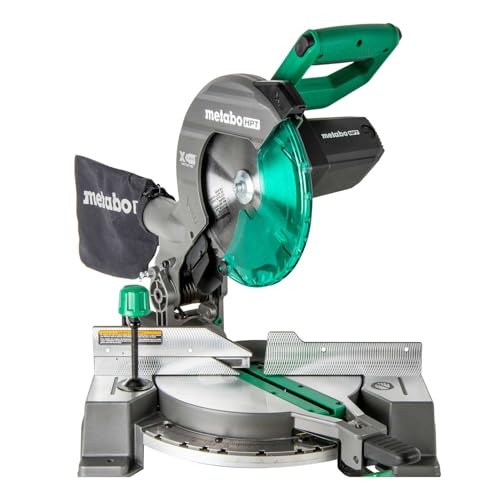
Metabo HPT 10 Inch Compound Miter Saw C10FCG2 15 Amp
10 inch blade15 amp motor24 lb body
Check price on Amazon
Best for: DIYers who want a light, capable 10 inch saw for trim and framing.

The Metabo HPT C10FCG2 is a straightforward 10 inch single bevel compound saw with a 15 amp motor and a 24T carbide-tipped blade. At 24 lb it is light enough to carry between jobs, and the second-generation design includes an improved miter scale and more precise controls.

Against the DEKOPRO it has a stronger motor rating and a better-known maker. Against the SKIL 7-1/4 inch it offers a larger blade and more capacity. It ranks first because the weight, motor and fit-and-finish suit most DIY work, and because a 10 inch blade covers the sizes most homeowners cut.

The stock 24T blade is a framing blade, so swap in a 60T or higher blade for trim to avoid tear-out. Check the fence for square before you cut, and clamp the workpiece. Single bevel means you flip the board for opposite bevels. Wait for the blade to stop before lifting the head, and keep your hands clear of the cutting line. Dust collection on saws at this level is limited, so work outdoors or attach a shop vacuum to the port if one is fitted.

What works

  • 15 amp motor suits most DIY cuts
  • Light 24 lb body carries easily
  • Improved miter scale aids accuracy
  • 10 inch blade handles most lumber

Watch out for

  • Stock 24T blade tears finish trim
  • Single bevel means flipping boards
  • No sliding rail for wide boards

Specs

Blade
10 inch, 24T carbide tipped
Motor
15 amp
Bevel
Single bevel compound
Weight
24 lb
Scale
Improved miter scale and controls
02
DOVAMAN 10 Inch Sliding Miter Saw 2-Speed 3 Blades
13 inch sliding rail2-speed motor3 blades included
Check price on Amazon
Best for: Cutting wider boards on a budget.

The DOVAMAN is the only sliding saw in the lineup. A 13 inch sliding rail extends the cutting range to wider boards, and the extendable side tables support long stock. It ships with three carbide blades, two 40T and one 48T, and a two-speed motor aimed at multi-material cutting.

Against the Metabo HPT it adds slide capacity and extra blades, but it is a less established brand and a heavier, bulkier tool. Against the SKIL 7-1/4 inch it handles far wider boards. It ranks second because the capacity and blade count are real strengths, and only the brand uncertainty keeps it from first place.

Sliding saws need more bench depth, because the rail extends behind the saw. Check the rail for play, which is common on budget sliders. Use the two-speed setting carefully, since cutting non-wood materials needs the right blade. The laser guide is a rough reference, and a shadow line is generally more reliable. Clamp the work and wait for the blade to stop.

What works

  • 13 inch slide handles wider boards
  • Three blades included
  • Two-speed motor adds versatility
  • Extendable side tables support long stock

Watch out for

  • Sliding rail can develop play
  • Heavier and needs more bench depth
  • Less established brand

Specs

Blade
10 inch, two 40T and one 48T
Motor
15 amp, 2-speed
Slide
13 inch sliding rail
Bevel
0 to 45 degrees
Extras
Laser guide and extendable side tables
03
DEKOPRO 10 Inch Compound Miter Saw 13 Amp 5000 RPM
10 inch blade13 amp motor5,000 rpm
Check price on Amazon
Best for: Occasional trim and framing on a very low spend.

The DEKOPRO is a basic 10 inch compound saw with a 13 amp motor running at 5,000 rpm. Its large work table supports material for cleaner cuts, and it offers a range of angle adjustments for mitres.

Against the Metabo HPT it has a smaller motor and less detail about the build. Against the SEESII it gives a larger blade and more capacity. It ranks third because it is a sensible, low-cost 10 inch saw but the brand and the spec sheet are less convincing.

Check the fence and bevel for square when the saw arrives, since budget saws can ship slightly off. Use a finer blade for trim. Clamp the work and avoid cutting small pieces by hand. Expect to adjust the miter stops with a square before critical cuts. If you plan to use it every week, a better-known saw has a lower chance of a wandering miter.

What works

  • Full 10 inch blade at a low cost
  • 5,000 rpm motor cuts quickly
  • Large table supports workpieces
  • Single bevel compound design

Watch out for

  • 13 amp motor is smaller than rivals
  • Out-of-box squareness may need adjusting
  • Brand support is thinner

Specs

Blade
10 inch
Motor
13 amp, 5,000 rpm
Bevel
Single bevel compound
Table
Large work table
Use
Wood trim and lumber
04
SEESII 8-1/4 Inch Compound Miter Saw 4900 RPM Laser
8-1/4 inch blade4,900 rpmLaser guide
Check price on Amazon
Best for: Small trim and craft work in compact spaces.

The SEESII is a compact 8-1/4 inch saw with a laser guide, a 4,900 rpm motor and a single bevel of 0 to 45 degrees. The smaller blade and body make it light and easy to store, and it suits picture frames, baseboard and small trim.

Against the DEKOPRO it has a smaller blade and a smaller crosscut capacity. Against the SKIL 7-1/4 inch it has a slightly larger blade and a laser rather than a shadow line. It ranks fourth because the reduced capacity limits it to small stock, and a laser can be less reliable than a shadow line in bright light.

Check how it handles a 2x4 and a 1x6 before you commit, since smaller blades can struggle with thick lumber. Use the laser as a rough guide and confirm the cutline with a test cut. Clamp the work and wait for the blade to stop. If you build decks or framing, choose a 10 inch saw instead.

What works

  • Compact and easy to store
  • 4,900 rpm cuts trim cleanly with the right blade
  • Single bevel from 0 to 45 degrees
  • Laser guide helps quick setup

Watch out for

  • 8-1/4 inch blade limits capacity
  • Laser can be hard to see in bright light
  • Not suited to thick lumber

Specs

Blade
8-1/4 inch
Speed
4,900 rpm
Bevel
Single bevel 0 to 45 degrees
Guide
Laser
Size
Compact
05
SKIL 7-1/4 Inch Single Bevel Miter Saw Compact Rail LED
7-1/4 inch bladeCompact rail systemLED shadow line
Check price on Amazon
Best for: Small workshops that need a compact, light saw.

The SKIL 7-1/4 inch saw uses a fixed compact rail system to keep the bench-to-wall footprint small, which helps in a cramped workshop. It offers a 2x10 crosscut at 0 degrees and nested crown moulding up to 3-1/2 inches, and an LED shadow line to mark the cut.

Against the Metabo HPT it has a smaller blade and motor, but it takes less space. Against the SEESII it uses a shadow line, which is generally more accurate than a laser. It ranks last because a 10 amp motor and a 7-1/4 inch blade limit it to light work.

The rail system is a clever space-saver, but it adds weight at the back and needs the stand sold separately to be fully useful. Use it for trim, baseboard and small boards. Do not use it for thick framing in bulk. Wait for the blade to stop, keep hands clear and clamp the work. If you may later need to cut 2x12 lumber, go for a larger blade.

What works

  • Compact rail cuts bench-to-wall footprint
  • LED shadow line marks the cutline clearly
  • Handles 2x10 crosscuts at 0 degrees
  • Light and easy to move

Watch out for

  • 7-1/4 inch blade limits cut depth
  • 10 amp motor is the smallest here
  • Stand is sold separately

Specs

Blade
7-1/4 inch
Motor
10 amp
Capacity
2x10 crosscut at 0, 3-1/2 inch crown nested
Rail
Fixed compact rail system
Guide
LED shadow line

Spec decoder

What the listing measurements really mean

The numbers brands lead with, translated into what they tell you about fit, comfort and wear at home.

Blade diameter

The size of the blade, which sets the maximum crosscut and cut depth. Larger blades cut thicker material.

Watch forThe SKIL's 7-1/4 inch blade limits it to light work.

Amp rating

The motor's current draw, a rough guide to power. 15 amps is a common full-power rating.

Watch forThe Metabo HPT lists 15 amps while the DEKOPRO lists 13 amps.

Single bevel

The blade tilts in one direction only. You flip the board for the other side.

Watch forAll five picks are single bevel.

Sliding capacity

The extra width a sliding head can cut compared with a fixed head.

Watch forThe DOVAMAN lists a 13 inch slide.

Tooth count (T)

The number of carbide teeth on the blade. Fewer teeth cut fast and rough, and more teeth cut slower and smoother.

Watch forThe Metabo HPT's 24T blade is a framing blade.

Methodology

How We Evaluated These Budget Miter Saws

Capacity and blade size

We compared blade diameter and stated crosscut limits. The SKIL lists a 2x10 crosscut while the 10 inch saws go larger. We rewarded capacity that suits common lumber.

Motor and weight

We read motor ratings and weight. The Metabo HPT is 15 amps at 24 lb. Owner feedback patterns show weight matters for portability.

Bevel and slide design

We considered single versus dual bevel and slide capacity. The DOVAMAN adds a sliding rail. We favoured features that match typical DIY cuts.

Guides and accuracy

We compared lasers and shadow lines and the accuracy of the miter scale. The SKIL uses a shadow line, and the Metabo HPT has an improved scale. We expect every saw to be squared at setup, and a saw that cannot hold a square setting after a few weeks is a poor value no matter how low the cost.

Value versus compromise

Each pick sits in the lower half of the price range. We weighed what each gives up, such as dual bevel, dust collection or a better blade.

Decision guide

How to Choose the Right Budget Miter Saws

By Blade Size

SituationPickWhy
Framing and trimMetabo HPT 10 inch15 amp and light
Wide boardsDOVAMAN 10 inch slider13 inch slide
Low-cost 10 inchDEKOPROFull blade for less
Small trim onlySEESII 8-1/4 inchCompact

By Budget

Budget tierPickWhy
Lowest spendSEESII 8-1/4 inchCheapest saw here
Low spendDEKOPROLow-cost 10 inch
Low to mid spendSKIL 7-1/4 inchCompact rail
Upper end of guideMetabo HPT or DOVAMANBetter motor or slide

Sliding vs Fixed

DOVAMAN (sliding)

Cuts wider boards and ships with extra blades. It needs bench depth and the rail can develop play.

Metabo HPT (fixed)

Simple, light and stiff. It cannot cut as wide a board.

Pick sliding for wide shelving boards. Pick fixed for trim and framing.

By Workshop Space

SituationPickWhy
Tight garageSKIL compact railSmall bench-to-wall footprint
Portable useMetabo HPTOnly 24 lb
Light craft workSEESIICompact body
Room for a sliderDOVAMANLong rail

For Trim and Baseboard Specifically

Look for

A fine blade, a clear cutline, accurate miter stops and enough fence height for baseboard. Test cuts on scrap before the real board.

In this comparison

The Metabo HPT with a finer blade suits most trim. The SKIL is a space-saving choice for small boards.

When to Spend More

Spend more if

You cut crown, build decks or use the saw weekly. A dual bevel, dust collection and a stiffer fence pay back in accuracy and time.

Save if

You cut trim and shelving a few times a year. A budget saw with a good blade is enough.

Ownership

Maintenance schedule

The upkeep that decides whether a piece still looks good in year five.

TaskIntervalWhy it matters
Check fence and miter for squareBefore each projectVibration shifts settings. A square confirms accuracy. Make a test cut in scrap, flip the offcut and check that the two pieces fit together without a gap. Even a small error at 90 degrees opens a visible joint in a picture frame or door casing.
Replace or sharpen the bladeWhen cuts burn or tearDull blades strain the motor and give rough edges. Fit a finer blade for trim. Unplug the saw before you change it, and wear gloves to protect your hands from the teeth.
Clean dust from the pivot and railsAfter dusty jobsSawdust jams moving parts. A dry brush clears it. Do not blast the pivot with an air hose, which drives dust into the bearings, and put a drop of light oil on the slide rails only if the manual calls for it.
Inspect the cord and switchEvery few monthsCuts and loose switches are safety risks. Replace damaged parts.
Store dry and coveredAlwaysRust forms on tables and rails. A light oil wipe protects them.

FAQ

Frequently Asked Questions

Is a 10 inch miter saw better than a 7-1/4 inch?

For capacity, yes. A 10 inch blade cuts wider and thicker boards. A smaller saw is lighter and cheaper but limited.

Do I need a sliding miter saw?

Only if you cut boards wider than a fixed saw can handle. Many DIYers do not. A fixed saw is stiffer and simpler.

Why does my saw tear the wood?

Stock blades are often coarse. A 60T or higher blade gives smoother cuts. Use masking tape on the cutline for delicate finishes, cut with the good face up, and lower the blade slowly through the work so it does not grab and chip the edge.

Are lasers accurate?

They are a rough guide. A shadow line is usually better. Confirm with a test cut.

What stand do I need?

A stand or long supports help with long boards. Support both sides of the blade at the same height, because a board that droops pinches the blade and can kick back. A pair of sawhorses with a straight scrap board across them works as a cheap alternative.

How do I cut safely?

Clamp the workpiece and keep hands well clear of the blade path. Wait for the blade to stop before lifting the head. Wear eye and ear protection.

Bottom line

The short version

Browse more budget miter sawson Amazon →
Brianna Cole, Lead Product Editor

About the author

Brianna Cole

Lead Product Editor, SenseiReview

Brianna Cole leads SenseiReview's buying guides, turning published specifications, documentation and owner feedback patterns into clear verdicts across home, tech, fitness, outdoor and DIY products.

More from Brianna →

Keep reading

Related guides