
Amazon affiliate links - we earn a commission.Affiliate disclosure

Buying guide · 12 min read · Updated 2026-11-21

Best Wood Cutting Boards (2026)

Five wood and bamboo cutting boards compared on grain direction, thickness, size, juice grooves, knife friendliness and long-term care for home cooks.

Brianna Cole, Lead Product EditorBy Brianna ColeLead Product Editor5 picks comparedSpec-sheet verified
Best Wood Cutting Boards

At a glance

Our top picks

Side by side

Spec comparison

PieceSizeConstructionWoodThicknessBest use
BABILONIA American walnut end grain butcher block, 16 by 10 by 1.7 inchBest OverallBABILONIA American walnut end grain butcher block, 16 by 10 by 1.7 inch16 by 10 by 1.7 inchesEnd grain butcher blockAmerican black walnut1.7 inches for stabilityDaily chopping and a serious prep station
BABILONIA walnut end grain cutting board, 17 by 13 by 1 inchBest LargeBABILONIA walnut end grain cutting board, 17 by 13 by 1 inch17 by 13 by 1 inchesEnd grainWalnut1 inchBig prep jobs and carving
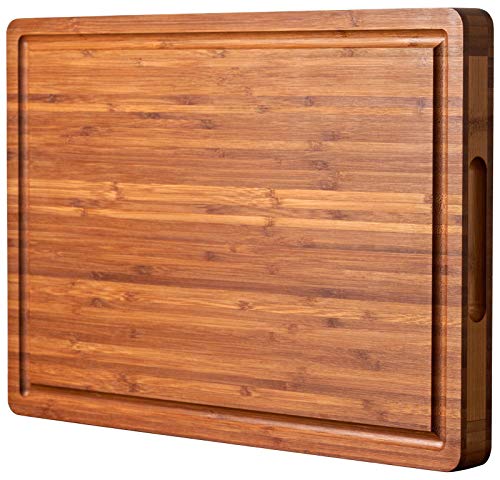
Allsum extra thick carbonized bamboo cutting board, 1 inch thickBest Thick BambooAllsum extra thick carbonized bamboo cutting board, 1 inch thickn/a3-layer bamboo butcher blockn/a1 inchEveryday prep and heavy chopping
Deer and Oak 3-piece acacia cutting board set with standBest SetDeer and Oak 3-piece acacia cutting board set with standn/an/aAcacian/aHouseholds that want separate boards for different foods
Kikcoin 17 by 11 inch bamboo cutting board, reversible XLBest ValueKikcoin 17 by 11 inch bamboo cutting board, reversible XL17 by 11 inchesn/an/an/aEveryday chopping on a budget

A cutting board is the surface your knife meets for every meal, so it shapes both knife life and kitchen safety. Wood and bamboo boards are kinder to edges than glass or stone, look better on the counter and can last for years with simple care.

Looks can hide big differences: grain direction, thickness, glue and finish decide whether a board warps, cracks or stays flat. We evaluated five boards from the candidate pool using published specifications, listing details and patterns in owner feedback, then ranked them by fit for real kitchens.

Before you buy

6 Criteria to Look For Before Buying a Wood Cutting Board

  1. 01

    End grain vs edge grain

    End grain boards show the ends of the wood fibers on the cutting face, so knives slip between fibers and edges last longer. Edge grain boards show the long side of the fibers, and are lighter, cheaper and more common. End grain costs more and needs more oiling. If you own good knives, end grain is the kinder choice. If you care about knife edges, test the board by pressing a fingernail across the surface and feeling how much give it has.

  2. 02

    Wood type and hardness

    Walnut and maple are classic hardwoods with a good balance of firmness and give. Bamboo is a grass and is harder, which can dull edges faster. Acacia is a dense hardwood that looks attractive and is moderately hard. The mistake is choosing the hardest surface, which wears knives and rarely lasts longer. Measure the sink or the dishwasher-free washing space, because a board that does not fit the sink is harder to clean properly.

  3. 03

    Thickness and stability

    Thicker boards, such as the 1.7 inch walnut, resist warping and stay put while you chop. Thin boards under about 0.75 inch bow when wet. A heavy board does not slide, but it is harder to move and store. Pick the thickness that matches whether the board stays on the counter. Before you buy a thick board, confirm you have somewhere to store it upright and out of the sun.

  4. 04

    Size and layout

    A 16 by 10 board suits most daily prep, and 17 by 13 inches or more suits roasts and large batches. A board that is too small makes ingredients spill onto the counter. Consider whether it fits in your sink for washing and your cabinet for storage. Look closely at joint lines in photos, since gaps between strips are where water enters and the board starts to split.

  5. 05

    Juice grooves and handles

    A groove catches meat juices and liquids, and a handle or hole helps carrying and hanging. Grooves reduce usable space and can trap debris. End grain boards often have no groove, since juices are best caught with a tray. Choose features based on the foods you cut. Keep one board for raw meat and one for produce, and mark them so every household member uses the right one.

  6. 06

    Care and sanitation

    Wood boards need hand washing, thorough drying and periodic oiling with food-grade mineral oil. Soaking or dishwashing causes cracks and warping. Keep separate boards for raw meat and ready-to-eat foods, and clean them with hot soapy water. A board that is not cared for will not last. Choose a size that leaves a hand's width free on each side of your usual pile of ingredients.

Detailed reviews

The 5 best wood cutting boards, explained

01
BABILONIA American walnut end grain butcher block, 16 by 10 by 1.7 inch
End grain1.7 in thickAmerican walnut16 x 10 in
Check price on Amazon
Best for: Home cooks who want a durable, knife-friendly board and will oil it regularly.

This walnut board is built as an end grain butcher block, with short ends of the wood fibers facing up and glued together in a checkerboard. End grain lets the knife slide between fibers instead of cutting across them, which is why it is considered gentler on edges and shows fewer deep knife marks. At 1.7 inches thick, it is heavy and stays put on the counter.

The tradeoff is weight, cost and care. It is heavier than edge grain boards, takes more drawer or counter space and needs regular oiling to stay healthy. Compared with the 17 by 13 BABILONIA, it is smaller and thicker. Compared with the Ziruma acacia board, it costs more but is much kinder to knives.

Ownership requires a routine. Hand wash and dry, never soak or put it in the dishwasher, and oil the board every few weeks with food-grade mineral oil. Owner feedback patterns on end grain boards report cracking when they are left wet or dried by heat, so store them upright and keep them away from the stove.

What works

  • End grain construction is kind to knife edges
  • 1.7 inch thickness resists warping and stays put
  • American walnut looks rich and hides marks
  • Heavy enough that it does not slide while chopping

Watch out for

  • Heavy and bulky to store and carry
  • Needs regular oiling to prevent drying and cracking
  • Costs more than edge grain or bamboo boards

Specs

Size
16 by 10 by 1.7 inches
Construction
End grain butcher block
Wood
American black walnut
Thickness
1.7 inches for stability
Best use
Daily chopping and a serious prep station
02
BABILONIA walnut end grain cutting board, 17 by 13 by 1 inch
End grain17 x 13 in1 in thickWalnut
Check price on Amazon
Best for: Cooks who need a large end grain surface for big prep and carving.

This is the larger sibling, a 17 by 13 inch end grain walnut board at 1 inch thick. The bigger footprint gives you room for a whole chicken, a big batch of vegetables or a roast to carve. The end grain construction offers the same gentle edge feel as the thicker board.

The tradeoff is thickness. At 1 inch it is lighter than the 1.7 inch version, but also more likely to warp if it gets wet on one side. It also takes a large amount of counter and cabinet space. Compared with the 16 by 10 board, it offers more room but less stability. Compared with the Allsum bamboo, it is gentler on knives but costs more.

Ownership is routine. Hand wash, dry upright and oil regularly. Owner feedback patterns on larger end grain boards say that warping and cracks appear if they are soaked, so treat them as furniture rather than dishes.

What works

  • 17 by 13 inch surface handles large cuts and batches
  • End grain walnut is gentle on knife edges
  • Attractive enough to serve from
  • Larger footprint reduces overflow on busy prep days

Watch out for

  • Thinner than the 1.7 inch board, so more prone to warping
  • Large and heavy to store
  • Needs regular oiling and hand washing

Specs

Size
17 by 13 by 1 inches
Construction
End grain
Wood
Walnut
Thickness
1 inch
Best use
Big prep jobs and carving
03
Allsum extra thick carbonized bamboo cutting board, 1 inch thick
1 in thickCarbonized bambooReversible3 layers
Check price on Amazon
Best for: Cooks who want a durable, reasonably priced board that is thicker than typical bamboo.

The Allsum board is a 1 inch thick, three layer bamboo block with a carbonized, darker finish. Bamboo is a grass rather than a hardwood, and it is hard and dense, which makes it durable but a little tougher on knife edges than walnut. The thick build resists warping better than thin bamboo boards.

The tradeoff is knife wear. Bamboo is harder than many woods, so edges dull sooner, and the glue lines can be a weak point if the board gets soaked. Compared with the walnut end grain boards, it costs less but is less gentle on knives. Compared with the Kikcoin bamboo, it is thicker and more stable.

Ownership requires simple care. Hand wash, dry promptly and oil occasionally to prevent drying. Owner feedback patterns on bamboo boards note that thin ones warp and split, while thicker boards like this fare better, though they should still never be soaked.

What works

  • 1 inch thickness resists warping better than thin bamboo
  • Dark carbonized finish hides stains
  • Reversible with grooves for juices
  • Lower cost than hardwood end grain boards

Watch out for

  • Bamboo is harder on knife edges than walnut
  • Glue lines can fail if the board is soaked
  • Needs oiling to prevent drying

Specs

Thickness
1 inch
Construction
3-layer bamboo butcher block
Finish
Carbonized dark bamboo
Style
Reversible with grooves
Best use
Everyday prep and heavy chopping
04
Deer and Oak 3-piece acacia cutting board set with stand
3 boardsAcacia woodPre-oiledStand included
Check price on Amazon
Best for: Households that want separate boards for different foods and a tidy storage stand.

The Deer and Oak set gives you three acacia boards in graduated sizes with a stand for upright storage. The listing says each board arrives pre-oiled and ready for heavy use. Three sizes let you keep one board for produce, one for bread and one for meat, which is good kitchen hygiene.

The tradeoff is thickness and grain. Acacia boards in sets are usually edge grain and thinner than butcher blocks, so they can warp over time. Compared with the walnut end grain boards, they are less gentle on knives but cost less per board. Compared with the Ziruma acacia, you get three sizes and a stand.

Ownership requires basic care. Hand wash, dry upright in the stand and oil the boards periodically. Owner feedback patterns on acacia sets say that surface scratches appear sooner than on end grain, and the boards can bow if left wet.

What works

  • Three sizes cover produce, bread and meat
  • Pre-oiled and ready to use out of the box
  • Stand keeps boards upright and drying
  • Acacia has attractive grain at a moderate cost

Watch out for

  • Thinner edge grain boards can warp over time
  • Scratches appear sooner than on end grain
  • Three boards need more oiling and care

Specs

Sizes
15.7 by 11.8, 13.0 by 9.4 and 10.2 by 7 inches
Wood
Acacia
Finish
Pre-oiled and ready to use
Extras
Storage stand included
Best use
Households that want separate boards for different foods
05
Kikcoin 17 by 11 inch bamboo cutting board, reversible XL
17 x 11 inBambooReversibleExtra large
Check price on Amazon
Best for: Budget buyers who want a large, light board for everyday chopping.

The Kikcoin is a 17 by 11 inch reversible bamboo board and the lowest-tier pick in this shortlist. It is flat, light and large enough for everyday chopping. Bamboo's hardness keeps knife marks shallow, and the reversible design lets you rotate wear.

The tradeoff is thickness and glue. Thin bamboo boards warp and split if they get wet, and the glue lines can fail. Compared with the Allsum, it is thinner and lighter, while the Allsum is more stable. Compared with the walnut end grain boards, it costs far less but is harder on knives.

Ownership requires simple care. Hand wash, dry promptly and oil occasionally. Owner feedback patterns on thin bamboo boards say they last a year or two with careful use, so treat it as an affordable board that you can replace.

What works

  • Large 17 by 11 inch surface at a low cost
  • Reversible design spreads wear
  • Lightweight and easy to handle
  • Bamboo is hard and shows shallow knife marks

Watch out for

  • Thin construction can warp and split if wet
  • Glue lines may fail with soaking
  • Harder on knife edges than walnut

Specs

Size
17 by 11 inches
Material
100 percent bamboo
Style
Reversible
Surface
Flat with a hanging hole
Best use
Everyday chopping on a budget

Spec decoder

What the listing measurements really mean

The numbers brands lead with, translated into what they tell you about fit, comfort and wear at home.

End grain

A board where the cut ends of the wood fibers face up. It is gentler on knives and heals minor cuts. End grain boards tend to be heavier, since the blocks are cut thick, which also adds stability.

Watch forThe BABILONIA walnut boards are end grain, the others are edge grain or laminated.

Edge grain

A board where the long edges of the fibers face up. It is lighter, cheaper and more common. Edge grain is the style most people think of as a classic butcher board, and it is easier to manufacture.

Watch forThe acacia and bamboo boards in this lineup are edge grain or layered.

Thickness

The board's depth in inches. Thicker boards resist warping and stay put. A thicker board is not always better for small kitchens, so check weight and storage space too.

Watch forThe BABILONIA 16 by 10 is 1.7 inches, the 17 by 13 is 1 inch.

Carbonized bamboo

Bamboo darkened by heat treatment. It changes color and can soften the material slightly. Heat treatment changes color and sometimes hardness, but the care routine is still the same.

Watch forThe Allsum board uses carbonized bamboo.

Food-grade mineral oil

A non-drying oil used to condition wood boards. It prevents drying and cracks. Reapply after each deep clean or when water no longer beads on the surface.

Watch forApply to all wood boards in this lineup, including the pre-oiled set.

Methodology

How We Evaluated These Wood Cutting Boards

Spec sheet and listing review

We compared board size, thickness, wood type and grain direction as published by each seller. We checked that dimensions were stated consistently. For example, thickness is the most important number for warping. We also read seller notes about glue type and finishes, since those affect both safety and lifespan.

Grain and construction

We reviewed end grain, edge grain and laminated builds. These choices decide knife friendliness and durability. They explain the walnut picks. We checked that each board's listed size matched the product images where we could.

Size and usability

We looked at board footprint, thickness and features such as grooves. A board must fit your workflow. This shaped the large and set picks. We gave more weight to reports of warping and cracking than to one-off cosmetic complaints.

Ownership and care

We read owner feedback patterns about warping, cracking, glue failure and oiling needs. We weighed how forgiving each board is. This shaped the order of the lineup. We paid attention to how often owners say they oil and what happens when they do not.

Value for the cook

We compared price tier against construction and size for casual and serious cooks. A thin bamboo board suits light use. This shaped the budget pick. We kept the order tied to the cook, not the price tag.

Decision guide

How to Choose the Right Wood Cutting Boards

By Cooking Style

SituationPickWhy
Serious cook, good knivesBABILONIA 16 x 10 x 1.7Thick end grain walnut
Large roasts and carvingBABILONIA 17 x 13Big end grain surface
Everyday chopping on a budgetKikcoin 17 x 11Large, light and low cost
Separate boards for foodsDeer and Oak 3-piece setThree sizes with a stand

By Budget

SituationPickWhy
Lowest costKikcoin 17 x 11 bambooLower tier, large surface
Low to mid tier, thickerAllsum bamboo1 inch thick carbonized
Mid tier, setDeer and Oak 3-piece setThree boards and a stand
Higher spend, long lifeBABILONIA walnut end grainThick end grain construction

End Grain vs Bamboo

End grain walnut

The BABILONIA boards are gentle on knives, heal minor cuts and last for years with oiling. They are heavy and cost more.

Bamboo

The Allsum and Kikcoin boards are light, cheap and hard. They dull knives sooner and can warp or split if wet.

Choose end grain for knife care and longevity, and bamboo for light, low-cost use.

By Counter Space

SituationPickWhy
Tight counterBABILONIA 16 x 10Compact but thick
Standard counterKikcoin 17 x 11Large and light
Counter-top stationBABILONIA 17 x 13Large and sturdy
Wall or drawer storageDeer and Oak setStand keeps boards upright

For Knife Care Specifically

Look for

End grain construction, a medium hardness wood such as walnut or maple and a thick board that does not slide.

In this comparison

The BABILONIA end grain boards are best for knives. The acacia and bamboo boards are harder and dull edges faster.

When to Spend More

Spend more if

You own good knives, cook daily and will oil the board. The BABILONIA walnut end grain board is the clearest upgrade.

Save if

You chop casually and accept replacing a board. The Kikcoin or Allsum covers it.

Ownership

Maintenance schedule

The upkeep that decides whether a piece still looks good in year five.

TaskIntervalWhy it matters
Hand wash with mild soap and hot waterAfter every useDishwashers and soaking crack and warp wood. A quick wash prevents bacteria buildup. Use a plastic scraper first to lift stuck-on food before washing.
Dry upright immediatelyAfter every washMoisture trapped on one side causes warping. Standing the board upright dries both sides evenly. Stand the board on its edge so air reaches both faces.
Oil with food-grade mineral oilEvery 2 to 4 weeksOil prevents drying and cracking. A thin coat soaks in and keeps the board healthy. Rub oil in with a lint-free cloth, and wipe off the excess after a few hours.
Sand out deep cutsYearly or as neededDeep grooves hold moisture and food. Light sanding and re-oiling restores the surface. Use fine sandpaper and finish with oil, always sanding with the grain.
Keep away from heatAlwaysHeat dries wood and causes cracks. Store away from the stove and sunlight. A cabinet beside the oven is not a good place to keep a wood board.

FAQ

Frequently Asked Questions

Is wood or plastic better for cutting boards?

Wood is gentler on knives and looks better, but needs oiling and hand washing. Plastic can go in the dishwasher and is practical for raw meat. Plastic is the better choice if you want dishwasher cleaning and strict hygiene routines.

Is bamboo a good cutting board material?

Bamboo is hard and durable, but it can dull knives sooner and may split if thin. Thicker bamboo boards fare better. Thin bamboo boards are the most likely to split, so prefer one that is at least an inch thick.

How often should I oil a wood board?

Every two to four weeks, or whenever the surface looks dry. A thin coat of food-grade mineral oil is enough. Oil more often in dry winter air and after a heavy wash.

Can I put a wood board in the dishwasher?

No. Heat and water cause cracking and warping. Hand wash and dry upright. Soaking or dishwashing is the quickest way to ruin a wood board.

Is end grain worth the extra cost?

If you own good knives and cook often, yes. It is gentler on edges and lasts longer, though it costs more and needs oiling. If you do not cook often, an inexpensive bamboo board is a fine choice.

Can I cut raw meat on a wood board?

Many cooks do, but wood needs careful cleaning and drying. Use separate boards for raw meat and ready-to-eat foods when possible. Wash with hot soapy water, dry well and use a clean board for each type of food.

Bottom line

The short version

Browse more wood cutting boardson Amazon →
Brianna Cole, Lead Product Editor

About the author

Brianna Cole

Lead Product Editor, SenseiReview

Brianna Cole leads SenseiReview's buying guides, turning published specifications, documentation and owner feedback patterns into clear verdicts across home, tech, fitness, outdoor and DIY products.

More from Brianna →

Keep reading

Related guides