
Amazon affiliate links - we earn a commission.Affiliate disclosure

Buying guide · 12 min read · Updated 2026-11-21

Best Food Dehydrators (2026)

Six food dehydrators compared on tray area, airflow design, temperature range, timers and cleanup, with picks for jerky, fruit leather, herbs and big harvests.

Brianna Cole, Lead Product EditorBy Brianna ColeLead Product Editor6 picks comparedSpec-sheet verified
Best Food Dehydrators

At a glance

Our top picks

Side by side

Spec comparison

A food dehydrator removes moisture with a steady flow of warm air so fruit, herbs, vegetables and jerky keep for months. The machine is simply a heater, a fan and a stack of trays, and the quality of the result depends on how evenly that air moves across every tray.

Tray area and airflow direction are the specs that matter. A rear-fan machine with horizontal flow dries every tray at a similar rate, while a stacked design with a fan at the base often leaves the top trays slower or the bottom ones over-dried and needing rotation.

Before you buy

6 Criteria to Look For Before Buying a Food Dehydrator

  1. 01

    Airflow design

    Rear-fan cabinets like the Cosori six-tray and Magic Mill Pro push warm air horizontally across every tray, so nothing needs rotating. Stacking towers like the Elite Gourmet blow air up through the stack, and trays nearer the heater dry first. If you dry daily, horizontal flow saves real effort, while occasional users can live with rotating trays.

  2. 02

    Drying area and tray count

    Area, not tray count, tells you capacity. The Cosori six-tray lists 6.5 square feet, while the five-tray Cosori lists 3.1. Five trays on one machine can hold half what five trays hold on another. Estimate your biggest batch, such as a bushel of apples, and size from there.

  3. 03

    Temperature range and accuracy

    Herbs dry best at low temperatures around 95 F, fruit near 130 to 135 F and jerky at the highest settings. The Cosori models reach 165 F or 176 F. A wide range lets you tune each food, but accuracy depends on the sensor, so use a probe thermometer for jerky.

  4. 04

    Tray material

    Stainless steel trays resist odors and go in the dishwasher. BPA-free plastic trays stain and hold smells from jerky and onions but cost less. If you dry meat, steel is worth the extra, since odors are the common reason people quit using their dehydrators.

  5. 05

    Timer and shut-off

    A timer lets you run overnight and shut off by itself. The Magic Mill compact and Cosori expandable offer up to 48 hours. Units without a timer, like the Elite Gourmet, need you to be home to switch them off, and over-dried food turns brittle.

  6. 06

    Noise and footprint

    Fans run for many hours, so noise matters in an open kitchen. Cabinets with strong fans can be louder than small stacks, and large cabinets need permanent space. Decide where the machine will live, since a dehydrator in a closet gets used less.

Detailed reviews

The 6 best food dehydrators, explained

01
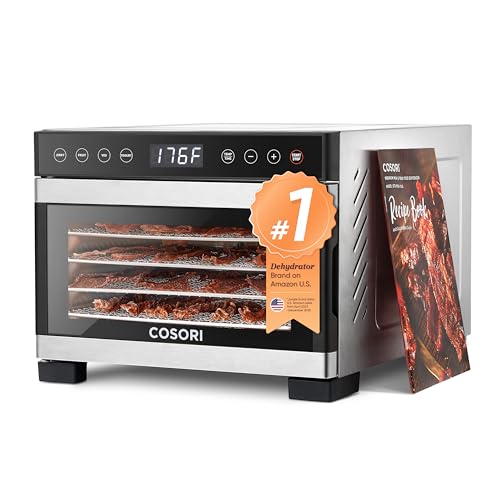
Cosori 6 tray stainless steel food dehydrator with 6.5 square feet of drying space
6 steel trays6.5 sq ft95 to 165 FRear fan
Check price on Amazon
Best for: Home users who dry jerky, fruit and herbs often and want even results across trays.

The Cosori six-tray dehydrator offers 6.5 square feet of drying space on stainless steel trays, with a temperature range from 95 F to 165 F and a digital control. The airflow is horizontal from the rear, so each tray sees similar conditions and you rarely need to rotate trays. It is a cabinet-style machine rather than a stacking tower, which makes loading and unloading quick.

The tradeoff is size and weight. It is a large machine that needs a permanent counter or shelf spot, and it costs more than basic stacking models. Compared with the Elite Gourmet, it covers more than twice the practical area and gives you reliable results across trays. Against the Magic Mill Pro with seven trays, it has a lower wattage and less area, but a more established brand and manual.

In ownership, stainless trays go in the dishwasher or soak clean, which beats the sticky plastic trays on cheaper models. Wipe the interior and the fan guard regularly because jerky fat and fruit sugar collect there. Run it in a ventilated room, since long cycles can smell.

What works

  • Horizontal rear airflow dries every tray evenly without rotation
  • Stainless steel trays are easy to clean and do not hold odors
  • 6.5 square feet handles a full harvest batch in one run
  • Digital control with a wide range suits herbs, fruit and jerky

Watch out for

  • Large cabinet needs permanent shelf or counter space
  • Higher price tier than basic stackable dehydrators

Specs

Trays
6 stainless steel
Drying area
6.5 sq ft
Temperature
95 F to 165 F
Airflow
Horizontal, rear fan
Brand
Cosori
02
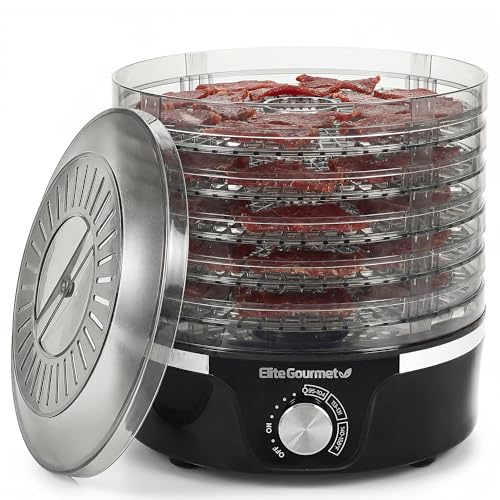
Elite Gourmet 5 tray food dehydrator with adjustable temperature dial
5 BPA-free trays11.4 inch traysAdjustable dialPower light
Check price on Amazon
Best for: Occasional dryers who want an inexpensive way to preserve fruit and herbs.

The Elite Gourmet is a classic stacking dehydrator with five BPA-free plastic trays, each about 11.4 inches across, and a simple temperature dial with a power light. The trays stack on a heater and fan base, and the design is expandable with extra trays. It is the cheapest and simplest option that still lets you set temperature.

The tradeoff is airflow and cleanup. Stackable machines blow air up through the trays, so those nearest the heater dry fastest and you may need to rotate them. Compared with the Cosori, it has less drying area and no timer, so you must watch the clock. Against the Magic Mill compact with a digital timer, it is cheaper but offers less precise control. For occasional use, the simple dial is enough.

Plastic trays can stain and hold odors from jerky and onions. Wash them by hand, avoid abrasive scrubbers and replace trays that warp. Keep the heater base dry and wipe it with a damp cloth.

What works

  • Low price tier makes it a low-risk first dehydrator
  • Adjustable dial lets you choose temperatures for fruit, herbs and jerky
  • Stackable trays can be expanded if you need more capacity
  • Compact footprint stores easily in a cabinet

Watch out for

  • Trays nearest the heater dry faster and may need rotating
  • No timer, so batches need watching and manual shut-off

Specs

Trays
5, BPA-free plastic
Tray size
11.4 inch
Control
Adjustable temperature dial
Design
Stackable, expandable
Brand
Elite Gourmet
03
Magic Mill Pro food dehydrator, 600 W rear fan, 7 full-size stainless trays
600 W7 steel traysRear fanFull stainless build
Check price on Amazon
Best for: Serious preservers who dry big harvests or lots of jerky.

The Magic Mill Pro is a full stainless-steel cabinet dehydrator with a 600 W rear fan system and seven full-size stainless trays. The listing emphasizes stainless construction inside and out, which resists odors and cleans easily. It is aimed at serious home preservers who dry large harvests or batches of jerky.

The tradeoff is size and cost. A seven-tray cabinet is big and heavy, and the higher wattage means more noise and a higher energy draw than a small stack. Compared with the Cosori six-tray, it offers more trays and power but a less proven manual and support. Against the Magic Mill compact, it triples the capacity but needs permanent space.

For care, remove the trays and wash them, then wipe the interior and fan guard. Leave the door open after a long run so humidity escapes. Check the door gasket and hinges, which are the usual wear points on cabinet units.

What works

  • 600 W rear fan drives airflow evenly across seven trays
  • Full stainless build resists odors and staining
  • Seven full-size trays handle large batches
  • Digital controls make repeatable settings simple

Watch out for

  • Large, heavy cabinet needs a permanent location
  • Higher noise and energy use than small stacking units

Specs

Power
600 W
Trays
7 full-size stainless steel
Airflow
Rear fan, even drying
Build
Stainless inside and out
Brand
Magic Mill
04
Cosori 5 tray food dehydrator, BPA-free trays, 165 F control, 350 W, expandable to 7
350 W5 traysUp to 165 F48 hour timer
Check price on Amazon
Best for: Beginners who want a timer and a high maximum temperature and room to expand.

This Cosori compact dehydrator has five BPA-free trays that can be expanded to seven, a 350 W motor, a maximum temperature of 165 F and a timer up to 48 hours. The listing notes that the 165 F maximum is higher than the 158 F of many competing units, which helps with jerky safety and faster drying. It is a stacking design with a digital control and timer.

The tradeoff is airflow and tray material. Stacking designs push air upward, so trays nearest the heater dry faster. Compared with the Cosori stainless cabinet, it is cheaper and smaller but has plastic trays. Against the Elite Gourmet, it adds a timer and a higher maximum temperature at a modest price increase. It suits people who want to start small and grow.

In ownership, wash the plastic trays by hand and replace stained or warped ones. Rotate trays halfway through long batches. Keep the base dry and check the fan guard for dust.

What works

  • Maximum 165 F supports jerky and faster drying cycles
  • 48 hour timer allows long, unattended batches
  • Expandable from five to seven trays as needs grow
  • Moderate price tier is accessible for a digital model

Watch out for

  • Plastic trays stain and may need rotating during drying
  • Stack design gives less even airflow than a rear-fan cabinet

Specs

Power
350 W
Trays
5, expandable to 7
Maximum temperature
165 F
Timer
48 hours
Brand
Cosori
05
Cosori 5 tray stainless steel food dehydrator, 3.1 square feet, 176 F control
5 steel trays3.1 sq ft95 to 176 F1 F steps
Check price on Amazon
Best for: Smaller households that want stainless trays and precise temperature control.

The Cosori five-tray stainless model offers 3.1 square feet of drying area and a temperature range from 95 F to 176 F in 1 F increments. Its horizontal airflow and stainless trays carry the benefits of the larger cabinet in a smaller body. It is a good fit for kitchens where space is tight but plastic trays are unwelcome.

The tradeoff is capacity. At 3.1 square feet, it handles about half the area of the six-tray Cosori, so big harvests need multiple rounds. Compared with the Cosori expandable stack, it is more expensive but has better airflow and trays. Against the Magic Mill compact, it offers a wider temperature range and a steel interior.

For care, wash trays in the dishwasher or by hand. Wipe the interior after sticky batches like fruit leather. Leave the door slightly open after use so moisture escapes.

What works

  • Horizontal airflow keeps every tray at a similar dryness
  • Stainless trays clean easily and resist stains
  • 1 F increments give very precise control
  • Compact body fits on a counter or a shelf

Watch out for

  • Smaller area than six-tray cabinets requires multiple batches
  • Costs more than plastic stack models with similar tray counts

Specs

Trays
5 stainless steel
Drying area
3.1 sq ft
Temperature
95 F to 176 F
Adjustment
1 F increments
Brand
Cosori
06
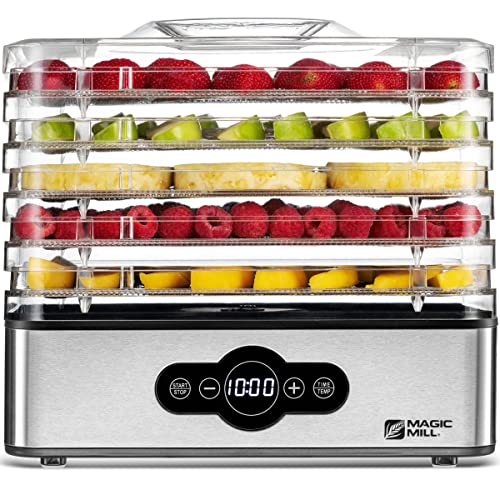
Magic Mill 5 tray stackable stainless steel dehydrator with 48 hour timer, 240 W
240 W5 steel trays48 hour timerDigital control
Check price on Amazon
Best for: Small-batch dryers who want steel trays and a digital timer in a small footprint.

The Magic Mill compact has five stackable stainless steel trays, a 240 W heater and a digital control with a timer up to 48 hours. The steel trays resist odors and are dishwasher friendly, and the digital controls make settings repeatable. It is a small tower for herbs, fruit and small jerky batches.

The tradeoff is power and airflow. At 240 W, it dries more slowly than the 600 W Magic Mill Pro, and stacking means the trays nearest the heater finish first. Compared with the Elite Gourmet, it adds steel trays and a digital timer for a higher price. Against the Cosori compact, it has less rated power and a simpler airflow design.

Ownership tips: rotate trays during long runs, wash steel trays after each batch and wipe the base. Do not immerse the heater unit. Check the fan for dust.

What works

  • Stainless steel trays resist odors and clean easily
  • Digital timer to 48 hours allows unattended drying
  • Stackable design is compact and easy to store
  • Moderate price tier for a digital steel unit

Watch out for

  • Low 240 W power makes batches slower than larger cabinets
  • Stacked airflow means rotating trays for even results

Specs

Power
240 W
Trays
5 stackable stainless steel
Timer
48 hours digital
Control
Digital temperature
Brand
Magic Mill

Spec decoder

What the listing measurements really mean

The numbers brands lead with, translated into what they tell you about fit, comfort and wear at home.

Drying area

Drying area is the total tray surface in square feet, such as 6.5 for the Cosori six-tray. It sets how much food fits per batch.

Watch forCompare area, since tray count alone can mislead.

Wattage

Wattage reflects heater and fan power, such as 600 W on the Magic Mill Pro or 240 W on the compact. More watts usually mean faster drying and more noise.

Watch forHigh wattage does not fix poor airflow design.

Horizontal airflow

Horizontal airflow moves warm air from the rear across each tray. It dries trays evenly without rotation.

Watch forStack designs blow air upward and usually need rotation.

Temperature increment

Increment is the step size of the temperature control, such as 1 F on the Cosori compact steel model. Finer steps allow more precise settings.

Watch forCheck accuracy with a thermometer, since a precise dial can still be off.

BPA-free plastic

BPA-free plastic is a tray material that avoids the chemical bisphenol A. It is lightweight and cheap but stains and absorbs odors.

Watch forStainless steel is the more durable choice for meat.

Methodology

How We Evaluated These Food Dehydrators

Research basis

We evaluated each dehydrator from published specifications, listing details and recurring patterns in owner feedback. Our opinions are editorial assessments, not measurements. Drying area, wattage and temperature range come from the listings.

Airflow and capacity

We compared rear-fan cabinets with stacking towers and weighed drying area from 3.1 to 6.5 square feet. We also considered whether trays need rotating.

Temperature control

We looked at ranges from 95 F to 176 F, increments and timers. Jerky needs higher heat, while herbs need low heat, so range matters.

Tray material and cleanup

We weighed stainless versus BPA-free plastic trays, dishwasher friendliness and odor retention. Owner feedback often cites stained plastic trays as the main annoyance.

Fit for users

We matched machines to occasional users, serious preservers and small households. Each pick says who should skip it.

Decision guide

How to Choose the Right Food Dehydrators

By Use

SituationPickWhy
Jerky and meatCosori 6-tray or Magic Mill ProHigher temperatures, steel trays and even airflow.
Fruit and fruit leatherCosori 5-tray steelPrecise low temperatures and easy cleanup.
HerbsElite GourmetLow, steady heat from a simple dial.
Large harvestsMagic Mill ProSeven full-size trays and 600 W.

By Budget

SituationPickWhy
Lowest tierElite GourmetSimple stack with adjustable dial.
Lower to middleCosori expandable or Magic Mill compactTimer and digital control on a budget.
MiddleCosori 5-tray steelSteel trays and precise temperature.
Higher tierCosori 6-tray or Magic Mill ProPay for area, airflow and build.

Stack vs Cabinet

Stack

The Elite Gourmet and Cosori expandable are cheaper, smaller and expandable, but airflow is uneven and trays need rotating.

Cabinet

The Cosori six-tray and Magic Mill Pro dry evenly and load easily, but they are bigger, heavier and cost more.

Choose a stack for occasional drying and tight storage. Choose a cabinet if you dry weekly or in large batches.

By Tray Material

SituationPickWhy
Meat and onionsCosori steel or Magic Mill steelSteel resists odors and stains.
Fruit and herbsElite GourmetPlastic trays are fine for mild foods.
Dishwasher cleaningCosori 5-tray steelStainless trays go in the dishwasher.
Budget with a timerCosori expandablePlastic trays and a 48 hour timer.

For Jerky Specifically

Look for

A maximum temperature of at least 160 F, even airflow, steel trays and a timer. Follow current food safety guidance, such as heating meat to a safe internal temperature before or after drying.

In this comparison

The Cosori models reach 165 F or 176 F, and the Magic Mill Pro has a strong rear fan that suits jerky.

When to Spend More

Spend more if

You dry weekly or in large batches and value even airflow and steel trays, as with the Cosori six-tray or Magic Mill Pro.

Save if

You dry now and then and an Elite Gourmet covers herbs and fruit.

Ownership

Maintenance schedule

The upkeep that decides whether a piece still looks good in year five.

TaskIntervalWhy it matters
Wash traysAfter each batchSugar and fat dry into hard residue. Soak steel trays and hand wash plastic ones.
Wipe interior and fan guardAfter sticky or fatty batchesResidue near the fan smells and can catch dust. A damp cloth keeps airflow clear.
Rotate stacked traysMidway through long runsTrays nearest the heater dry first. Swapping them evens out the result.
Check temperatureA few times a yearDial settings drift. A probe thermometer shows if the machine runs hot or cool.
Inspect cord and doorTwice a yearA frayed cord or warped door lets heat escape or is a safety risk. Replace worn parts.

FAQ

Frequently Asked Questions

Is a dehydrator better than an oven?

A dehydrator holds low temperatures more reliably and moves air continuously. Ovens are hard to set low enough and waste energy. For occasional drying, an oven works, but a dehydrator gives better results.

How many trays do I need?

Look at total area rather than count. A 3.1 square foot machine suits small households, while 6.5 square feet suits big harvests. Think about your largest batch.

Are stainless steel trays worth it?

If you dry meat or strong foods, yes. Steel resists odors and stains, and it goes in the dishwasher. Plastic trays are fine for fruit and herbs.

What temperature should I use for jerky?

Follow current food safety guidance from agencies such as the USDA, which recommends heating meat to a safe internal temperature. A dehydrator that reaches 160 F or higher helps, but use a probe to confirm.

Do I need to rotate trays?

On stacking models, yes, because trays nearer the heater dry first. On rear-fan cabinets like the Cosori six-tray and Magic Mill Pro, rotation is usually not needed.

How long do dehydrators last?

With regular cleaning, many last for years. Common wear points are fan motors, plastic trays and door gaskets. Steel trays last longer than plastic.

Bottom line

The short version

Browse more food dehydratorson Amazon →
Brianna Cole, Lead Product Editor

About the author

Brianna Cole

Lead Product Editor, SenseiReview

Brianna Cole leads SenseiReview's buying guides, turning published specifications, documentation and owner feedback patterns into clear verdicts across home, tech, fitness, outdoor and DIY products.

More from Brianna →

Keep reading

Related guides