
Amazon affiliate links - we earn a commission.Affiliate disclosure

Buying guide · 12 min read · Updated 2026-11-27

Best Microphone Arms for Streaming (2026)

Microphone boom arms compared on load rating, spring noise, low-profile design and desk clamps, so your mic stays put and out of your camera view.

Brianna Cole, Lead Product EditorBy Brianna ColeLead Product Editor6 picks comparedSpec-sheet verified
Best Microphone Arms for Streaming

At a glance

Our top picks

Side by side

Spec comparison

A boom arm lifts your microphone off the desk, which cuts keyboard thumps and lets you place it close to your mouth. A good arm holds its position, moves silently and stays out of your camera frame.

This guide compares microphone arms for streaming and podcasting desks. We evaluated each on published specifications, load rating, spring design, clamp range, cable handling and owner feedback patterns, and we explain how mic weight and arm type decide what works with your setup.

Before you buy

6 Criteria to Look For Before Buying a Microphone Arm for Streaming

  1. 01

    Load rating

    The arm must hold the microphone plus the shock mount and pop filter. The RODE PSA1+ lists 0.25 to 1.2 kg, while budget arms list lighter loads. Reviewers advise adding the shock mount weight to the mic weight. An overloaded arm droops, and an underloaded arm springs up. Check the rating on the manufacturer's spec sheet. A pop filter and a cable add small amounts of weight, so leave a margin below the maximum rating rather than loading the arm to its limit.

  2. 02

    Standard or low profile

    A standard overhead boom, like the RODE and Frgyee, reaches over the desk, while a low-profile arm, like the Elgato, InnoGear and FIFINE models, sits below the shoulder line and out of camera view. Low-profile arms suit face cam streamers. Tall booms suit standing desks and wide setups. Choose by your camera framing. Try the mic about two to three fingers from your mouth and slightly off axis to reduce plosive sounds, and check that the arm can hold that position.

  3. 03

    Spring noise and damping

    Cheap springs creak when you move the arm and transmit vibration. The RODE PSA1+ has internal spring damping for quiet movement. Noise matters when you adjust the arm mid-stream. Also check how much the arm creeps over time. Mute your mic before you reposition a cheap arm mid-stream, since the creak travels straight into the recording.

  4. 04

    Clamp and desk fit

    The clamp must fit your desk thickness. The RODE PSA1+ fits up to 70 mm. Glass or thin desks may not take a clamp, and a loose clamp makes the arm drift. Tighten it firmly and check it occasionally. Desks with a lip, a rear shelf or a monitor stand close to the edge may block the clamp, so look at the underside before you buy.

  5. 05

    Cable management

    Cables dangling from the arm look messy and can tug on the microphone. The InnoGear low-profile arm has a snap-on magnetic channel, and others use clips. Good routing prevents cable noise and keeps the arm balanced.

  6. 06

    Build material and longevity

    All-metal builds, as on the Elgato and FIFINE, resist torsion and feel sturdier than thin tube arms. Springs and joints are the wear points on every arm. Plan to tighten and adjust over the years. A cheaper arm may suffice if your mic is light and your use is moderate.

Detailed reviews

The 6 best microphone arms for streaming, explained

01
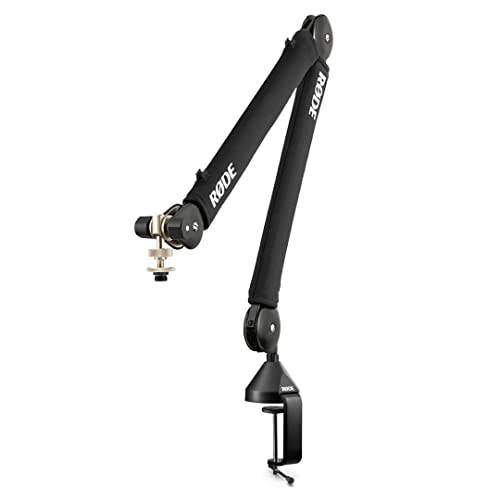
RODE PSA1+ Professional Studio Boom Arm, Spring Damping
0.25 to 1.2 kg load70 mm desk clampSpring dampingStudio arm
Check price on Amazon
Best for: Streamers and podcasters who want a quiet, durable arm with a wide load range.

The RODE PSA1+ is a studio boom arm that clamps to desks up to 70 mm thick and holds microphones from 0.25 to 1.2 kg. Internal spring damping lets you move the arm during recording without creaks or handling noise. It is the update to a long-running studio standard.

The load range is wide enough for most streaming mics, from lighter USB models to heavier dynamic microphones with a shock mount. Compared with the Elgato Wave Mic Arm, it offers a classic overhead boom design with more reach, at a similar tier. Compared with the InnoGear classic, it is better built and quieter in movement. It is the pick for people who want a quiet arm and expect it to last.

Setup is simple: clamp it to the desk, thread the mic mount and balance the arm. Route the cable along the arm with the supplied clips or your own. Springs can sag over years, so tighten the adjustment screws occasionally. Make sure your desk is thick enough and the clamp is seated firmly, since a loose clamp makes the whole arm drift.

What works

  • Internal spring damping gives silent movement
  • Holds microphones from 0.25 to 1.2 kg
  • Clamp fits desks up to 70 mm thick
  • Established studio design with wide support

Watch out for

  • Upper-mid cost tier
  • Overhead boom can appear in camera view if not tucked
  • Springs can sag over many years

Specs

Load range
Microphones from 0.25 to 1.2 kg
Desk clamp
Desks up to 70 mm thick
Damping
Internal spring damping
Thread
Mic mount with standard threads
Class
Upper-mid tier
02
Elgato Wave Mic Arm Low Profile, All-Metal, 360 Degree Rotation
Low profileAll metalAnti-torsion360 degree rotation
Check price on Amazon
Best for: Streamers who want the mic below the camera frame and a sturdy all-metal build.

The Elgato Wave Mic Arm Low Profile is an all-metal arm with anti-torsion construction and 360 degree rotation. It sits below the shoulder line, so the arm stays out of the camera frame. The low profile is built for streamers whose face cam makes a tall overhead boom a distraction.

The design puts the mic in front of you from below, which is also the usual position for streaming. Compared with the RODE PSA1+, it takes a different approach: less reach and less visibility. Compared with the InnoGear low profile arms, it offers an all-metal build and a brand with a streamer focus. The trade is a smaller range of positioning than a tall boom.

Ownership notes: check that your microphone's weight matches the arm's rated load, because a heavy mic can cause the arm to sag. Routing the cable through clips or channels keeps the desk tidy. Metal arms resist torsion, which means the arm does not twist under load. As with any arm, tighten the clamp and check the joints from time to time.

What works

  • Low profile keeps the arm out of camera view
  • All-metal anti-torsion construction resists twisting
  • 360 degree rotation for flexible placement
  • Brand focused on streaming setups

Watch out for

  • Upper-mid cost tier
  • Less reach than a tall overhead boom
  • Load rating must match your microphone

Specs

Design
Low profile, sits below the shoulder line
Material
All-metal, anti-torsion construction
Rotation
360 degrees
View
Unobstructed camera view
Class
Upper-mid tier
03
InnoGear Low Profile Mic Arm, 3.35 Inch Lower Arm, Magnetic Cable Channel
3.35 in above deskMagnetic cable channelLow profileDesk mount
Check price on Amazon
Best for: Small desks and light USB mics where a low-profile, low-cost arm is enough.

The InnoGear low-profile arm keeps its lower arm just 3.35 inches above the desk and includes a snap-on magnetic cable channel. It is built for streaming and podcast setups where a tall boom would intrude. It sits at the low end of this guide's cost range.

The low profile makes it a good match for mics used close to the face and for small desks. Compared with the Elgato Wave Mic Arm, it costs less and relies on a lighter build. Compared with the Fifine BM88W, it is similar in concept, with the magnetic cable channel as a distinguishing feature. Load ratings on budget arms are lower, so check the weight of your mic and shock mount.

Ownership steps include seating the clamp securely and adjusting the spring tension so the mic stays where you put it. Cable channels keep wires from dangling, but check that they do not pull on the mic. Springs and pivot joints are the wear points, and a light arm may sag over time. For lightweight USB mics it is a good fit.

What works

  • Lower arm sits just 3.35 inches above the desk
  • Snap-on magnetic cable channel tidies the wire
  • Low profile keeps the camera view clear
  • Low cost tier

Watch out for

  • Lighter build than premium arms
  • Lower load rating suits only light mics
  • Springs may sag over time

Specs

Lower arm height
3.35 inches above the desk
Cable handling
Snap-on magnetic cable channel
Design
Low-profile desk mount
Mic compatibility
Popular USB streaming mics
Class
Low tier
04
FIFINE BM88W Low Profile Mic Boom Arm, Metal Construction
Metal armLow profileSpace-savingPodcast and stream
Check price on Amazon
Best for: Streamers who want a low-profile metal arm at a modest cost.

The FIFINE BM88W is a low-profile boom arm built from metal, aimed at podcast and streaming setups. The maker describes a sleek design that fits recording setups and stresses sturdiness. It sits in the low to mid tier.

The metal construction is the selling point at this level, since many budget arms rely on thin tubing. Compared with the InnoGear low-profile arm, it offers a similar form with a stronger material claim. Compared with the Elgato, it is cheaper and less proven. It suits buyers who want a low-profile arm without paying for a big brand.

Ownership notes: check the weight rating on the listing against your mic and shock mount. Clamp the arm firmly and balance the spring tension, since too little tension makes the mic droop and too much makes it spring up. A quick check for wobble after a week of use will reveal loose joints. Cables should be clipped so they do not pull the arm.

What works

  • Metal construction feels sturdier than thin tube arms
  • Low profile saves desk space and camera view
  • Suited to podcast and streaming setups
  • Low to mid cost tier

Watch out for

  • Less proven than Rode or Elgato
  • Load rating needs checking against your mic
  • Fewer reviews of long-term spring behavior

Specs

Material
Metal construction
Design
Low profile, space-saving
Use
Podcast recording and streaming
Mount
Desk clamp
Class
Low to mid tier
05
Frgyee Overhead Mic Boom Arm, 31.5 Inch Riser, Heavy-Duty Steel
31.5 in riserOverhead boomHeavy-duty steelAdjustable height
Check price on Amazon
Best for: Standing desks and setups that need a tall overhead position for the microphone.

The Frgyee is an overhead boom stand with a 31.5 inch (80 cm) extension riser and heavy-duty steel construction. The extra height lets you hang a microphone over a desk or a tall setup, such as a standing desk or a drum, and the thick steel aims at stability. It is the tall option in this guide.

Height is its purpose. Compared with the low-profile arms, it reaches higher and farther, which suits users who stand or who want the mic above a monitor. Compared with the RODE PSA1+, it offers more riser height at a lower tier but with less polished movement. The tall riser can wobble if the clamp is not tight.

In ownership, check the clamp range and the desk thickness, and clamp it where the desk is solid. A tall arm amplifies vibration from typing, so a shock mount is wise. Make sure the cable is clipped and that the arm does not cross your camera view. Steel is heavy, which helps stability but makes it harder to move.

What works

  • 31.5 inch riser gives much more height than low-profile arms
  • Thick steel adds stability
  • Overhead position keeps the mic clear of the desk
  • Low to mid cost tier

Watch out for

  • Tall arm can wobble if the clamp is loose
  • Heavy and harder to move
  • Overhead boom can intrude on the camera view

Specs

Riser height
31.5 inches (80 cm)
Design
Overhead desk mic stand
Material
Thickened heavy-duty steel
Use
Podcasts and recording
Class
Low to mid tier
06
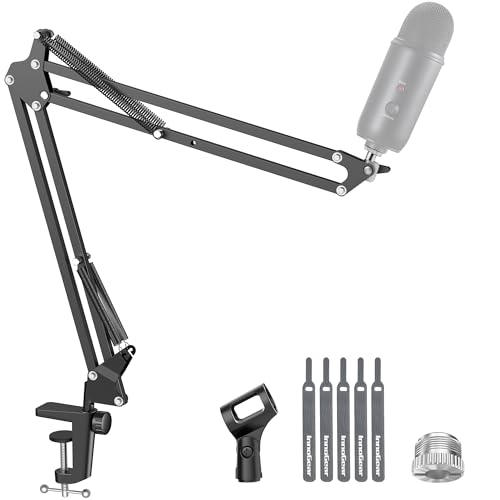
InnoGear Boom Arm Microphone Stand for Blue Yeti, Fifine, HyperX
Fully adjustableDesk mountUSB mic compatibleNo knob on arm shaft
Check price on Amazon
Best for: First-time arm buyers with lightweight USB microphones.

The InnoGear boom arm is a classic spring-loaded desk mount that fits popular USB microphones such as the Blue Yeti, Fifine and HyperX models. It is fully adjustable and, according to the maker, avoids a knob on the arm shaft that can loosen over time. It is the lowest cost arm in this guide.

It is the simple choice for a first mic arm. Compared with the RODE PSA1+, it is lighter and noisier in movement, and compared with the InnoGear low-profile arms, it is a taller overhead design. It works with light USB mics, but heavy microphones with shock mounts may overload it.

In practice, balance the spring tension for your mic, clamp it firmly and route the cable along the arm. Cheap springs can creak or creep, and a mic that droops over a session is a sign of insufficient tension. Check the load rating before you load it. It is a good starter arm that shows whether you like using one.

What works

  • Lowest cost tier
  • Fits popular USB microphones
  • Fully adjustable with a simple design
  • Familiar spring boom form

Watch out for

  • Spring movement can creak or creep
  • Light build limits heavy microphones
  • Less polished than studio arms

Specs

Adjustment
Fully adjustable arm and joints
Mount
Desk clamp
Compatibility
Blue Yeti, Fifine and HyperX style mics
Design note
No knob on the arm shaft to loosen
Class
Lowest cost tier

Spec decoder

What the listing measurements really mean

The numbers brands lead with, translated into what they tell you about fit, comfort and wear at home.

Load capacity

The maximum weight the arm can hold in position, including the mic and shock mount.

Watch forThe RODE PSA1+ lists 0.25 to 1.2 kg.

Low profile

A design where the arm sits low beside the desk and out of the camera frame.

Watch forThe Elgato, InnoGear low-profile and FIFINE arms are low profile.

Spring damping

Internal damping that reduces noise and vibration when the arm moves.

Watch forThe RODE PSA1+ lists internal spring damping.

Clamp thickness

The maximum desk thickness the clamp can grip.

Watch forThe RODE PSA1+ lists desks up to 70 mm.

Anti-torsion

A construction that resists twisting under load, so the arm holds its position.

Watch forThe Elgato lists anti-torsion construction.

Methodology

How We Evaluated These Microphone Arms for Streaming

Load and stability

We compared load ratings and construction, from the 0.25 to 1.2 kg RODE range to lighter budget arms. Our scores are editorial assessments based on published specifications and owner feedback patterns.

Profile and reach

We compared low-profile and tall overhead designs for camera view and reach, including the Frgyee 31.5 inch riser.

Noise and damping

We noted spring damping and movement noise, crediting the RODE for its damped design.

Cable and clamp

We looked at cable channels and clamp ranges, such as the magnetic channel on the InnoGear low-profile arm.

Value and honesty

We judged each arm by relative cost tier and avoided price figures. Load ratings on budget arms were flagged for checking.

Decision guide

How to Choose the Right Microphone Arms for Streaming

By Camera Setup

SituationPickWhy
Face cam streamingElgato Wave Mic Arm Low ProfileSits below the shoulder line.
Small deskInnoGear Low ProfileLow arm height.
Standing deskFrgyee Overhead31.5 inch riser.
Studio podcastingRODE PSA1+Quiet damped arm.

By Budget

SituationPickWhy
Lowest spendInnoGear ClassicBasic spring arm.
LowInnoGear Low ProfileCable channel.
Low to midFIFINE BM88WMetal low profile.
Upper-midRODE PSA1+ or ElgatoPremium build.

Low Profile vs Overhead

Low profile

The Elgato, InnoGear low-profile and FIFINE arms stay out of the frame and suit small desks.

Overhead

The RODE PSA1+, Frgyee and InnoGear classic reach over the desk and suit tall or wide setups.

Choose low profile if you stream on camera. Choose overhead if you need height and reach.

By Microphone Weight

SituationPickWhy
Light USB micInnoGear ClassicMatched to light loads.
Medium mic with shock mountFIFINE BM88WMetal build.
Heavy dynamic micRODE PSA1+Rated to 1.2 kg.
Heavy mic, low profileElgato Wave Mic ArmAll-metal anti-torsion.

For Streaming Specifically

Look for

A load rating above your mic and shock mount weight, quiet joints, a clamp that fits your desk and a profile that stays out of frame.

In this comparison

The RODE leads on quiet and load, the Elgato on camera view and the InnoGear on value.

When to Spend More

Spend more if

You use a heavy mic, stream daily or hate arm noise. The RODE or Elgato earns its cost.

Save if

You use a light USB mic. The InnoGear classic is enough.

Ownership

Maintenance schedule

The upkeep that decides whether a piece still looks good in year five.

TaskIntervalWhy it matters
Tighten the clampMonthlyA loose clamp causes drift and wobble. Check it firmly after the first week.
Adjust spring tensionWhen the mic droops or springs upSprings settle with use. Tune them to match your mic weight. Retest the position after changing the shock mount or the mic.
Check joints and screwsEvery few monthsPivot screws loosen over time. Tighten what you can reach.
Re-route cablesWhen changing gearDangling cables pull on the arm and add noise. Clip them along the arm.
Wipe the armMonthlyDust and finger oils dull finishes. Use a dry cloth.

FAQ

Frequently Asked Questions

Why does my mic droop?

The spring tension is too low for the mic weight or the arm is overloaded. Adjust the tension and check the load rating.

Do I need a shock mount?

Often yes. It isolates the mic from desk and arm vibration. Add its weight when checking the arm rating. Mount the shock mount to the arm first and weigh the whole assembly if you are close to the limit.

Will it fit my desk?

Check the clamp thickness range. Thin or glass desks may need a different mount.

Low profile or overhead?

Low profile stays out of camera view. Overhead reaches higher and farther. Choose by your camera framing.

Why does my arm creak?

Springs and joints rub as you move the arm. Damped designs are quieter, and tightening or lubricating joints can help. A thin coat of light grease on pivot joints, applied sparingly, can quieten a squeaking arm.

How long do boom arms last?

Years with care. Springs sag and screws loosen, so periodic tightening extends life.

Bottom line

The short version

Browse more microphone arms for streamingon Amazon →
Brianna Cole, Lead Product Editor

About the author

Brianna Cole

Lead Product Editor, SenseiReview

Brianna Cole leads SenseiReview's buying guides, turning published specifications, documentation and owner feedback patterns into clear verdicts across home, tech, fitness, outdoor and DIY products.

More from Brianna →

Keep reading

Related guides