
Amazon affiliate links - we earn a commission.Affiliate disclosure

Buying guide · 12 min read · Updated 2026-11-27

Best WiFi Extenders for Large Homes (2026)

WiFi extenders for large homes compared on standard, antennas, Ethernet and placement, with honest notes on inflated coverage claims and when mesh is smarter.

Brianna Cole, Lead Product EditorBy Brianna ColeLead Product Editor6 picks comparedSpec-sheet verified
Best WiFi Extenders for Large Homes

At a glance

Our top picks

Side by side

Spec comparison

PieceStandardCoverage claimWired portClass
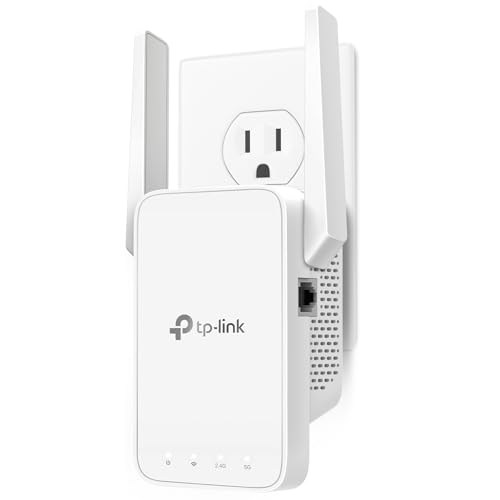
TP-Link AX3000 WiFi 6 Dual-Band Range Extender with EthernetBest OverallTP-Link AX3000 WiFi 6 Dual-Band Range Extender with EthernetWiFi 6, dual band, 3 Gbps combinedUp to 2400 sq ftGigabit EthernetUpper-mid tier
TP-Link RE550 AC1900 WiFi Range Extender, Gigabit EthernetBest Value PickTP-Link RE550 AC1900 WiFi Range Extender, Gigabit EthernetWiFi 5, dual band, 1.9 Gbps combinedUp to 2100 sq ftGigabit EthernetLow to mid tier
TP-Link RE315 AC1200 Dual Band WiFi ExtenderBest Budget Plug-InTP-Link RE315 AC1200 Dual Band WiFi ExtenderWiFi 5, dual bandn/an/aLowest cost tier
WAVLINK AX3000 Outdoor WiFi 6 Extender, IP67, Long RangeBest Outdoor ExtenderWAVLINK AX3000 Outdoor WiFi 6 Extender, IP67, Long RangeWiFi 6, dual band, AX3000n/an/aMid tier
JoyLantern AX3000 WiFi 6 Extender, 165+ Devices, Long RangeBest High-Capacity ClaimJoyLantern AX3000 WiFi 6 Extender, 165+ Devices, Long RangeWiFi 6, AX3000Up to 21099 sq ftn/aLow to mid tier
RAGOAT Dual Band WiFi Extender, 12880 Sq Ft Claim, EthernetBest Entry Large-Claim UnitRAGOAT Dual Band WiFi Extender, 12880 Sq Ft Claim, Ethernetn/aUp to 12880 sq ftEthernetLow tier

A WiFi extender listens to your router and repeats the signal into a dead zone. It is the cheapest way to cover a far bedroom or garage, but it comes with real tradeoffs in speed, network names and placement that product pages rarely explain.

This guide compares extenders aimed at large homes. We evaluated each on published specifications, WiFi standard, antennas, Ethernet ports and owner feedback patterns, and we treat large coverage figures as marketing claims, since real range depends on walls and floors far more than on any number on a box.

Before you buy

6 Criteria to Look For Before Buying a WiFi Extender for Large Homes

  1. 01

    Treat coverage claims as marketing

    Square footage figures are best-case, open-space numbers. The JoyLantern lists 21099 sq ft and the RAGOAT lists 12880 sq ft, while the TP-Link models list 2100 to 2400 sq ft. A single extender cannot cover a house of that size, because walls, floors and metal cut the signal. Choose by placement and standard, not by the largest number.

  2. 02

    WiFi standard and bands

    WiFi 6, as on the TP-Link AX3000, uses the spectrum more efficiently than WiFi 5, but only helps if your router and devices support it. Dual band means 2.4 GHz for range and 5 GHz for speed. If your router is WiFi 5, a WiFi 5 extender like the RE550 is a more sensible match. The extender can never be faster than the signal it receives.

  3. 03

    The repeating penalty

    Most extenders use one radio to both receive from the router and repeat to your device, which can roughly halve throughput on that link. A wired Ethernet connection, used as access point mode, avoids that penalty. Tri-band mesh systems dedicate a radio to backhaul, which is why they perform better. For a large home, the penalty adds up with each hop.

  4. 04

    Placement

    Put the extender about halfway between the router and the dead zone, where the router signal is still strong. Putting it in the dead zone repeats a weak signal. Avoid placing it behind furniture, near microwaves or next to thick walls. Poor placement is the main reason extenders disappoint.

  5. 05

    Ethernet and extra ports

    An Ethernet port, as on the TP-Link AX3000, RE550 and RAGOAT, lets you connect a TV or console with a wire, which is faster and steadier than WiFi. Some extenders can run as access points when connected by cable, which is the best use of one. The RE315 has no Ethernet port.

  6. 06

    Extender or mesh

    An extender creates a second network name or a same-name network with limited roaming, while mesh gives one name and smarter handoff. For a multi-story or large home, mesh is usually the better answer. An extender suits one or two dead zones in a mid-size home. Buying a pile of extenders is a worse deal than one mesh set.

Detailed reviews

The 6 best wifi extenders for large homes, explained

01
TP-Link AX3000 WiFi 6 Dual-Band Range Extender with Ethernet
WiFi 6 AX30002 directional antennasEthernet portUp to 2400 sq ft
Check price on Amazon
Best for: Homes with a WiFi 6 router and one or two weak zones who want the strongest single extender.

The TP-Link AX3000 is a dual-band WiFi 6 extender with two high-gain directional antennas, beamforming and an Ethernet port. The maker lists 3 Gbps of combined bandwidth and coverage up to 2400 sq ft. It is the most capable extender in this guide and the one most likely to keep up with a modern router.

Beamforming concentrates the signal toward your devices, and the Ethernet port lets you plug in a TV or console with a wire. Compared with the RE550, it adds WiFi 6 and a higher combined speed. Compared with the outdoor Wavlink models, it is an indoor wall-plug design. The 2400 sq ft figure is a best-case claim, and real coverage depends on walls.

Placement is everything. Plug it in about halfway between the router and the dead zone, where the router signal is still strong, not inside the dead zone. A single radio shared between receiving and repeating can halve throughput on that hop, so expect less than the router's speed. Update the firmware, and keep it away from microwaves and other interference.

What works

  • WiFi 6 with 3 Gbps combined bandwidth claimed
  • Two directional antennas with beamforming
  • Gigabit Ethernet port for wired devices
  • Established brand with firmware support

Watch out for

  • Repeating over the same radio costs throughput
  • Coverage figure is a best-case claim
  • Upper-mid cost tier for an extender

Specs

Standard
WiFi 6, dual band, 3 Gbps combined
Antennas
Two high-gain directional with beamforming
Coverage claim
Up to 2400 sq ft
Wired port
Gigabit Ethernet
Class
Upper-mid tier
02
TP-Link RE550 AC1900 WiFi Range Extender, Gigabit Ethernet
AC19003 external antennasGigabit EthernetUp to 2100 sq ft
Check price on Amazon
Best for: Homes with WiFi 5 routers and devices who want solid coverage at a moderate cost.

The TP-Link RE550 is a WiFi 5 dual-band extender with three adjustable external antennas, 1.9 Gbps of combined bandwidth and a gigabit Ethernet port. The maker lists coverage up to 2100 sq ft. It is the value option for a household whose devices and router are WiFi 5.

The adjustable antennas give you some control over where the signal goes, which is useful in an oddly shaped house. Compared with the AX3000, it lacks WiFi 6 and costs less. Compared with the RE315, it is faster and has Ethernet, but is larger. For most homes with WiFi 5 devices, the speed difference to WiFi 6 will not show up through the walls.

In use, place it halfway to the dead zone and aim the antennas. Use the app or web page to set up, and choose whether to use the same network name or a separate one. A same-name setup can hold onto the extender after you walk away from it, so some people prefer a separate name. Check for firmware updates after setup.

What works

  • Three adjustable antennas for tuning coverage
  • Gigabit Ethernet port for a wired device
  • 1.9 Gbps combined bandwidth claimed
  • Lower cost than WiFi 6 extenders

Watch out for

  • WiFi 5 only, with no WiFi 6 features
  • Bulkier than plug-in models
  • Shared-radio hop cuts speed

Specs

Standard
WiFi 5, dual band, 1.9 Gbps combined
Antennas
Three adjustable external
Coverage claim
Up to 2100 sq ft
Wired port
Gigabit Ethernet
Class
Low to mid tier
03
TP-Link RE315 AC1200 Dual Band WiFi Extender
AC1200Dual bandPlug-in design1.2 Gbps combined
Check price on Amazon
Best for: One weak room in a small or mid-size home at the lowest cost.

The TP-Link RE315 is a compact plug-in AC1200 extender with 1.2 Gbps of combined dual-band bandwidth. It is the cheapest option in this guide, and it plugs directly into a wall outlet with no cables. The maker claims coverage for a modest house, which is more honest than the larger claims elsewhere in this guide.

It is built for one weak room, such as a bedroom at the end of a hall. Compared with the RE550, it has no Ethernet port and fewer antennas. Compared with the AX3000, it is much slower and older in standard. It suits a small to mid-size home, not a large one, which makes it a fair entry for the dead-zone-only scenario.

Ownership steps are easy: plug it in midway, run the setup and check the signal lights. A plug-in extender can block a neighboring outlet and shift if you tug on cables. Firmware updates matter, and the brand typically supports its devices for a long time. If you find the connection still weak, the fix is a better placement, not a second extender.

What works

  • Lowest cost tier with a known brand
  • Compact plug-in design needs no cables
  • Dual band with 1.2 Gbps combined
  • Simple app setup

Watch out for

  • No Ethernet port
  • Slower and older standard than the others
  • Not suited to a large home on its own

Specs

Standard
WiFi 5, dual band
Bandwidth
1.2 Gbps combined
Design
Compact wall plug
Use
Single weak room
Class
Lowest cost tier
04
WAVLINK AX3000 Outdoor WiFi 6 Extender, IP67, Long Range
AX3000IP67 weatherproof5 GHz 2402 MbpsOutdoor use
Check price on Amazon
Best for: Properties with a garage, barn or yard that need a weatherproof signal.

The WAVLINK AX3000 is an outdoor WiFi 6 extender rated IP67 for weather, with a stated 2402 Mbps on 5 GHz and a combined 3000 Mbps. It is aimed at extending a signal to a yard, garage, barn or RV, which indoor plug-in extenders cannot do. IP67 means it resists dust and temporary immersion.

This is a different job from the indoor models. Compared with the TP-Link AX3000, it is built for weather and distance, not for a living room. It typically needs mounting and a power source, and the maker notes it can serve as an access point or repeater. Range outdoors is better than indoors since there are fewer walls, but trees and metal still block signal.

Ownership notes: mount it high and in line of sight to the house, use outdoor-rated cable and check the power method. Cable entry and weather sealing should be done carefully, and the unit is a bigger project than a plug-in. It is the right tool for the shed, not for the bedroom.

What works

  • IP67 rating suits outdoor mounting
  • WiFi 6 with 2402 Mbps on 5 GHz claimed
  • Built to reach outbuildings and yards
  • Can work as a repeater or access point

Watch out for

  • Needs mounting and power planning
  • Overkill for indoor dead zones
  • Trees and metal still block signal

Specs

Standard
WiFi 6, dual band, AX3000
5 GHz speed
Up to 2402 Mbps
Weather rating
IP67
Use
Yard, garage, barn, RV
Class
Mid tier
05
JoyLantern AX3000 WiFi 6 Extender, 165+ Devices, Long Range
WiFi 6 AX3000165+ devices claim21099 sq ft claimEthernet
Check price on Amazon
Best for: Buyers who want a WiFi 6 extender at a low to mid tier and accept brand risk.

The JoyLantern is a WiFi 6 AX3000 extender whose listing claims coverage up to 21099 sq ft and support for 165 or more devices. These are very large numbers for a single extender, and the honest reading is to treat them as marketing. Coverage depends on walls, floors and the router signal, not on a number printed on the listing.

The hardware is a WiFi 6 repeater with a combined AX3000 rating, similar in standard to the TP-Link AX3000. Compared with the TP-Link, it comes from a less known brand with a bolder claim and a lower cost tier. Compared with the RAGOAT, it offers WiFi 6 and a higher claimed speed.

In ownership terms, check the warranty and the firmware update history, since lesser-known extenders can go unsupported. Place it midway like any extender, and do not expect anything close to the claimed area. A device count claim matters less than the radio hop, since all those devices share the same limited airtime.

What works

  • WiFi 6 AX3000 at a low to mid cost tier
  • Targets bedrooms, garages and basements
  • Ethernet port for a wired device
  • High device capacity listed

Watch out for

  • Coverage and device claims are far above what any extender delivers
  • Lesser-known brand with unclear support
  • Shared radio still cuts speed

Specs

Standard
WiFi 6, AX3000
Device claim
165 or more devices
Coverage claim
Up to 21099 sq ft
Target
Bedrooms, garages and basements
Class
Low to mid tier
06
RAGOAT Dual Band WiFi Extender, 12880 Sq Ft Claim, Ethernet
Dual band 5 and 2.4 GHz12880 sq ft claim105 devicesEthernet
Check price on Amazon
Best for: Low-cost buyers who need an Ethernet-equipped dual-band repeater and will check return terms.

The RAGOAT extender is a dual-band unit that claims coverage up to 12880 sq ft and compatibility with 105 devices, with an Ethernet port. It is a low cost option that leans heavily on large claims. As with the JoyLantern, those numbers should be read as marketing and not as a measured range.

The practical question is what the extender actually does: it repeats an existing signal over a dual-band link, which is useful but limited. Compared with the TP-Link RE315, it makes larger claims at a low tier but has less brand backing. Compared with the TP-Link AX3000, it lacks WiFi 6 and the track record.

Ownership comes with caveats. Check the return policy, since unfamiliar brands vary in support. Place it where the router signal is still good, and use the Ethernet port for a stationary device. If speeds disappoint, move the extender closer to the router before blaming the hardware.

What works

  • Lowest cost tier with an Ethernet port
  • Dual band 5 and 2.4 GHz
  • Plug-in installation
  • Simple to set up

Watch out for

  • 12880 sq ft claim is far beyond real-world range
  • Lesser-known brand with uncertain support
  • No WiFi 6

Specs

Bands
5 GHz and 2.4 GHz dual band
Coverage claim
Up to 12880 sq ft
Device claim
105 devices
Wired port
Ethernet
Class
Low tier

Spec decoder

What the listing measurements really mean

The numbers brands lead with, translated into what they tell you about fit, comfort and wear at home.

AX3000 and AC1900

Combined speed labels that add up the bands. They are not what one device gets.

Watch forThe TP-Link AX3000 and the JoyLantern use AX3000, and the RE550 uses AC1900.

Coverage in sq ft

A best-case figure in open space. Walls and floors reduce it a lot.

Watch forThe listing claims range from 2100 sq ft on the RE550 to 21099 sq ft on the JoyLantern.

Beamforming

A technique that aims the signal at your device instead of broadcasting evenly.

Watch forThe TP-Link AX3000 lists beamforming with two directional antennas.

IP67

Dust tight and resistant to temporary immersion, a weatherproof rating.

Watch forThe WAVLINK AX3000 outdoor model lists IP67.

Access point mode

Using an extender with an Ethernet cable to the router, so it broadcasts a fresh WiFi signal without a wireless hop.

Watch forExtenders with Ethernet ports can often do this, as on the TP-Link AX3000 and RE550.

Methodology

How We Evaluated These WiFi Extenders for Large Homes

Standard and speed

We compared WiFi standards and combined speed labels, from the AC1200 RE315 to the AX3000 models. We treated combined speeds as labels. Our scores are editorial assessments based on published specifications and owner feedback patterns.

Coverage claims

We read claims from 2100 sq ft to 21099 sq ft and discounted the largest ones. Claims were weighed against what walls and floors do to a signal.

Ports and antennas

We looked at Ethernet ports and antenna design, such as the TP-Link directional antennas and the RE550 adjustable antennas.

Use case

We separated indoor plug-in units from the outdoor WAVLINK, and matched each to a job.

Value and honesty

We judged each extender by relative cost tier and avoided price figures. Lesser-known brands were flagged for support risk.

Decision guide

How to Choose the Right WiFi Extenders for Large Homes

By Router Standard

SituationPickWhy
WiFi 6 routerTP-Link AX3000Matches the standard and adds beamforming.
WiFi 5 routerTP-Link RE550Matched speed with Ethernet.
One weak roomTP-Link RE315Compact and low cost.
OutbuildingsWAVLINK AX3000 OutdoorIP67 weatherproof.

By Budget

SituationPickWhy
Lowest spendRAGOAT or TP-Link RE315Low tier options.
Low to midJoyLantern AX3000WiFi 6 at a low tier.
MidTP-Link RE550Adjustable antennas.
HigherTP-Link AX3000Strongest single unit.

Extender vs Mesh

Extender

The TP-Link and others add coverage to one or two dead zones cheaply, but halve throughput on a shared radio.

Mesh

A mesh set gives one network name and better handoff, and is usually the better answer for multi-story or large homes.

Choose an extender for one or two dead zones. Choose mesh for a large or multi-story house.

By Location

SituationPickWhy
Back bedroomTP-Link RE315Single room fix.
Home office with a wired PCTP-Link AX3000Ethernet and WiFi 6.
Garage or barnWAVLINK AX3000 OutdoorWeatherproof.
BasementTP-Link RE550Adjustable antennas.

For Large Homes Specifically

Look for

A current WiFi standard, an Ethernet port, honest claims and a placement plan. Consider mesh first if you have several floors.

In this comparison

The TP-Link AX3000 leads on capability, the RE550 on value and the WAVLINK on reaching outbuildings.

When to Spend More

Spend more if

You have a WiFi 6 router and need faster repeated speeds. The TP-Link AX3000 is the step up.

Save if

You need one room covered. The RE315 does the job.

Ownership

Maintenance schedule

The upkeep that decides whether a piece still looks good in year five.

TaskIntervalWhy it matters
Update firmwareEvery few monthsUpdates fix bugs and security issues. Check the maker's app or page.
Reposition if speeds dropAs neededFurniture, new devices and appliances change the signal. Move it closer to the router if the link is weak.
Check the signal lightMonthlyA poor link light means the extender is too far from the router. Move it midway.
Restart occasionallyEvery few monthsExtenders can lose their connection to the router. A power cycle often restores it.
Inspect outdoor mounts and cablesSeasonallyWeather wears seals and cables on the WAVLINK. Check the cable entry and seals.

FAQ

Frequently Asked Questions

Will an extender cover my large home?

One extender rarely covers a large home. It adds coverage to a dead zone. For a large or multi-story house, a mesh system is usually better.

Why is my extended WiFi slower?

Most extenders use one radio to receive and repeat, which can roughly halve speed. A wired Ethernet link or mesh avoids that.

Where should I put the extender?

About halfway between the router and the dead zone, where the router signal is still strong.

Are the 20000 sq ft claims real?

They are best-case marketing figures. Walls, floors and interference reduce real range a lot.

Should I use the same network name?

Same name is convenient but devices can cling to a weak extender. A separate name gives control.

Can I plug a TV into the extender?

Yes, with an Ethernet port. A wired link is faster and steadier than WiFi for a stationary device.

Bottom line

The short version

Browse more wifi extenders for large homeson Amazon →
Brianna Cole, Lead Product Editor

About the author

Brianna Cole

Lead Product Editor, SenseiReview

Brianna Cole leads SenseiReview's buying guides, turning published specifications, documentation and owner feedback patterns into clear verdicts across home, tech, fitness, outdoor and DIY products.

More from Brianna →

Keep reading

Related guides