Massage guns arrived as a gym accessory and became a mainstream gadget, which means the spec sheets are written to impress. Numbers for strokes, force and speed run across the listing in bold type, and a shopper has little way to know which of them matter. A gun with a huge speed figure may feel harsh and shallow, while a quieter one with a longer stroke can feel far better on a sore thigh.
This guide explains the main specifications, amplitude, stall force and percussions per minute, then covers attachments, noise, battery life and ergonomics. It also states what the evidence does and does not support, and who should avoid percussion massage. It does not diagnose or treat anything, and anyone with pain that persists, an injury or a medical condition should speak with a doctor or physiotherapist before using one.
Amplitude, or stroke length
Amplitude, sometimes called stroke length or travel, is the distance the head moves forward and back with each percussion, measured in millimetres. Typical consumer figures run from about 8 mm to 16 mm, with some larger models higher. A short amplitude gives a quick, surface level pulse, and a longer amplitude delivers a deeper, more powerful thump that reaches further into thick muscle.
Amplitude is the spec that most affects how a gun feels. A long stroke on a large muscle such as the quadriceps or glutes feels substantial, whereas a short stroke may feel like a buzz. On small or bony areas, a short stroke is gentler and more comfortable. Some people find a long amplitude too intense for the neck and shoulders, and it should never be used on bone or directly over a joint.
No source documents a single best amplitude, because it depends on the user and the area. If you want one gun for the whole body, a mid range stroke with adjustable speed is a sensible compromise. If you are mainly after leg and back work, a longer stroke is useful. Check the stated amplitude in the specification, since some listings omit it.
Stall force
Stall force is the amount of pressure you can press into the gun before the motor stalls, usually given in pounds or kilograms. A higher figure means the motor keeps working under heavier pressure, while a lower figure means the gun slows or stops when you lean in. It is a measure of motor strength under load and is one of the more telling specs.
For gentle use, stall force barely matters, because you can use a light touch. For deep work on large muscles, a low stall force frustrates, since the gun bogs down as soon as you press. Typical consumer figures vary widely, and no standard test exists, so the number from one brand is not strictly comparable with another's. Treat it as a rough ranking within a product range, and read owner feedback for how the gun behaves under pressure.
Be careful with the idea that more pressure is better. Pressing hard can bruise and irritate tissue, and the aim is to let the gun do the work with a light to moderate touch. A high stall force gives headroom, but it does not mean you should use it.
| Spec | What it describes | Why it matters | Caution |
|---|---|---|---|
| Amplitude | Stroke length of the head | Sets depth and feel | Long strokes can be too intense on small areas |
| Stall force | Pressure before the motor stops | Motor strength under load | No standard test between brands |
| Percussions per minute | Strokes per minute | Speed and sensation | High numbers are not better by default |
| Noise | Sound level in use | Comfort, shared spaces | Measured differently by brand |
| Battery | Run time per charge | Convenience | Falls under heavy pressure |
Percussions per minute
Percussions per minute, often shortened to PPM, counts how many strokes the head makes in a minute. Consumer guns range from roughly 1,200 up to 3,200 or more, with several speed settings. A lower speed feels like deep, slow tapping, and a higher speed gives a faster buzz.
Speed matters less than the marketing suggests. A very high PPM with a short amplitude can feel shallow, while a moderate PPM with a longer stroke feels deeper. Most users end up spending their time on the lower and middle settings, because the highest speeds can feel harsh. What is useful is a good range of speeds with steps that are easy to change, so you can pick a gentle setting for sensitive areas.
Some listings give a maximum speed under no load. Under pressure the actual rate drops, especially with a weak motor, which is another reason stall force is worth checking. A gun that holds its speed under load will feel more consistent than one that stutters.
Attachments
Most guns come with a set of heads. A round or ball head is the general purpose choice for large muscles. A flat head spreads the force over a wider area and suits dense muscle groups such as the back or thighs. A bullet or cone head is for small, targeted areas, and a fork or U shaped head fits either side of the spine or the Achilles tendon area, avoiding direct pressure on bone.
Soft foam heads are gentler and suit people who find the standard heads too harsh. Check that the attachments fit snugly, because loose heads rattle and can fly off. Metal heads are firmer and more durable but more intense. Many people use only one or two heads, so a gun with a wide kit is not necessarily a better buy. Check whether replacement heads are sold, as foam heads wear out.
A bullet or very small head concentrates force, which is why it should be used sparingly and never over bone, joints, the neck or the front of the throat. If you are unsure about a particular area, leave it alone and ask a professional.
Noise, battery and ergonomics
Noise is measured in decibels, but there is no standard for how brands measure it, so a quoted figure is a rough guide. Many guns are marketed as quiet, and they do vary, with higher speeds louder than lower ones. If you want to use a gun while a partner sleeps or while watching television, read owner feedback on noise at the speeds you will actually use.
Battery life is stated in hours at a given speed, and real life use under pressure gives less. A gun with a battery that lasts several sessions is convenient, and a USB C charging port makes it easier to top up. Check whether the battery can be replaced, since the cell wears over time. A removable battery extends the life of the device.
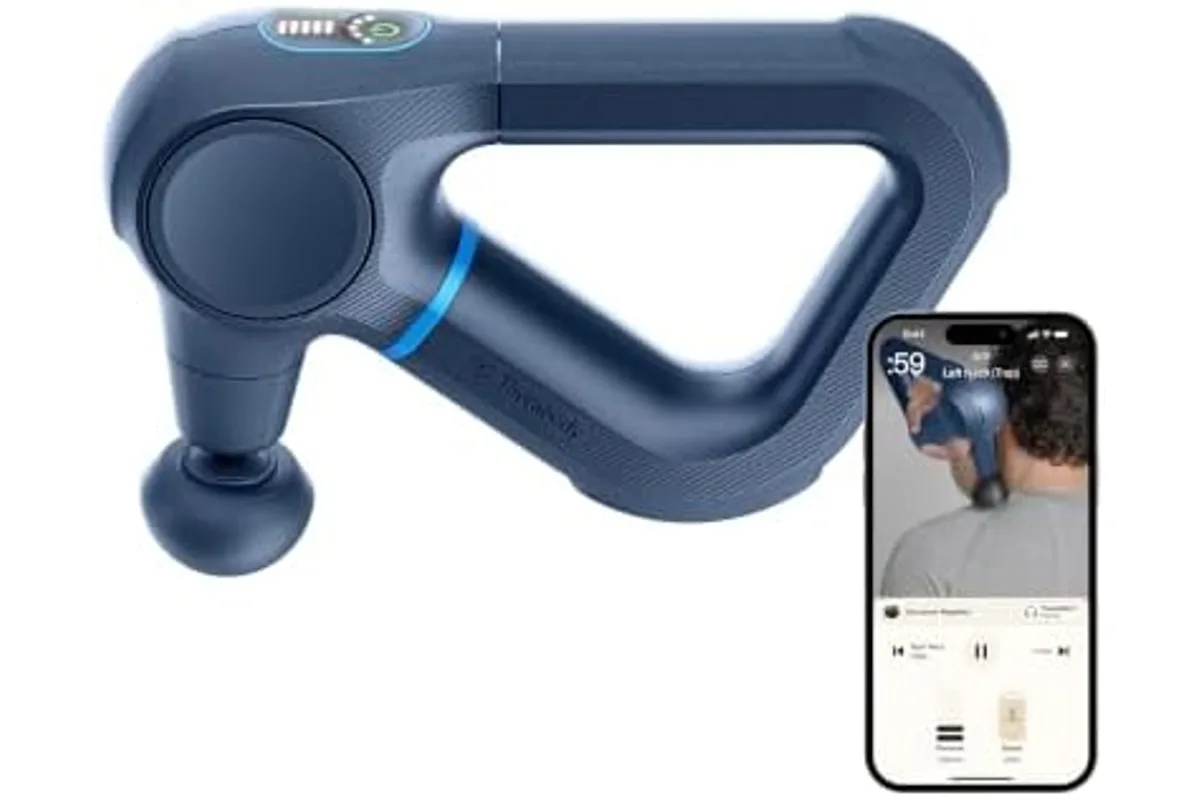
Ergonomics deserve attention because you hold the gun at awkward angles to reach your own back. A triangular handle gives several grip options and helps with reaching the shoulders and the back. A lightweight gun reduces fatigue, and a heavy one feels powerful but tires the arm. Check the weight, the handle shape, and where the controls sit. A gun you cannot comfortably hold in the positions you need is not useful, however powerful it is.
What the evidence does and does not support
Research on percussion massage devices is limited and mixed. Small studies have found that using one can temporarily increase range of motion, and some report a lower sense of muscle soreness after exercise. These effects tend to be modest and short lived, and the studies are small, so they cannot be treated as settled.
What is not supported is the claim that a massage gun breaks up scar tissue, flushes toxins, repairs muscle or speeds healing of an injury. No source documents tissue changes of that kind from using a handheld device. It is more accurate to say that the gun may change how a muscle feels for a while, through effects on the nervous system and on sensation, and that many people enjoy it and find it helps them feel looser before or after exercise.
If you enjoy using one, there is no need to stop, but keep expectations realistic. It does not replace sleep, a warm up, strength work or medical care. A foam roller offers a similar short term effect at lower cost, and our guide on foam roller density covers that option.
When not to use one
Avoid using a massage gun directly on bones, joints, the spine, the front or sides of the neck, the head, or over any area that is swollen, bruised, burned or injured. Avoid areas with varicose veins, open wounds or skin conditions. Do not use one over an area where you have had recent surgery without your doctor's advice.
Several conditions call for medical advice first, including blood clots or a history of clotting problems, use of blood thinning medication, pregnancy, osteoporosis, diabetes with nerve damage, a pacemaker or other implanted device, and cancer. A person with unexplained pain, numbness, tingling, or swelling in a limb should see a doctor and not use a gun on it. If a muscle hurts sharply or the pain increases during use, stop.
Use light pressure, keep the gun moving, and limit time on one area to a minute or two, since more is not better and can leave a muscle bruised. Start on the lowest speed. Children should not use massage guns without adult and professional guidance.
Choosing a gun for your needs
For general use and a mix of areas, a mid range amplitude of around 10 to 12 mm, a handful of speeds, a comfortable handle and a removable battery cover most needs. If you mainly work large muscles hard, look for a longer amplitude and a strong stall force. If you want something for sensitive areas or travel, a small, light, quiet gun with a soft head is gentler and easier to carry.
Look past the headline numbers to build quality, warranty, and owner feedback on durability and noise. A well built gun from a brand that sells replacement parts will last longer than a cheap model with a big speed figure. For more equipment guides, visit our Health and Fitness section. If you are putting together a recovery and stretching kit, the guide to choosing a yoga mat covers the surface to use it on.
Using a gun sensibly in a routine
The way you use a gun matters as much as which one you buy. Before exercise, a short pass of 30 to 60 seconds on the large muscles you are about to use, at a low to medium speed, is a common habit and is aimed at feeling ready, not at replacing a warm up. After exercise, a slower, lighter pass can feel pleasant on tired legs. No source documents an exact duration, frequency or speed that works best for everyone, so use how the area feels as the guide and keep sessions short.
Move the head slowly, around a few centimetres per second, and let the weight of the gun rest on the muscle without leaning in. Keep the head flat to the skin rather than at a sharp angle, and glide over the belly of the muscle, away from bones and tendons. If you find a tender spot, hover over it for a few seconds, then move on. Pressing hard into a sore spot does not clear it and can leave a bruise that lasts days.
Drink water and do not use the gun to push through pain that was there before you began. If a muscle feels better for a while and then returns to the same ache, that is normal and a sign the effect is short lived. Persistent or worsening pain means it is time for professional advice, not a longer session. Never use the gun over clothing that bunches or over lotions that make the head slip unpredictably.
Massage gun or foam roller
The two tools do similar jobs by different means. A foam roller uses your body weight and works well on large areas, costs very little, and needs no charging. A massage gun delivers percussion with less effort from you, reaches awkward spots such as the back of the shoulder and the calf more easily when sitting, and suits people who find rolling on the floor hard.
Neither has strong evidence of lasting benefit, and the short term effects look similar in the small studies that exist. The choice comes down to cost, convenience and preference. A roller is the budget option and a good place to start, and a gun is a comfort purchase for those who will use it regularly. Many people own both, using the roller at home and the gun for travel and the gym bag.
Weigh the running costs too. A gun has a battery that will eventually wear out, parts that can fail, and a price that is far higher than a roller. If you are unsure whether you will use one, try a friend's or the gym's before buying, and check the return policy of the seller, since comfort and noise are personal.
For a lighter, cheaper way to warm muscles before training, resistance bands are worth a look, since a few minutes of band work does what many people use a gun for.
Frequently asked questions
What amplitude should I look for?
No source documents one best figure. A mid range stroke suits most people, longer strokes suit large muscles and deeper work, and shorter ones are gentler. Choose according to the areas you will treat.
Does a higher PPM mean a better massage gun?
No. Speed is a sensation setting. Amplitude and stall force affect feel and power more. A good range of easy to change speeds is more useful than a very high maximum.
Can a massage gun heal an injury?
No evidence supports that. It may change how a muscle feels for a short time, but it does not repair tissue. See a doctor or physiotherapist for an injury.
How long should I use a massage gun on one area?
Short sessions of up to a minute or two per muscle at a low to moderate speed with light pressure are typical. Longer use is not better and can bruise tissue.
Who should not use a massage gun?
People with clotting disorders, those on blood thinners, pregnant women, people with implanted devices, osteoporosis or nerve problems should ask a doctor first. Nobody should use one on bones, joints, the neck or injured areas.
The bottom line
Judge a massage gun by amplitude, stall force, noise, battery and comfort in the hand, and treat speed as a secondary setting. Choose a mid range stroke unless you have a clear reason to go bigger, and read owner feedback on durability and noise.
Use it with a light touch, avoid bones, joints and injuries, and keep expectations modest: it is a short term feel good tool, not a treatment. If you have a medical condition, pain that will not settle, or an injury, ask a professional first.