
Amazon affiliate links - we earn a commission.Affiliate disclosure

Buying guide · 12 min read · Updated 2026-11-26

Best Budget Food Dehydrators (2026)

The best budget food dehydrators for 2026, with honest notes on airflow design, tray material, temperature range and jerky safety at a low price.

Brianna Cole, Lead Product EditorBy Brianna ColeLead Product Editor5 picks comparedSpec-sheet verified
Best Budget Food Dehydrators

At a glance

Our top picks

Side by side

Spec comparison

A food dehydrator is a low, steady fan oven built to move warm air across thin slices for hours. The budget tier covers fruit chips, herbs, jerky and pet treats well enough, but it differs sharply in airflow design, tray material and how precisely you can set the temperature.

Match the machine to what you dry. Fruit and herbs forgive a basic stack, while jerky needs a reliable temperature range and even airflow. Count your trays, check how much space each really gives, and expect long cycles of many hours.

Before you buy

6 Criteria to Look For Before Buying a Budget Food Dehydrator

  1. 01

    Airflow design

    A rear-mounted fan, as on the Magic Mill Pro, pushes air horizontally across each tray so they dry evenly. Stacked models like the FOHERE and Elite Gourmet send air up from the base, which can leave top trays slower. The common mistake is assuming more trays means more output. Even airflow matters more than tray count for time and quality.

  2. 02

    Tray material

    Stainless steel trays resist stains and odours and wash easily, as on the Cosori and Magic Mill models. Plastic trays are lighter and cheaper but can stain from tomato or spices and warp at higher temperatures. Check whether trays are dishwasher safe. Mesh screens help with small items that fall through. Fruit roll sheets let you dry purees into leather, and a few silicone mats can stand in if you do not have them. Whatever you buy, check that spare trays are sold separately, because a cracked plastic tray is hard to replace on a discontinued model.

  3. 03

    Temperature range and control

    A range of 95 to 176 degrees F, as on the Cosori, covers herbs through meat. Digital control in one degree steps repeats results, while a dial is only a rough guide. For jerky, check food-safety guidance for meat, since many home dehydrators do not reach pasteurising temperature alone. A quick oven finish solves that.

  4. 04

    Capacity and footprint

    Drying area is measured in square feet, and the Cosori gives about 3.1 sq ft over five trays. Seven trays on the Magic Mill Pro give a larger area but also a bigger box. Count the trays you will really fill. A household that dries a single apple or a handful of herbs a month will never use seven trays, and an empty tray still takes up shelf space. Measure the cabinet where it will live, because several of these units are as tall as a stand mixer. Big machines are rarely used if they need a permanent shelf.

  5. 05

    Power and noise

    Heater wattage ranges from 240W on the compact Magic Mill to 600W on the Pro. More power dries faster and recovers heat quicker. Fan noise is similar to a desk fan on most models. Run the unit in a ventilated room because the exhaust is warm and food smells carry. Drying onions, garlic or fish will scent a small apartment for hours, so a garage, a utility room or an open window helps. Leave a few inches of clearance on every side so the vents are not blocked.

  6. 06

    Timer and shut-off

    Long cycles of 6 to 12 hours or more benefit from a timer that shuts the unit off automatically. The FOHERE and Magic Mill models offer digital timers up to 48 hours. A dial-only unit like the Elite Gourmet needs an external timer. Auto shut-off adds peace of mind if you sleep during a cycle. Fruit leathers and thick jerky often finish overnight, so a machine that stops itself and keeps the food from over-drying is a real convenience rather than a luxury.

Detailed reviews

The 5 best budget food dehydrators, explained

01
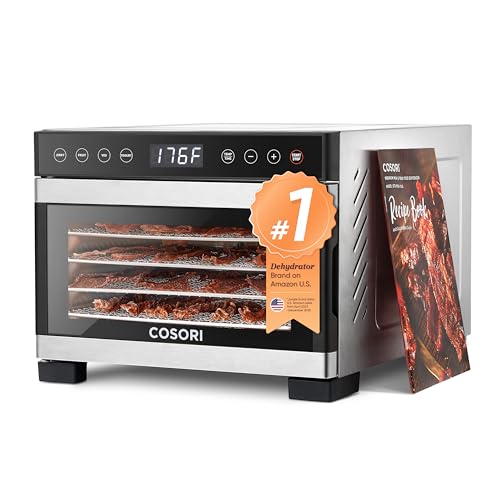
Cosori 5 Tray Stainless Steel Food Dehydrator 176°F
5 stainless trays3.1 sq ft space95 to 176°F
Check price on Amazon
Best for: Cooks who dry jerky, fruit and herbs and want one dependable machine.

The Cosori is the best all-rounder in this lineup because it combines a wide temperature range with stainless steel trays and a horizontal airflow design. The range of 95 to 176 degrees F in one degree steps is useful because it covers delicate herbs at the bottom and meat at the top. Four presets cover jerky, fruit, vegetables and yogurt.

Against the FOHERE 5 tray it costs more but gives metal trays that do not stain or hold odours, and a higher top temperature. Against the Magic Mill Pro 7 tray it dries a smaller batch but is easier to fit on a counter. It ranks first because the combination of features, accessories and temperature control is better balanced than any other pick.

The included mesh screen and fruit roll sheet are real conveniences, since small herbs fall through bare trays. Wash trays by hand or in the dishwasher if the manual allows. Plan on 6 to 12 hours for jerky and fruit, and keep the unit in a ventilated spot because the exhaust is warm. After a few years the fan and the control panel are the parts to watch.

What works

  • Stainless trays resist stains and odours
  • Wide 95 to 176°F range covers all uses
  • Mesh screen and roll sheet come included
  • Four presets simplify common batches

Watch out for

  • Five trays limit big harvest batches
  • Costs more than plastic-tray models
  • Counter footprint is bigger than a stack

Specs

Trays
5 stainless steel
Drying area
3.1 sq ft
Temperature range
95 to 176°F in 1°F steps
Presets
Jerky, fruit, vegetables, yogurt
Included
Cookbook, mesh screen, fruit roll sheet
02
Magic Mill Pro 7 Tray Stainless Dehydrator 600W
7 stainless trays600W rear fan95 to 176°F
Check price on Amazon
Best for: Gardeners and jerky makers who dry large batches.

The Magic Mill Pro is the choice if batch size matters. Seven full-size stainless steel trays, a 600W rear fan and rear heating make it a true oven-style machine, with even airflow from front to back. That means you rarely rotate trays mid-cycle, which is the main chore with cheaper stacks.

Against the Cosori 5 tray it holds more and has a bigger heater, but it is larger and heavier and takes more counter or cupboard room. Against the Magic Mill 5 tray it is more powerful and better built, which is why it ranks above it. It sits lower than the Cosori only because many buyers will not use seven trays.

Set aside a permanent spot, because a box this size does not tuck into a cabinet. Clean the trays after every batch, since meat grease sticks to stainless. Wipe the interior and the fan guard monthly. If you only dry a small batch of herbs once a season, this is more machine than you need.

What works

  • Seven trays handle large harvest batches
  • Rear fan gives even airflow with no rotation
  • Full stainless build is easy to wipe clean
  • Digital timer and temperature are precise

Watch out for

  • Large and heavy for small kitchens
  • Too much machine for occasional use
  • Higher power draw than compact units

Specs

Trays
7 full-size stainless steel
Power
600W
Fan
Rear-mounted
Temperature range
95 to 176°F in 1° steps
Build
Stainless inside and out
03
FOHERE 5 Tray Dehydrator 95 to 158°F with Timer
5 BPA-free trays95 to 158°F range48 h timer
Check price on Amazon
Best for: Fruit, herbs and vegetables on the lowest spend.

The FOHERE is the cheapest machine here and a solid fit for fruit chips, herbs and vegetable crisps. It offers an LED display, a 48 hour timer and a range of 95 to 158 degrees F, which is plenty for plants. Its five stackable BPA-free trays are light and easy to wash.

The compromise is the top temperature and the airflow. Against the Cosori it tops out 18 degrees F lower, so it is a weaker fit for jerky. Against the Elite Gourmet it adds a digital timer and a more precise display. The trays are plastic, so strong spices and meat can stain them and they can warp near the upper limit.

Rotate the trays halfway through a cycle if drying times vary between levels. Wash by hand with warm water. Expect fan noise comparable to a small desk fan. If you plan to make jerky, check the temperature requirements for meat safety and consider finishing in an oven.

What works

  • Lowest cost in this lineup
  • Digital timer runs up to 48 hours
  • Light plastic trays are easy to wash
  • LED display makes settings clear

Watch out for

  • 158°F top limit is weak for meat
  • Plastic trays stain with strong foods
  • Stacked design may need tray rotation

Specs

Trays
5 BPA-free, 11.42 inch
Temperature range
95 to 158°F
Timer
0 to 48 hours
Controls
LED display
Style
Stackable vertical
04
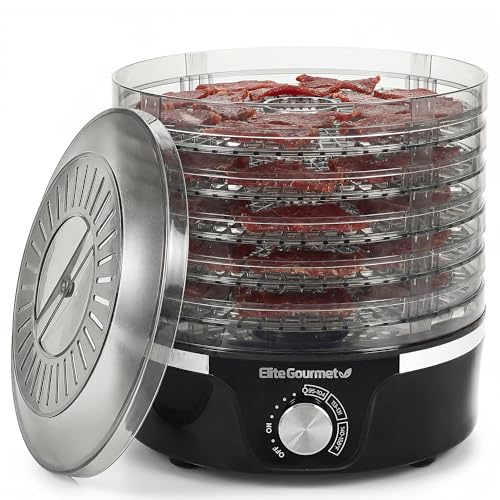
Elite Gourmet 5 Tray Dehydrator Adjustable Temp
5 expandable trays11.4 inch traysDial temperature
Check price on Amazon
Best for: Beginners who want a simple dial and an easy first batch.

The Elite Gourmet is the simplest machine here: a dial sets the temperature, a light shows power and clear BPA-free trays stack up and can be added to as needed. There is no digital timer, so you must watch the clock yourself. That simplicity suits people who want a machine that behaves like a small appliance.

Against the FOHERE it lacks a timer and a numeric readout, so it is harder to repeat results. Against the Cosori it has no presets and plastic trays, so it ranks fourth. It is still a reasonable pick for herbs, fruit and the occasional batch of jerky, especially if you want to start cheaply and see whether you will use it.

Use a kitchen timer and check the food regularly, since dial markings are rough guides rather than precise settings. Rotate trays during longer cycles. Hand wash the trays and wipe the base with a damp cloth. If you find yourself drying often, plan to upgrade to a digital model.

What works

  • Simple dial is easy to understand
  • Trays can be added to expand capacity
  • Clear BPA-free trays show progress
  • Low entry cost for first-time buyers

Watch out for

  • No timer so you must watch the clock
  • Dial settings are imprecise
  • Plastic trays can stain and warp

Specs

Trays
5 BPA-free, 11.4 inch
Control
Temperature dial
Indicator
Power light
Expandable
Stack height grows with trays
Use
Jerky, fruit, herbs, veggies
05
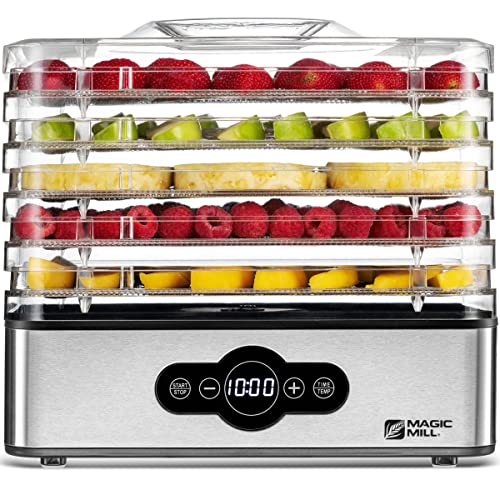
Magic Mill 5 Tray Stainless Dehydrator 240W 48H Timer
5 stainless trays240W power48 h timer
Check price on Amazon
Best for: Small batches in a compact stainless machine.

The Magic Mill 5 tray is a compact digital machine with stainless steel trays and a 240W heater. The digital timer and temperature control make it more repeatable than the dial-only Elite Gourmet, and stainless trays resist the staining that plagues plastic.

The tradeoff is power. At 240W it dries more slowly than the 600W Magic Mill Pro and it struggles with large or wet batches. Against the Cosori it offers a similar tray count but less airflow and a less versatile range. It ranks last because the lower power means longer cycles and a greater need to rotate trays.

Use it for small batches of herbs, fruit and thin jerky strips, and give each cycle extra time. Wipe the trays after use and keep the base dry. If you often find that the top trays dry faster than the bottom, rotate them every few hours. For bigger harvests step up to a rear fan model.

What works

  • Stainless trays do not stain or warp
  • Digital timer and temperature are repeatable
  • Compact stack fits small counters
  • Low power draw suits shared circuits

Watch out for

  • 240W heater dries slowly
  • Needs tray rotation on longer cycles
  • Struggles with large or wet loads

Specs

Trays
5 stackable stainless steel
Power
240W
Timer
Up to 48 hours
Controls
Digital temperature and timer
Style
Compact stack

Spec decoder

What the listing measurements really mean

The numbers brands lead with, translated into what they tell you about fit, comfort and wear at home.

Drying area

This is the total tray surface in square feet. It sets how much you can dry per batch.

Watch forThe Cosori lists 3.1 sq ft across five trays, which is a useful benchmark.

Wattage

Heater power affects warm-up time and recovery. Higher wattage dries faster but costs more to run.

Watch forThe compact Magic Mill is 240W while the Pro is 600W.

Temperature range

This is the lowest and highest setting. Herbs need low heat and meat needs high heat.

Watch forThe FOHERE tops out at 158°F while the Cosori reaches 176°F.

Fan position

A rear fan blows air horizontally and a base fan blows it upward. Horizontal flow is more even.

Watch forThe Magic Mill Pro uses a rear fan while the Elite Gourmet is a stack.

Tray count

More trays mean a larger batch, but only if airflow can keep up. Tray size also differs between models.

Watch forFive trays on a stack may dry less evenly than five on a rear fan model.

Methodology

How We Evaluated These Budget Food Dehydrators

Airflow and evenness

We compared fan position and wattage described in each spec sheet. The rear fan on the Magic Mill Pro favours even drying, while stacks like the FOHERE need rotation. We rewarded designs that match fan power to tray count.

Temperature control

We looked at range, steps and whether control is digital or dial. The Cosori covers 95 to 176°F in one degree steps. Precision and repeatability scored higher.

Tray material and cleaning

We compared stainless and BPA-free plastic trays. Owner feedback patterns show staining and warping are common complaints with plastic. We favoured stainless when the price premium was modest.

Capacity and footprint

We matched tray count and drying area to realistic batches. The Cosori's 3.1 sq ft and the Pro's seven trays represent different needs. We penalised units that are oversized for typical use.

Value versus compromise

Each pick sits in the lower half of the price range. We weighed what each gives up, such as top temperature or airflow, and whether that suits the intended food.

Decision guide

How to Choose the Right Budget Food Dehydrators

By Food Type

SituationPickWhy
Fruit and herbsFOHERE 5 trayRange suits plants and low cost
Jerky and meat stripsCosori 5 trayReaches 176°F
Big garden harvestsMagic Mill Pro 7 trayLargest drying area
First-time try-outElite Gourmet 5 traySimple dial and low cost

By Budget

Budget tierPickWhy
Lowest spendFOHERE 5 trayCheapest with a digital timer
Low spendElite Gourmet 5 trayDial control and expandable
Low to mid spendMagic Mill 5 trayStainless trays and digital control
Upper end of guideMagic Mill Pro 7 trayRear fan and big capacity

Rear Fan vs Stacked Design

Magic Mill Pro (rear fan)

Air flows across each tray so drying is even and you rarely rotate. It is larger and heavier.

FOHERE (stacked)

Compact, light and low cost. Trays nearer the base dry faster, so rotation helps.

Pick the rear fan for jerky and big batches. Pick a stack for occasional fruit and herbs.

By Tray Material

SituationPickWhy
Stain-prone foodsCosori 5 trayStainless trays
Lightweight and cheapFOHERE 5 trayBPA-free plastic
Meat and greaseMagic Mill Pro 7 trayStainless wipes clean
See-through monitoringElite Gourmet 5 trayClear trays

For Jerky Specifically

Look for

A top temperature of at least 160°F or a plan to finish in the oven, stainless trays and even airflow. Trim fat well and slice evenly.

In this comparison

The Cosori and Magic Mill Pro have the best range and build. The FOHERE and Elite Gourmet are better for fruit and herbs.

When to Spend More

Spend more if

You dry weekly, want a bigger drying area or need quiet, even airflow. A premium rear fan machine also lasts longer under heavy use.

Save if

You dry fruit, herbs or a few batches of jerky each year. A budget stack will do the job with some tray rotation.

Ownership

Maintenance schedule

The upkeep that decides whether a piece still looks good in year five.

TaskIntervalWhy it matters
Wash traysAfter every batchMeat grease and fruit sugars harden if left on trays. Warm soapy water and a soft brush remove them without scratching.
Wipe the interior and baseAfter every batchDrips collect near the heater and fan. A damp cloth removes them once the unit is cool.
Clean the fan guardMonthlyDust and food particles block airflow and reduce drying speed. Use a dry brush.
Check the power cord and plugEvery six monthsLong cycles heat the cord. Stop using any unit with a frayed or warm cord.
Store dry and coveredBetween seasonsMoisture left in the machine breeds mould. Dry all parts fully and keep it in a closed cupboard.

FAQ

Frequently Asked Questions

Is a stacked or rear fan dehydrator better?

Rear fan models dry more evenly and need less tray rotation. Stacks are cheaper and smaller. Choose by how often you dry and how large your batches are. A stack that you use a few times a year is a perfectly good buy, while a weekly jerky maker will appreciate the steadier airflow of a rear fan machine and the extra capacity.

Can I make jerky in a budget dehydrator?

Yes, but check the safe temperature guidance for meat. Many home units do not reach pasteurising heat alone, so some people finish jerky in an oven. The Cosori's 176°F top setting helps.

Are plastic trays safe?

BPA-free plastic trays are food safe at normal dehydrator temperatures. They stain and may warp over time. Stainless steel trays avoid those problems.

How long does drying take?

Herbs may take a few hours while fruit and jerky take 6 to 12 hours or more. Slice thickness and humidity change the time. Check pieces rather than trusting the clock. Apple slices should bend without releasing moisture, herbs should crumble, and jerky should crack but not snap. Let batches cool before storing, then keep them in airtight jars away from light.

Do dehydrators use a lot of electricity?

Compact units draw 240W to 600W for long cycles, so the cost is modest. A larger machine uses more but dries more. Run full trays for best efficiency.

Is a dehydrator worth it over an oven?

An oven can dry food but runs hotter and uses more energy. A dehydrator holds low temperatures with a fan, which gives better texture and saves power on long cycles.

Bottom line

The short version

Browse more budget food dehydratorson Amazon →
Brianna Cole, Lead Product Editor

About the author

Brianna Cole

Lead Product Editor, SenseiReview

Brianna Cole leads SenseiReview's buying guides, turning published specifications, documentation and owner feedback patterns into clear verdicts across home, tech, fitness, outdoor and DIY products.

More from Brianna →

Keep reading

Related guides