
Amazon affiliate links - we earn a commission.Affiliate disclosure

Buying guide · 12 min read · Updated 2026-11-21

Best Smart Hose Timers for Gardens (2026)

Compare six smart hose timers by hub or no-hub connection, battery or solar power, number of outlets, weather features and app control, with setup advice.

Brianna Cole, Lead Product EditorBy Brianna ColeLead Product Editor6 picks comparedSpec-sheet verified
Best Smart Hose Timers for Gardens

At a glance

Our top picks

Side by side

Spec comparison

A smart hose timer screws onto an outdoor tap and opens and closes the flow on a schedule you set from a phone or a dial. Smart models add weather adjustment, remote control and, in some cases, a hub so the timer can be reached from anywhere.

What separates them is how the timer talks to your phone, how it is powered, how many outlets it has and what it does when conditions change. This guide compares those points for gardens and drip systems, with notes on range and reliability.

Before you buy

6 Criteria to Look For Before Buying a Smart Hose Timer for Gardens

  1. 01

    Hub, gateway or direct Wi-Fi

    A hub or gateway, as with the Rachio and Soildrops, gives a reliable link and longer range but adds a plug-in device. Direct Wi-Fi, as with the Insoma, needs a strong 2.4 GHz signal at the tap. Bluetooth-only control, as on the Orbit, works up close. Check your signal at the tap before buying.

  2. 02

    Power: battery or solar

    Most timers run on AA or similar batteries, and the Soildrops lists up to eight months on two AA. A solar model like the Insoma avoids battery swaps but needs sun. The most common failure is a forgotten battery, so choose a model that warns you in the app.

  3. 03

    Outlets and zones

    A single port serves one hose, a two-port model like the Orbit XD serves two zones, and a hub like the Rachio's can grow to eight valves. Two ports on one tap share flow, so running both at once can reduce pressure. Plan zones around your tap's real output.

  4. 04

    Weather and rain features

    Smart weather adjustment, as on the Orbit timers, uses forecast data to skip or reduce runs. A simple rain delay, as on the RAINPOINT, is a manual pause. Weather features are only as good as the location data, so check them for the first few weeks.

  5. 05

    Tap fit and build

    Most timers connect to a standard hose thread. Metal inlets and brass threads, as claimed for some Insoma models, resist cracking better than plastic. Hold the timer's weight with a short hose to avoid stressing the tap. Leaks usually come from worn washers or over-tightened plastic.

  6. 06

    Reliability and honest limits

    A smart timer depends on batteries, a signal and an app. If any of these fail, the schedule may not run. Keep a manual fallback, and avoid relying on one for an expensive planting during a heat wave without checking it. Claims like 100 percent operation are marketing.

Detailed reviews

The 6 best smart hose timers for gardens, explained

01
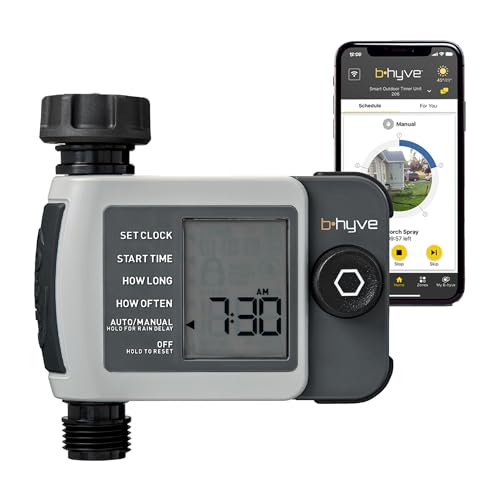
Orbit B-hyve XD 1-Port Smart Hose Timer, Bluetooth and Wi-Fi
1 outletWeather awareBluetooth setupWi-Fi with hub
Check price on Amazon
Best for: One-zone gardens that want weather-aware scheduling from a known brand.

The Orbit B-hyve XD 1-port is a single-outlet timer that you can program over Bluetooth at the tap or over Wi-Fi when it is paired with a hub. The listing says it adjusts watering to local weather data and drought conditions, and it is controlled from an app.

The tradeoff is that remote control needs a Wi-Fi hub, which is a separate purchase in some bundles, and the weather features work only if the app has an accurate location. Compared with the Orbit 2-port, it costs less but serves a single hose. Compared with the Rachio, it sits lower in the price order, fourth of twelve against eleventh.

In ownership, battery life and a firm tap connection are the main issues. Check the washers when you install it, replace the batteries when the app warns you and drain it before frost. A single-port timer pairs well with a drip system on one zone.

What works

  • Bluetooth setup at the tap means you can program it without a hub
  • Weather and drought adjustment reduces watering on wet or cool days
  • Fourth of twelve in price, mid-range for a branded smart timer
  • App control covers schedules, manual runs and rain skips

Watch out for

  • Remote control from away from home requires a separate Wi-Fi hub
  • Single port serves one hose, so extra zones need another timer

Specs

Outlets
1 port
Connection
Bluetooth locally, Wi-Fi with hub
Smart feature
Local weather and drought adjustment
Control
App controlled
Price position
Fourth of twelve
02
Orbit B-hyve XD 2-Port Smart Hose Timer with Independent Outlets
2 outletsWeather awareBluetoothDrought adjust
Check price on Amazon
Best for: Gardens with two zones, such as drip beds and a lawn sprinkler, on one tap.

The Orbit B-hyve XD 2-port is a dual-outlet timer with app control, Bluetooth and the same drought adjustment as the single-port model. Two ports let you run two zones, such as a drip line and a sprinkler, from one tap.

The tradeoff is price. It is the ninth most expensive of the twelve candidates, and two ports share a single tap's flow, so running both at once can lower pressure. Compared with the 1-port, it is the better choice for two zones but costs more. Compared with the 4-port model, it is simpler and cheaper.

In ownership, a two-port timer puts weight on the tap, so use a hose support and check connections after the first week. Replace batteries when prompted and drain it for winter. Set separate schedules so the zones do not run at once and starve each other.

What works

  • Two independent outlets run two zones from a single tap
  • Weather and drought adjustment reduces unnecessary watering
  • Bluetooth lets you program at the tap without a hub
  • App schedules each port separately for different plant needs

Watch out for

  • Ninth of twelve in price, which is a step up from the single-port model
  • Both ports share the tap's flow, so running them together lowers pressure

Specs

Outlets
2 ports
Smart feature
Drought and weather adjustment
Control
App, Bluetooth
Use
Dual outlet irrigation control
Price position
Ninth of twelve
03
Rachio Smart Hose Timer with 1 Valve and WiFi Hub
1 valveWiFi HubUp to 8 valvesApp scheduling
Check price on Amazon
Best for: People who plan to add more valves later under a single app.

The Rachio Smart Hose Timer kit includes one valve and a WiFi hub, and the listing says you can program up to eight hose valves per hub. It is sold as a quick-install replacement for a dial timer, controlled from the Rachio app.

The tradeoff is price. It is the eleventh most expensive of the twelve candidates, and the hub adds a power outlet and a place to put it. Compared with the Orbit 1-port, it gives a growth path to more valves under one app. Compared with the Soildrops, it uses a Wi-Fi hub and is the more premium choice.

In ownership, the hub needs a spot within wireless range of the valves, and each valve needs batteries. Place the hub indoors if possible, check the valve connections and keep firmware updated. It makes most sense if you expect to add valves later.

What works

  • One hub controls up to eight valves, so the system grows as you add zones
  • Quick install suits first-time smart timer buyers
  • App scheduling replaces a dial timer with remote control
  • Established brand in smart irrigation with a consistent app

Watch out for

  • Eleventh of twelve in price, near the top of the range
  • Hub needs an indoor spot and power, and the valve needs batteries

Specs

In the box
1 valve and 1 WiFi hub
Expandability
Up to 8 valves per hub
Install
Quick, minutes
Control
Rachio app
Price position
Eleventh of twelve
04
Soildrops WiFi Water Timer with Gateway, 984 ft RF Range
984 ft RF rangeGateway2 AA batteries8-month battery
Check price on Amazon
Best for: Large or long gardens where the tap is far from the house Wi-Fi.

The Soildrops timer uses a sub-GHz radio link to a gateway, with a listed range of up to 984 ft (300 m), which suits a long garden where the Wi-Fi does not reach the tap. It runs on two AA batteries for up to eight months, per the listing.

The tradeoff is that radio range figures are open-field maximums, and walls and metal reduce them. Compared with the Insoma WiFi timer, it needs a gateway, but reaches farther from the house. Compared with the Rachio, it is cheaper, fifth of twelve against eleventh, but has a smaller app ecosystem.

In ownership, place the gateway near a window or the back wall nearest the tap. Replace the batteries each season, check the tap washer and drain before frost. The eight-month battery claim depends on how often it runs.

What works

  • Sub-GHz radio link reaches up to 984 ft, which beats most Wi-Fi at the tap
  • Two AA batteries last up to eight months, per the listing
  • Gateway connects the timer to Wi-Fi so you control it from anywhere
  • Fifth of twelve in price, below the premium Rachio and Orbit multi-port

Watch out for

  • Needs a gateway, which adds a plug-in device inside the house
  • Range and battery life are best-case figures that depend on your site

Specs

Range
Up to 984 ft (300 m) RF
Gateway
Included, connects to WiFi
Power
2 AA batteries
Battery life
Up to 8 months
Price position
Fifth of twelve
05
RAINPOINT Programmable Hose Timer with LCD and Rain Delay
No appLCD screenRain delay1 min to 3 h 59 min
Check price on Amazon
Best for: Gardeners who want a simple, reliable timer with no app or hub.

The RAINPOINT is a programmable hose timer with a large LCD screen, a run time that ranges from 1 minute to 3 hours 59 minutes and a rain delay mode that pauses the schedule for 24, 48 or 72 hours. It has no app and no hub, and it is the second cheapest of the twelve candidates.

The tradeoff is that the rain delay is a manual choice and not a weather sensor. You press the button when rain arrives, and there is no phone control. Compared with the Orbit 1-port, it lacks weather data and remote control but costs far less. Compared with the Insoma Solar timer, it has no remote control but needs no sun or Wi-Fi signal.

In ownership, a simple timer has less to fail. Replace batteries each season, check the tap washer and drain before winter. It suits anyone who wants a reliable, offline timer for a soaker or drip line.

What works

  • Large LCD screen shows run time, frequency and battery at a glance
  • Run time from 1 minute to 3 hours 59 minutes covers drip and sprinkler jobs
  • Rain delay pauses the schedule for 24, 48 or 72 hours with one press
  • Second lowest price among twelve candidates, with no hub to buy

Watch out for

  • No app or weather sensor, so rain delay is a manual choice
  • No remote control, so you need to be at the tap to change the schedule

Specs

Run time
1 minute to 3 hours 59 minutes
Rain delay
24, 48 or 72 hours
Display
Big LCD screen
Control
On-device buttons
Price position
Second lowest of twelve
06
Insoma Solar WiFi Water Timer with Separate Solar Panel
Solar poweredNo hubUSB-C backup2.4 GHz WiFi
Check price on Amazon
Best for: Taps within Wi-Fi range where you want to avoid changing batteries.

The Insoma solar timer pairs directly with a 2.4 GHz home Wi-Fi network with no extra gateway. A separate solar panel can sit in the sunniest spot while the timer stays on the faucet, and a Type-C port provides a backup charge on cloudy days.

The tradeoff is that it needs Wi-Fi at the tap and 2.4 GHz specifically, so a distant tap may lose the connection. Compared with the Soildrops, it removes the gateway but loses the long radio range. Compared with the RAINPOINT, it is more expensive but offers remote control and no battery swaps.

In ownership, position the panel where it gets sun and keep it clean. Check signal strength at the tap before you rely on it, and bring the unit in for winter or drain it. The 365-day power claim is the maker's figure and depends on how much sun you get.

What works

  • Solar panel removes the need to replace batteries each season
  • Connects directly to 2.4 GHz Wi-Fi, so there is no hub to install
  • Separate panel can be placed in the sunniest spot, away from the tap
  • Type-C backup charging covers long cloudy spells

Watch out for

  • Needs a 2.4 GHz Wi-Fi signal at the tap, which a far tap may not get
  • The 365-day power claim is the maker's figure and depends on sun

Specs

Power
Solar panel with 365-day power claim
Backup
Type-C charging port
Connection
Direct 2.4 GHz Wi-Fi, no hub
Panel
Separate, placed in the sunniest spot
Price position
Sixth of twelve

Spec decoder

What the listing measurements really mean

The numbers brands lead with, translated into what they tell you about fit, comfort and wear at home.

Connection type

How the timer reaches your phone: Bluetooth at close range, Wi-Fi directly, or Wi-Fi through a hub or gateway.

Watch forThe Orbit uses Bluetooth plus a hub for Wi-Fi, and the Insoma pairs directly with 2.4 GHz Wi-Fi.

Radio range (ft)

Range is how far the timer can sit from its hub or gateway. Walls and metal cut the real figure.

Watch forThe Soildrops lists 984 ft, and range is an open-field maximum.

Battery life

How long the timer runs on a set of batteries. Frequent runs and cold weather shorten it.

Watch forThe Soildrops lists up to 8 months on two AA, and the Insoma Solar lists a 365-day solar claim.

Outlet count

Outlets are the number of hose connections a timer controls. More outlets mean more zones from one tap.

Watch forThe Orbit comes in 1 and 2 port versions, and the Rachio hub supports up to eight valves.

Run time range

The shortest and longest run you can program. A wide range suits both drip and sprinklers.

Watch forThe RAINPOINT lists 1 minute to 3 hours 59 minutes.

Methodology

How We Evaluated These Smart Hose Timers for Gardens

Connection and range

We evaluated how each timer connects: Bluetooth, direct Wi-Fi or hub. The Soildrops lists a 984 ft range and the Insoma needs 2.4 GHz at the tap. We did not measure range.

Power and upkeep

We compared battery, solar and USB backup options. The Insoma Solar avoids batteries, and the Soildrops lists up to 8 months on two AA.

Zones and scheduling

We looked at outlet counts and scheduling features. The Orbit comes in 1 and 2 port versions, and the Rachio hub supports up to 8 valves.

Weather features

We compared weather adjustment with manual rain delay. The Orbit lists local weather and drought adjustment, and the RAINPOINT offers 24, 48 or 72 hour delays.

Claims and value

We treated reliability and power claims as marketing. We weighed price position against connection, zones and weather features, and we noted where a gateway or hub adds cost.

Decision guide

How to Choose the Right Smart Hose Timers for Gardens

By Connection

SituationPickWhy
Tap close to the house Wi-FiInsoma SolarDirect 2.4 GHz Wi-Fi, no hub
Tap far from the houseSoildropsGateway with a listed 984 ft range
Bluetooth setup at the tapOrbit B-hyve XDProgram locally, add a hub for Wi-Fi
No phone neededRAINPOINTButtons and an LCD, no app

By Budget

SituationPickWhy
Lowest-cost reliable timerRAINPOINTSecond lowest of twelve
Mid-range smartOrbit B-hyve XD 1-portFourth of twelve
Mid-range with gatewaySoildropsFifth of twelve
Premium or multi-zoneRachio or Orbit 2-portEleventh and ninth of twelve

Smart vs Simple Timers

Smart timers

The Orbit, Rachio, Soildrops and Insoma add app control, weather features and remote control. They cost more and depend on batteries and a signal.

Simple timers

The RAINPOINT has no app and costs less. It runs on its own schedule and has fewer parts to fail, but you must be at the tap to change it.

Choose smart if you travel or want weather-aware watering, and simple if you want a low-cost, set-and-forget timer.

By Number of Zones

SituationPickWhy
One bed or one drip lineOrbit B-hyve XD 1-portSingle outlet, weather aware
Two zones on one tapOrbit B-hyve XD 2-portTwo independent outlets
Plan to grow to many zonesRachioUp to 8 valves per hub
One zone, solar poweredInsoma SolarPanel avoids battery swaps

For Gardens and Drip Systems Specifically

Look for

A short minimum run time for drip, a solid tap connection, and a timer that fits your Wi-Fi situation. Add a filter and pressure regulator at the tap.

In this comparison

The RAINPOINT covers drip with run times from one minute, and the Orbit 1-port is the best all-round smart option.

When to Spend More

Spend more if

You want multiple zones, weather features and remote control, or you expect the system to grow, as with the Rachio or the Orbit 2-port.

Save if

You have a single bed and are happy to be at the tap. The RAINPOINT is far cheaper and covers a basic schedule.

Ownership

Maintenance schedule

The upkeep that decides whether a piece still looks good in year five.

TaskIntervalWhy it matters
Replace batteriesEach season, or when the app warnsA dead battery means a missed watering. Replace them at the start of the season and keep spares.
Check the tap washerAt installation and each seasonWorn washers cause leaks at the tap. Replace them and hand-tighten the timer without a tool.
Clean the inlet screenEvery few monthsGrit blocks the valve and weakens flow. Rinse the screen and refit it.
Check signal and app statusMonthly in seasonWi-Fi and gateway links can drop. A quick look at the app confirms the timer still reports in.
Drain and bring in for winterBefore frostFrozen water cracks housings. Drain the unit and store it indoors in cold climates.

FAQ

Frequently Asked Questions

Do I need a hub for a smart hose timer?

Not always. Bluetooth timers work up close without a hub, and some Wi-Fi models connect directly. A hub or gateway gives longer range and reliable remote control.

How much should I spend on a hose timer?

A simple timer costs the least and does a basic job. Spend more for weather-aware features, multiple zones or a hub that can grow.

How long do the batteries last?

It varies. The Soildrops lists up to eight months on two AA, and solar models like the Insoma aim to avoid batteries. Frequent runs and cold weather shorten life.

Does weather adjustment really work?

It depends on accurate location data and the timer's forecast source. Treat it as a helpful skip on wet days, not a guarantee. Check soil moisture occasionally.

Can a timer run two hoses at once?

A two-port timer can, but both share the tap's flow, so pressure drops. Stagger the schedules if you want each zone to get full pressure.

Can I use one with a drip system?

Yes. Use a filter and pressure regulator after the timer. Choose a timer with a short minimum run time, since drip needs long, slow runs and not short bursts.

Bottom line

The short version

Browse more smart hose timers for gardenson Amazon →
Brianna Cole, Lead Product Editor

About the author

Brianna Cole

Lead Product Editor, SenseiReview

Brianna Cole leads SenseiReview's buying guides, turning published specifications, documentation and owner feedback patterns into clear verdicts across home, tech, fitness, outdoor and DIY products.

More from Brianna →

Keep reading

Related guides